JOHN CAGE begins anywhere
"John Cage begins anywhere" is an art exhibition focused on records, photographs, books, videos and visual scores by the legendary composer, held at Die Schachtel (O' art space) in Milano, in july 2011
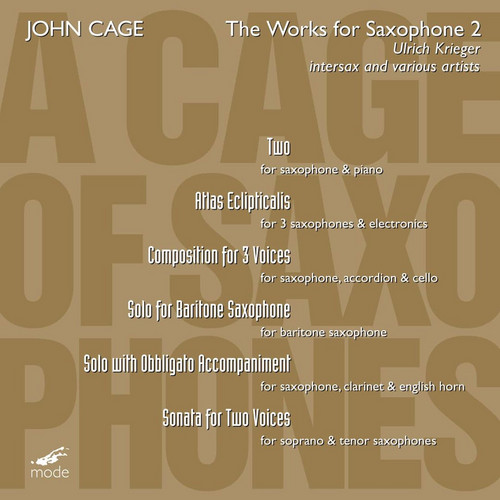
A Cage of Saxophones 2
Second volume of John Cage works for saxophones, played by Ulrich Krieger and his ensemble: early pieces of unspecified instrumentation, saxophone parts drawn from Atlas Eclipticalis and Concert for Piano and Orchestra, and the first saxophone versio…
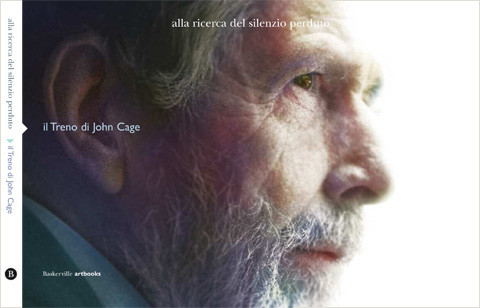
Alla ricerca del silenzio perduto - Il treno di John Cage
Included in 160-page, hardcover book with bilingual (Italian/English) 'Any and all sounds are music : the sounds that surround us, whether we are in a concert hall or not...' 'We can begin from this quote by John Cage to unearth the traces of one of …
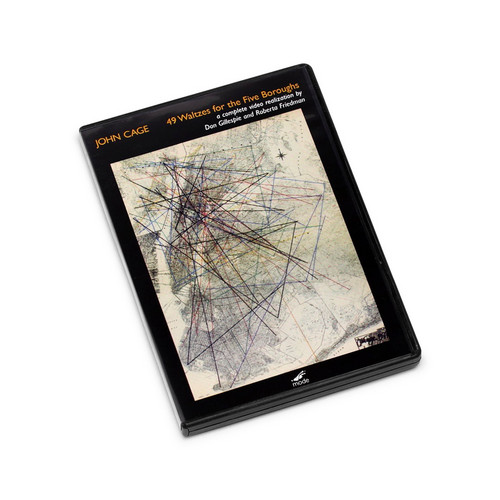
49 Waltzes for the Five Boroughs
A complete video realization of John Cage's 49 Waltzes for the Five Boroughs by Don Gillespie, Roberta Friedman and Gene Caprioglio, filmed at 147 New York City locations in 1994-95 with durations set by the I-Ching.
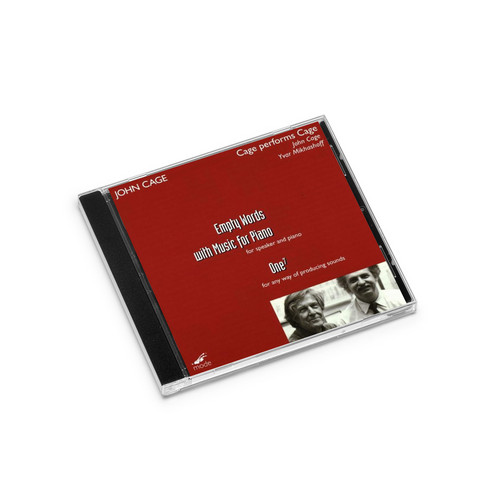
Cage Performs Cage
Mode's 200th release: John Cage himself performs Empty Words together with Music for Piano (with Yvar Mikhashoff) and the solo work One7, recorded at Buffalo in April 1991 and released for the first time.
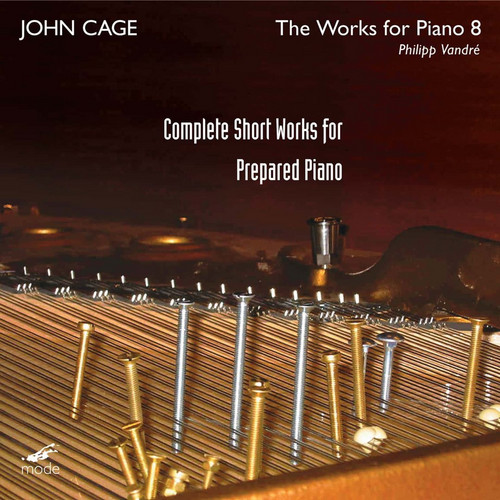
Complete Short Works for Prepared Piano
All of John Cage's short works for prepared piano on two CDs, everything except Sonatas and Interludes, played by Philipp Vandré.
44 Harmonies from Apartment House 1776
First recording of all 44 Harmonies from Cage's Apartment House 1776, arranged for string quartet by Irvine Arditti and played by the Arditti Quartet, with Arditti's solo violin performance of Cheap Imitation.
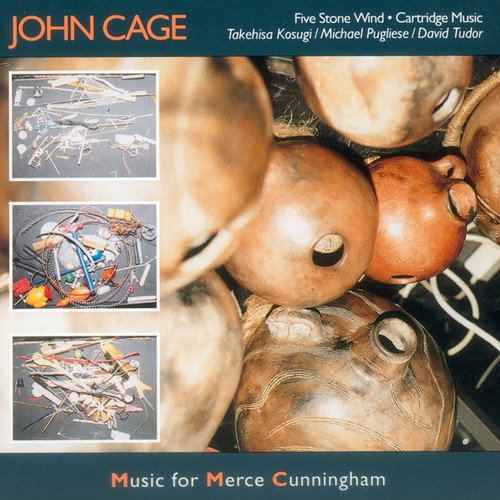
Music for Merce Cunningham
John Cage's Five Stone Wind (1988) and Cartridge Music (1960), both written for Merce Cunningham dances, played by David Tudor, Takehisa Kosugi and Michael Pugliese. 2008 remaster of the 1991 release, Cage Edition volume 4.
Piano Music
JUST ARRIVED, awesome and low priced essential triple CD set with the piano compositions by John Cage (1912–92) regarded as one of the most influential and controversial composers of the 20th century. It is not only his music that this reputation i…
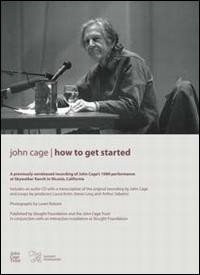
How To Get Started
"John Cage conceived How To Get Started almost as an afterthought -- a performance substituting for another that was previously planned in 1989 for delivery at 'Sound Design: An Invitational Conference on the Uses of Sound for Radio Drama, Film, …
Concerto for Prepared Piano and Chamber Orchestra / Sixty-Eight
For each of his compositions for prepared piano Cage created a specific piano preparation chart, setting out in meticulous detail the strings to be prepared, and the materials and manipulations to be used for preparing them. For the Concerto for Prep…
Music For Percussion Quartet
As early as in 1942, in Credo in Us, Cage employed not only a percussion ensemble but also sounds from the radio and records. Therefore, quite in accordance with what the composer would have wished, the materials used by the Percussion Ensemble Mainz…
Melodies & Harmonies
Cage is by no means a synonym for obligingness. All the more astonished we listen to the melodious and harmonious objects Annelie Gahl and Klaus Lang present on this album. Lang, the trained organist and internationally renowned composer, perform…
(Old school) John Cage
John Cage’s compositions have been part of zeitkratzer’s repertoire since the very first day. The pieces presented here justify zeitkratzer’s reputation as sound specialists. Avant-garde composer Cage is played in a conservative, precise and sensu…
Imaginary Landscapes
Improvising guitarist Derek Bailey has expressed the belief that «If you’re going to explore uncharted territory, it’s okay to carry a compass, but not a map.» It’s obvious; if you know where you’re going and have plotted the most efficient or scenic…
Atlas Eclipticalis With Winter Music
Two live 1983 performances of John Cage conducting Atlas Eclipticalis with Winter Music at Seattle's Cornish Institute, first issued on LP in 1986, with a bonus disc of the 86-part Atlas Eclipticalis and Winter Music for 20 pianos.
Etudes Australes For Piano
Etudes Australes is a set of etudes for piano solo by John Cage, composed in 1974–5 for Grete Sultan. It comprises 32 aleatoric pieces written using star charts as source material. The etudes, conceived as duets for two independent hands, are extreme…
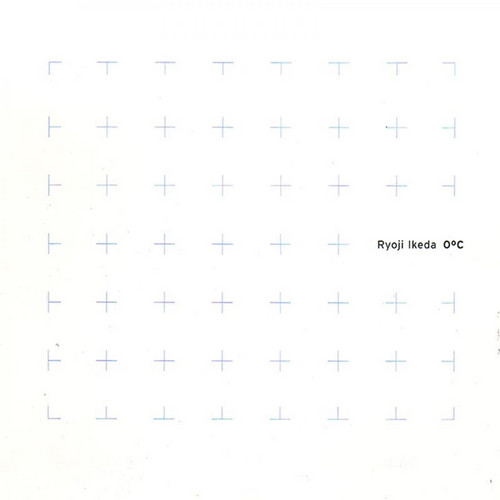
0°C
As the title may suggest, 0°C is a sonic exploration at a very bottom of human perception - the fragile line between life and death, dark and light, noise and silence. The authentic being is never to be achieved with complete and definitive perceptio…
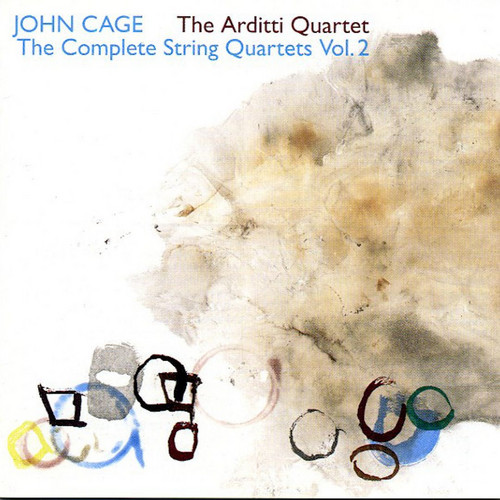
Complete string quartets, volume 2
Two string quartets by John Cage played by the Arditti Quartet: String Quartet in Four Parts (1949-50), in a new recording, and Four (1989), a first recording written for the ensemble. Composer-supervised sessions.
Atlas eclipticalis / 103
Two live, unedited performances of Cage's orchestral music: "At last Eclipticalis With Winter Music" (recorded 5/19/93, performed by The Orchestra of the SEM Ensemble, conducted by Petr Kotick, piano by David Tudor) and "103" (recorded 11/21/98, perf…
Empty words (parte III)
John Cage's empty words is something of an epic in reverse: a diminutive vocal exercise divided into four distinct parts that gradually breaks down the writings on sound from Henry David Thoreau's Journal into pure vocalise. Disarticulated, distended…