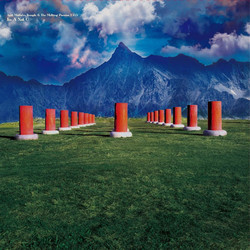
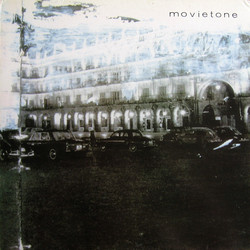
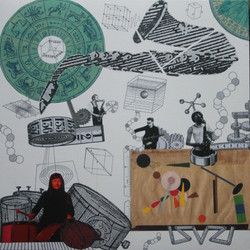
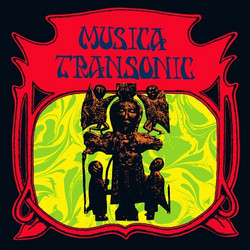
Solid Static captures Asahito Nanjo, Makoto Kawabata and Tatsuya Yoshida right where two of their most volatile projects blur into each other. Tracked at West Studio in Tokyo in 1997 as sessions for an abandoned Mainliner album, these wild, heavy electric recordings instead gravitate toward the moment‑to‑moment deconstruction that defined Musica Transonic. Nanjo’s bass and vocals, Kawabata’s guitar and Yoshida’s multi‑limbed drums collide in a search for “new directions” that never loses sight of the primal charge of volume, feedback and forward motion.
The ten‑minute title track opens on one of Mainliner’s trademark motor‑psycho riffs - a bludgeoning, overdriven figure that feels like it could loop forever - before the ground starts to tilt. What begins as mono‑maniacal drive veers off into auratic space: Kawabata’s guitar uncoils into snake‑charming lines and strangled harmonics, Nanjo’s bass becomes a buzzing force field rather than a mere low‑end anchor, and Yoshida splinters the beat into polyrhythmic shrapnel, pushing the trio into zones where free improvisation and hard psych become indistinguishable. It’s an encapsulation of the record’s core tension: the need to ride a riff into the red against the urge to pull it apart from the inside.
Elsewhere, the balance tips decisively toward Musica Transonic’s improvised, jazz‑informed approach. “Prosecutor” and “Topsy Turvy” scrawl distended rhythms and arcing bass and guitar lines across a constantly shifting grid, as if the trio were sketching and erasing the song in real time. Tempos lurch, accents flip, and yet a molten swing runs underneath the chaos, a reminder that all three players are listening as fiercely as they’re blasting. “Rot Way” sinks into a slurry of distorted tone, the band letting texture take precedence over motif: fuzz piles on fuzz, cymbals smear into the mid‑range, and what might once have been a rock tune melts into an engulfing, slow‑motion landslide of sound.
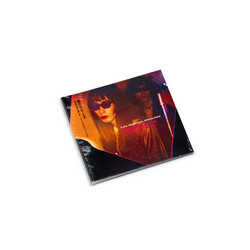
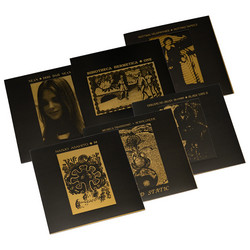
Long hailed by those who managed to snag one of the handful of CDRs sold at late‑’90s gigs, Solid Static now appears for the first time on vinyl or any widely available physical format. The release treats this “lost” chapter of Japanese psychedelia with the seriousness it deserves: housed in a custom die‑cut Uni‑Pak gatefold with metallic inks, spot finishes and a matching La Musica inner sleeve, it mirrors the music’s dense, scorched surfaces with packaging that feels just as tactile. Words and music are by Nanjo, arranged collectively by Musica Transonic and produced by Nanjo, underlining that this is not an archival curiosity but a fully fledged entry in a still‑evolving canon.
Heard now, Solid Static plays like a sleeper gem finally jolted awake - a missing link between Mainliner’s riff‑obsessed devastation and Musica Transonic’s cubist psych‑jazz. It documents three of Japan’s most uncompromising underground musicians at a peak of telepathic rapport, driving straight into “divergently fried terrain(s)” and refusing to choose between structure and collapse. The result is an album that still feels dangerous: a reminder that rock & roll, in the right hands, can be both obliterating and intricately, relentlessly alive.