
Pauline Oliveros
Pauline Oliveros (1932 to 2016) was an American composer, accordionist and author, born in Houston. In 1961 she co-founded the San Francisco Tape Music Center with Morton Subotnick and Ramon Sender and made some of the earliest electronic and tape pieces on the West Coast. Her instrument in performance was an accordion retuned in two systems of just intonation, later fed through the Expanded Instrument System, her own array of digital delays and processors.
Voice Coil
2008 release ** "Pauline Oliveros (accordion with Expanded Instrument System); Peer Bode (live text with Bode vocoder); Andrew Deutsch (live mixing, archival recordings, samples, loops and electronics). Voice Coil was performed by the Carrier Band in the fall of 2003 at the Deep Listening Space in Kingston, New York. Pauline Oliveros performed on accordion and computer-based Expanded Instrument System, Peer Bode performed live text with his Bode Vocoder, and Andrew Deutsch performed live mixing,…
Music From The Once Festival 1961-1966
With Robert Ashley, George Cacioppo, Gordon Mumma, Roger Reynolds, Donald Scavarda, David Behrman, George Crevoshay, Philip Krumm, Pauline Oliveros, Robert Sheff, Bruce Wise. Ann Arbor, Michigan, seems an unlikely site for the establishment of a major avant-garde festival that would shake the new-music community. Tucked away in America's heartland, the city is equally removed from the Eastern metropolises whose artists pride themselves on sensing the pulse of the times, and from the nonconformis…

The Minexcio Connection: Live at the Rosendale Cafe
One of the most unexpected yet fruitful partnerships of recent years: in the mid-1990s, Pauline Oliveros, electronic music pioneer and sage of the environmental drone, began working with Reynols, the prolific and resolutely undefinable Argentinian group. Their first joint effort sent Oliveros' music through the rigours of Reynols' heavily processed studio treatments.
The Minexcio Connection: Live! At The Rosendale Cafe finds them collaborating on-stage in real time. Recorded in August 2000 duri…
No mo
"In the summer of 1966 I worked in the classical Electronic Music Studio at the University of Toronto for six weeks. The system I used to create No Mo and Something Else consisted of Layfette tone generators, noise source and tape delay. In the Fall of 1966 I was the newly appointed director of the Mills Tape Music Center formerly the San Francisco Tape Music Center and now the Center for Contemporary Music at Mills College. Bog Road was created at the Mills Tape Music Center in the Summer of 19…
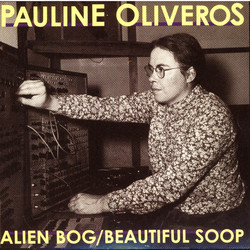
Alien Bog / Beautiful Soop
Pauline Oliveros completed Beautiful Soop (1966) and Alien Bog (1967) utilizing the original Buchla Box 100 series created for the Tape Music Center by Don Buchla and her tape delay system. "I was deeply impressed by the sounds from the frog pond outside the studio window at Mills. I loved the accompaniment as I worked on my pieces. Though I never recorded the frogs I was of course influenced by their music."

Electronic Works
One of our favourite "pure drone" album consisting of 3 amazing long tracks by Pauline Oliveros. I of IV was made in July 1966 at the University of Toronto Electronic Music Studio and was first released by CBS alongside works by 2 other young composers - 'Come out' by Steve Reich and 'Night music' by Richard Maxfield. It is really only in recent years (born out of the more radical elements of dance music, Electronica and ambient music) that music like this is being rediscovered by a growing numb…
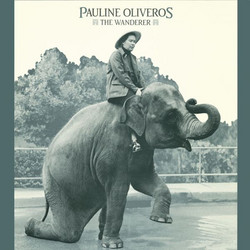
The Wanderer
2018 repress now packaged in a 6 panel digipak with heavy-duty stock and a matte finish. The Wanderer is based on a single modal scale (B C# D D# E F# G#) and rhythmic modes based on a meter consisting of 3/4 and 3/8. Part I, "Song," is intended to explore the unique resonant qualities of accordion reeds through long sounds. Subtle variations come about from differences in tuning and air pressure. Part II, "Dance," demonstrates the sharp accenting power of the accordion bellows in a mixture of c…
Sold Out
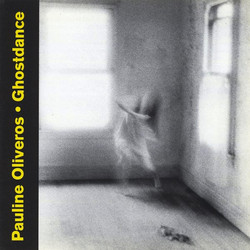
Ghostdance
The long awaited soundtrack of the Ghostdance music and dance collaboration between Oliveros and Paula Josa-Jones, commissioned by Lincoln Center Out-of -Doors. "The Gkostdance collaboration with choreographer Paula Josa Jones began in Monterrey Mexico supported in turn by two month US/Mexico Exchange Fellowships from the National Endowment for the Arts and FONCA. Together with our host—composer/ ethnomusicologist Arturo Salinas—we attended El Dia de los muertos in Chalco to help inform our work…