We use cookies on our website to provide you with the best experience. Most of these are essential and already present.
We do require your explicit consent to save your cart and browsing history between visits. Read about cookies we use here.
Your cart and preferences will not be saved if you leave the site.

Stefan Wolpe

Stefan Wolpe (1902-1972) was a German-born composer. He studied at the Klindworth-Scharwenka Conservatory and the Berlin Hochschule, with Franz Schreker and Ferruccio Busoni, and briefly with Anton Webern in Vienna. He left Germany in 1933 and lived in Palestine from 1934 to 1938, then settled in New York. His music joins twelve-tone technique with jazz and Middle Eastern influences. He directed music at Black Mountain College from 1952 to 1956, where he wrote Symphony for Twenty Four Instruments, and taught Morton Feldman and Ralph Shapey. Wolpe in Jerusalem on Mode is named for his Palestine years.
Stefan Wolpe (1902-1972) was a German-born composer. He studied at the Klindworth-Scharwenka Conservatory and the Berlin Hochschule, with Franz Schreker and Ferruccio Busoni, and briefly with Anton Webern in Vienna. He left Germany in 1933 and lived in Palestine from 1934 to 1938, then settled in New York. His music joins twelve-tone technique with jazz and Middle Eastern influences. He directed music at Black Mountain College from 1952 to 1956, where he wrote Symphony for Twenty Four Instruments, and taught Morton Feldman and Ralph Shapey. Wolpe in Jerusalem on Mode is named for his Palestine years.

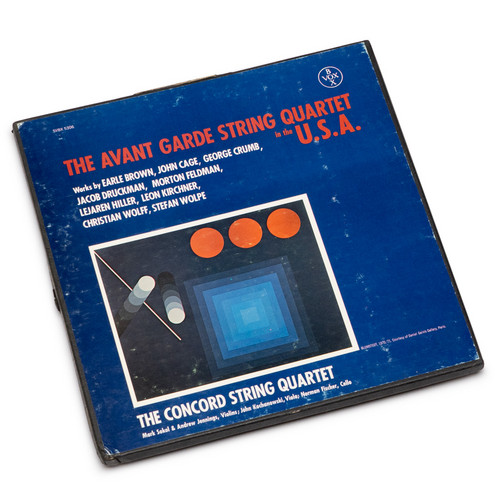
The Avant Garde String Quartet In The U.S.A. (3LP box)
Cage's beautiful and unusual 1950 string quartet in a monumental compilation released as a 3LP box set by Vox in 1973 with a who's who of the American avant-garde, including Crumb's and Kirchner's outstanding quartets with electric amplification and electronics, with impeccable performances by the Concord String Quartet. With insert.
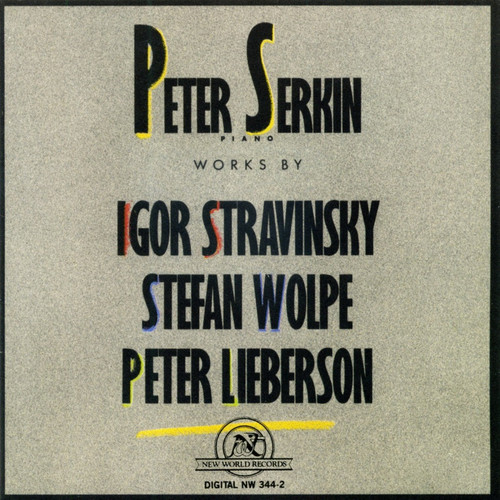
Piano Works
Pianist Peter Serkin is renowned for his performances and recordings of contemporary music. He has worked closely with composers such as Olivier Messiaen, Toru Takemitsu, Luciano Berio, and Peter Lieberson; he also was a founding member of the chamber group Tashi.  Igor Stravinsky's 1925 Serenade en La was originally composed to suit phonograph players, with each movement designed to fit the three-minute capacity of each of four ten-inch 78rpm sides. The title, Stravinsky explained, did not mea…
Form
Comet-like radiance, conviction, fervent intensity, penetrating thought on many levels of seriousness and humor, combined with breathtaking adventurousness and originality, marked the inner and outer life of Stefan Wolpe, as they do his compositions.”— -- Elliott Carter Stefan Wolpe (1902-1972) is an acknowledged master of modern music whose oeuvre has had a lasting influence on both classical and jazz musicians. Though receptive to prevailing musical trends, Wolpe was an individualist who forg…
Wolpe in Jerusalem
Stefan Wolpe's music from his Jerusalem years, 1934-38, including three world premiere recordings, played by ensemble recherche and the WDR Symphony Orchestra under Werner Herbers and Johannes Kalitzke.
Choral music of
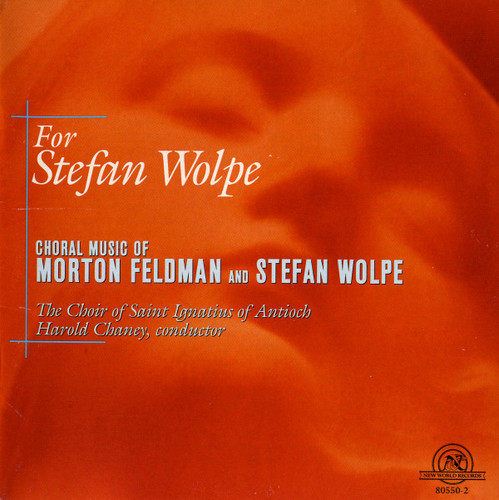
Choral Music of Morton Feldman and Stefan Wolpe Stefan Wolpe (1902-1972), one of the great teachers in twentieth century music, is also now recognized as one of its most significant composers. His Two Chinese Epitaphs, composed in Jerusalem in 1937, illustrates the composer's deep allegiance to socialist issues. He wrote the work swiftly and in anger, just after learning that the Basque town of Guernica had been bombed by the Fascists the previous week. He chose to set two poems by Louise …
1