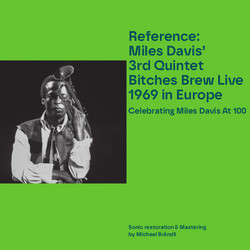
"In the beginning, the legend goes, it was Miles Davis’ electrifying jazz on In A Silent Way and Bitches Brew – modernizing the ensemble sound as well as reconfiguring compositional flow with repetition and variation – that begat what was to become known as fusion, exemplified by the subsequent spinoffs Weather Report (Wayne Shorter and Joe Zawinul), Mahavishnu Orchestra (John McLaughlin), Headhunters (Herbie Hancock), and Return to Forever (Chick Corea), all of which emerged after 1970 and concocted diverse amalgams of jazz, rock, funk, and ethnic grooves, attracting a new appreciative audience in a period of mainstream jazz doldrums. Overly simplistic as that historic viewpoint may be, it further neglects the first, most audacious, and least celebrated of the jazz-rock contingent, Tony Williams’ Lifetime.
Williams, having joined Miles in 1963, was by 1969 a seasoned veteran of 24, ready move on and allow his wide-ranging musical preferences – including both the popular and progressive persuasions of ‘60s rock and soul, and a broadly experimental interpretation of improvisation – free rein. The timing seemed propitious; innovative bands like that of Jimi Hendrix, Cream, and the Grateful Dead were extending guitar solos into uncharted territories, while British organists Mike Ratledge (Soft Machine) and Keith Emerson (The Nice) had psychedelicized their instrument. There’s no doubt Williams was aware of all of these revolutionary developments, and before the year was over had assembled and recorded his own power trio.
Though Miles Davis brought John McLaughlin into the studio for the February ’69 In A Silent Way sessions, thus bringing him to the attention of American audiences on that album’s release, it was Williams who, on the recommendation of British bassist Dave Holland, plugged him into his trio for live gigs towards the end of ’68, which is when Miles first heard him. Ironically, early in his career McLaughlin played in Graham Bond’s soul-jazz/r&b band alongside future Cream-mates bassist Jack Bruce and drummer Ginger Baker (a further irony is that Bruce joined Lifetime in 1970). Before he left England McLaughlin recorded his own electric-tinged jazz album, Extrapolation, which featured two notable collaborators fluent in conservative and free contexts, reedman John Surman and percussionist Tony Oxley. Larry Young, meanwhile, had previously established himself in the Jimmy Smith mode as one of the Prestige label’s house organists before he signed with Blue Note in 1964 and began remaking his style in a fresher, increasingly modal idiom, recording with Sam Rivers, Joe Henderson, James Spaulding, Woody Shaw, and Elvin Jones. Miles drafted him too into the studio in August and November ’69 as part of the extravaganza that produced tracks for Bitches Brew and the subsequent Big Fun compilation – although, another irony, Williams had already left Miles to focus on his new music, replaced primarily by Jack DeJohnette, so the three never performed together under Miles’ aegis.
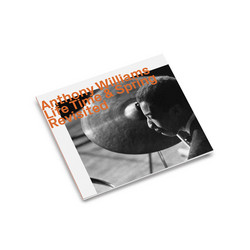
Nevertheless, the trio that recorded Emergency! in May ’69 was able to blend their discrete backgrounds into a maelstrom of energy and eloquence. The keys to their uniqueness were an instrumental equilibrium and the unpredictability of the material they attacked with such urgency. Williams’ compositions here, specifically, benefit from his experiences in the early ‘60s, outside of Miles’ influence, where he aligned his drum wizardry to six of the most advanced albums of the period, Jackie McLean’s One Step Beyond, Grachan Moncur III’s Evolution and Some Other Stuff, Andrew Hill’s Point of Departure, Sam Rivers’ Fuchsia Swing Song, and Eric Dolphy’s Out To Lunch – each a master class in radical intent and design for the still-teenaged Williams. His own two Blue Note albums, Life Time and Spring, from ’64 and ’65 respectively, though strictly acoustic, display a remarkable diversity of tonal colors and textures, and an unconventional sense of organization, with misdirections, stop and start rhythms, and shifting perspectives.
These same attributes enhance the spontaneous jam intensity of Emergency! with multi-sectional divisions, alternating rhythmic emphasis, twisting tempos, psychedelic detours, and extremes of dissonance and distortion. Within this fluctuating environment, Young’s organ thickens the density and enriches the harmonic complexity, as Williams provides percussive punctuation and counterpoint – even his spoken and monochromatic vocals could be seen as a precursor of rap. McLaughlin is the wild card; avoiding the blues-infused foundation of Hendrix or Eric Clapton, his guitar jolts and sprays, slices through the confluence, and invents its own vocabulary. Adding Jack Bruce’s bass for their next album, Turn It Over, altered the group dynamics, and the personnel changes that followed over time affected each subsequent album, until the Lifetime was no longer recognizable as the genre-exploding band it once was, and Williams abandoned the concept. Emergency!, however, has its own story to tell." - Art Lange