“It is a work built of the musicality of the spoken and written word - a book of poems - where music is the subject as much as the form.”
Two absolutely stunning and essential new volumes from Blank Forms, Maryanne Amacher’s Selected Writings and Interviews and Thulani Davis’ Nothing But Music, each radically readdressing, in very different ways, the perceptual boundaries between sound, text, and thought. Truly astounding accomplishments that are essential for any fan of music, the written word, or interdisciplinary practice, once again, Blank Forms has proved themselves to be among the most important initiatives in publishing working today.
Just over a month ago, with their release of 'Unbegrenzt’, Catherine Christer Hennix’s singular rendering of Karlheinz Stockhausen, we made mention of what an incredible year the New York based curatorial platform, publisher, and record label, Blank Forms, is having. They had already dropped stunning releases by Still House Plants, Exotic Sin, Masayuki Takayanagi New Direction Unit, and Judith Hamann. Now they’re back again, raising the bar with two incredible books that rest at the vanguard of musical thinking, Maryanne Amacher’s Selected Writings and Interviews, and Thulani Davis’ Nothing But Music. Not unlike 2019’s incredible suite of books from the publisher - Joseph Jarman’s ‘Black Case Volume I and II: Return From Exile’, CC Hennix’s ‘Poësy Matters and Other Matters’, and Loren Connors’ ‘Autumn's Sun’ - both, albeit in very different ways, radically readdress the perceptual boundaries between sound, text, and thought.
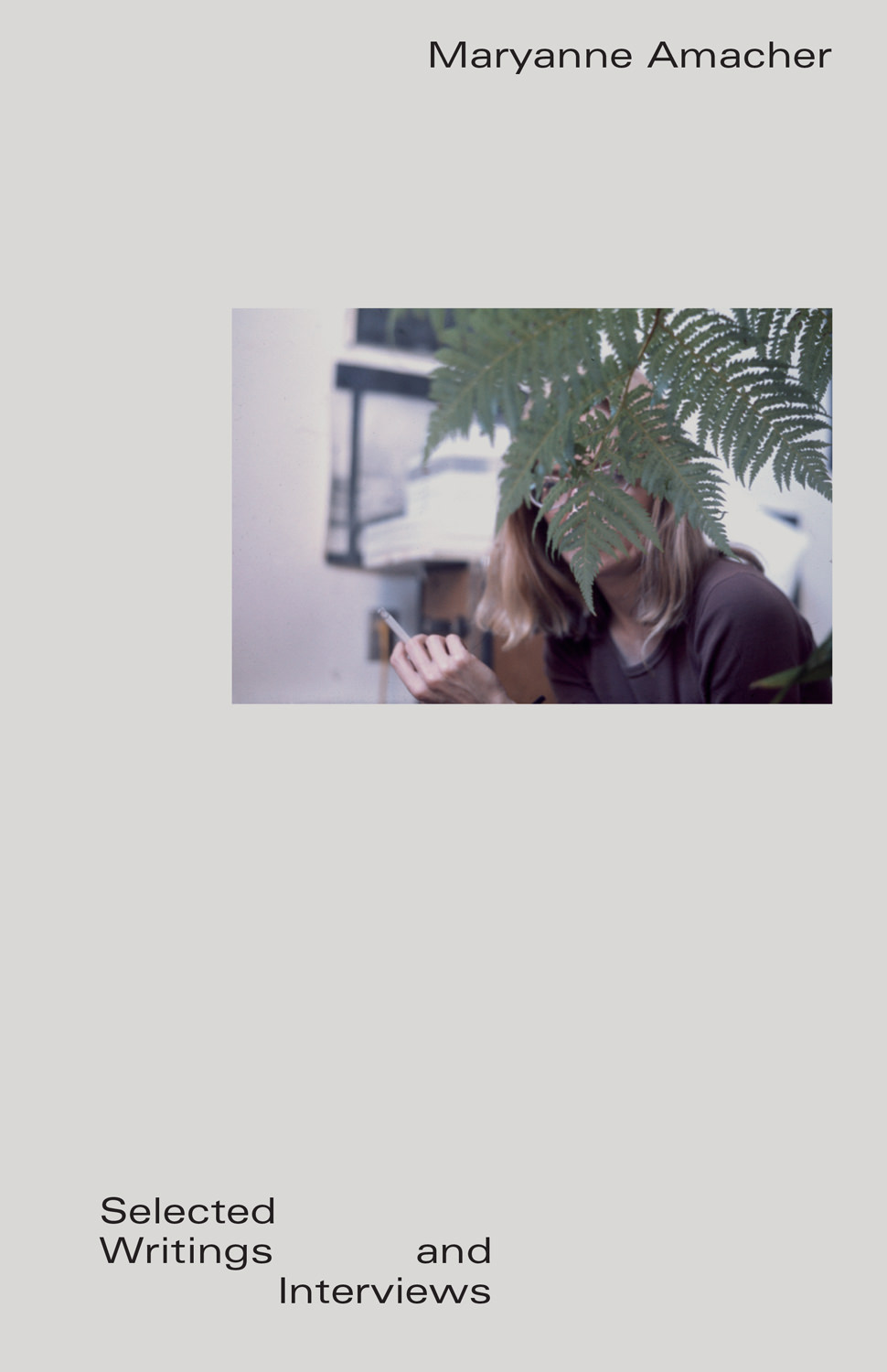
Maryanne Amacher - Selected Writings and Interviews.
At the time of her passing in 2009, the American composer and artist, Maryanne Amacher, remained shockingly under-acknowledged, particularly when faced with the towering importance of her contributions within the history of experimental sound practice and music; seemingly yet another woman relegated to the shadows of her male peers. Fortunately, this has slowly begun to change, helped considerably by the dedication to her work and legacy shown by Blank Forms via the presentation of numerous live performances of her works, talks, and the release of the stunning LP, Petra, in 2019 (only the third album in a remarkably distinguished career to entirely feature her music), an initiative now furthered considerably by the publication of Selected Writings and Interviews.
While by no means the limit of her output, Maryanne Amacher is best known for her extensive work with psychoacoustic phenomena, working heavily with the nuanced characteristics of time and space. A student of George Rochberg, Karlheinz Stockhausen, and numerous others, before her graduate work in the then emerging fields of acoustics and computer science, early in her career she became a regular collaborator with many of the 20th century avant-garde’s most noted names - John Cage, Max Neuhaus, Merce Cunningham, etc, but it didn’t take long for her to begin to delve toward realms almost entirely her own, pioneering, during the 1960s, what she designated as 'long distance music' - telematic, site-specific sound works that would later crystallize into her renowned City-Links series (1967 - 1980).
The lack of available recordings of Amacher’s remarkable efforts has a simple logic. Most of her major works were site specific, installational, and / or related to the family of psychoacoustic phenomena referred to as auditory distortion products (sometimes described as combination tones) - sounds generated inside the ear. In the simplest terms, Amacher’s works are difficult to reproduce and stage, making access to her remarkable ideas that much more important for understanding her monumental contribution, freed from parameters and limitations imposed by time and space, and thus why Selected Writings and Interviews is that much more important than similar books of its sort.
Drawing on a vast, often rebelliously unorthodox and idiosyncratic selection of largely unpublished documents, compiled by Amy Cimini and Bill Dietz across the breadth of the papers collected and housed within the Amacher Collection, Selected Writings and Interviews delves into the life, work, and ideas of Maryanne Amacher like no volume before it. Allowing intimate access to the composer and artist in her own words, the chronologically grouped documents, ranging from private writings and letters to program notes, manifestos, and proposals for unrealized projects, are framed by interviews in which Amacher discusses corresponding periods of her life, unveiling her thought process as it develops and transforms over time. It is a volume comprising staggeringly rich primary documents, as a means to uncover the mysterious world of the artist herself, while challenging the orthodoxies of music, sound, or media studies that have yet to acknowledge her remarkable work and contribution to the fields of music and sound art.
A truly monumental accomplishment, assembled with care, sensitivity, and conceptual vision on the part of Cimini, Dietz, and Blank Forms, Amacher’s Selected Writings and Interviews is just about as essential as texts come within the field of experimental music, while, via the vast range of media formats she worked across, being equally important for theorists and practitioners of urban design, contemporary art history, media and communications, music and sound studies, film, radio, art criticism, and performance studies. The voice of one of the most important artists of the last century delivered at long last.
Thulani Davis - Nothing But Music.
Particularly in the field of music, writers get the short end of the stick, often lost in the shadows of the sounds they serve. For this reason, among numerous others, this reality underscores the seminal importance of Blank Forms’ publication of Thulani Davis’ Nothing But Music. It foregrounds an artist of remarkable breadth and vision, who, for decades, has bent her talents writing both for and about music, while remaining widely under-celebrated for those efforts within a practice that also spans theatre, journalism, fiction, poetry, and screenwriting. Even more remarkably, it delves from the predictable path. It is a work built of the musicality of the spoken and written word - a book of poems - where music is the subject as much as the form.
Thulani Davis (b. 1949) is an interdisciplinary artist and scholar whose work includes works of poetry, theater, journalism, history, radio, and film. Her documentary about the Art Ensemble of Chicago, Fanfare for the Warriors, received the National Association of Black Journalists' First Place in Radio award. She has collaborated with her cousin, composer Anthony Davis, writing the libretti for the operas X, The Life and Times of Malcolm X and Amistad. In 1993, her writing for Aretha Franklin’s Queen of Soul - The Atlantic Recordings made her the first woman to win a Grammy for liner notes. Her bibliography includes My Confederate Kinfolk, novels 1959 and Maker of Saints, and several works of poetry. She is also an ordained Buddhist priest in the Jodo Shinshu sect, and founded the Brooklyn Buddhist Association with her husband Joseph Jarman.
Born in Virginia, Davis first emerged in San Francisco during the early 70s, already ‘schooled’, while a student at Barnard College, in spoken word performance by Gylan Kain and Felipe Luciano of the Original Last Poets. While working as a reporter for the San Francisco Sun-Reporter, notably covering the Soledad Brothers trial and subsequent persecution of Angela Davis, she became a respected poet and performer, collaborating with musicians and other writers in the city - notably the Filipino artist, Jessica Hagedorn, and Black feminist writer, Ntozake Shange, with whom she formed the trio, The Satin Sisters, a group that performed the poetry of each, danced, sang, and co-authored theatre - and joined the Third World Artists Collective, a ground-breaking initiative that supported the creative community of color, notably publishing the anthology of writings by women of color, Third World Women, which included Davis’ early poems.
During the late 70s, Davis moved to New York, joining the staff of the Village Voice, for which, in addition to the Nation and the New York Times Book Review, she wrote for 13 years - covering a broad range of topics, including race relations and the arts - eventually becoming the paper’s senior editor, all the while continuing to work in performance, and craft poetic and theatrical works. In addition to all of this, among the most fascinating of her endeavors included regular collaborations with jazz musicians, including Cecil Taylor, Joseph Jarman, Juju, Arthur Blythe, Miya Masaoka, David Murray, Henry Threadgill, Tania León, and others. It is this intimate relationship with music and its creators that underscores the works comprised by Nothing But Music.
Nothing But Music is, in the simplest sense, a book of poems by a profoundly talented artist. But, perhaps more importantly, it is a body of writing that, while entirely sculpted by a singular mind, is a consequence of collectivism, collaboration, community, and culture. Many of the poems collected across the volume have, over the course of their lives, been performed within a musical context by different improvising configurations that have included, among others, Pheeroan akLaff, Dwight Andrews, Kelvyn Bell, Arthur Blythe, Ronnie Burrage, Marilyn Crispell, Anthony Davis, Marty Ehrlich, Henry Grimes, Fred Hopkins, Joseph Jarman, Oliver Lake, Myra Melford, David Murray, James Newton, Jeffrey Schanzer, Bernadette Speach, Cecil Taylor, and Phillip Wilson. As such, in addition to being free-standing poems, they offer crucial insight into the broader African American creative context, first emerging during the 1960s and 70s under the banner of the Black Arts Movement, from which Davis sprang and continues to exist within, forging strong collaborative bonds across different disciplines within the arts, in this case the spoken word / poetry and music, but also dance, theatre, and visual forms.
Across the breadth of 22 poems, written between 1974 and 1992, we encounter luminaries and spaces from across numerous genres of music and dance, including Cecil Taylor, the Art Ensemble of Chicago, Bad Brains, Henry Threadgill, Thelonious Monk, The Revolutionary Ensemble, The Commodores, MFSB, Dianne McIntyre, Ishmael Houston-Jones, and many more in performances at historic venues such as The Five Spot, The Village Vanguard, The Apollo, Storyville, and Club Harlem, amounting to a collection of synesthetic, transportive documentary poems, imbued with a sonic-social history, the likes of which have been rarely encountered. Anecdotal and impressionistic, it leaps off the page, taking free flight in a series of odes to recorded music, its sacred spaces, and the encounters and experiences within; the raw feelings, smoke, dawn drunks, and impulsive energy of her moment, all imbued with a sense of social, political, creative, and cultural urgency.
A truly stunning body of work, Nothing But Music offers the most anthologized pieces of Davis’ work, having appeared in numerous collections of writing on black music, collectively assembled for the first time. The volume offers further proof of Davis’ place as a crucial figure, alongside poets Jayne Cortez, Sonia Sanchez, and Ntozake Shange, in the cultural landscape surrounding the Black Arts Movement. Beautiful, immersive, and rich with history and bubbling life, assembled with conceptual rigor and vision, it’s an absolutely wonderful way of experiencing music on singular and visionary terms, through the lens and voice of a true treasure of American cultural life, accented by fantastic introductory texts by Jessica Hagedorn and Tobi Haslett.
Originally published by Soundohm.