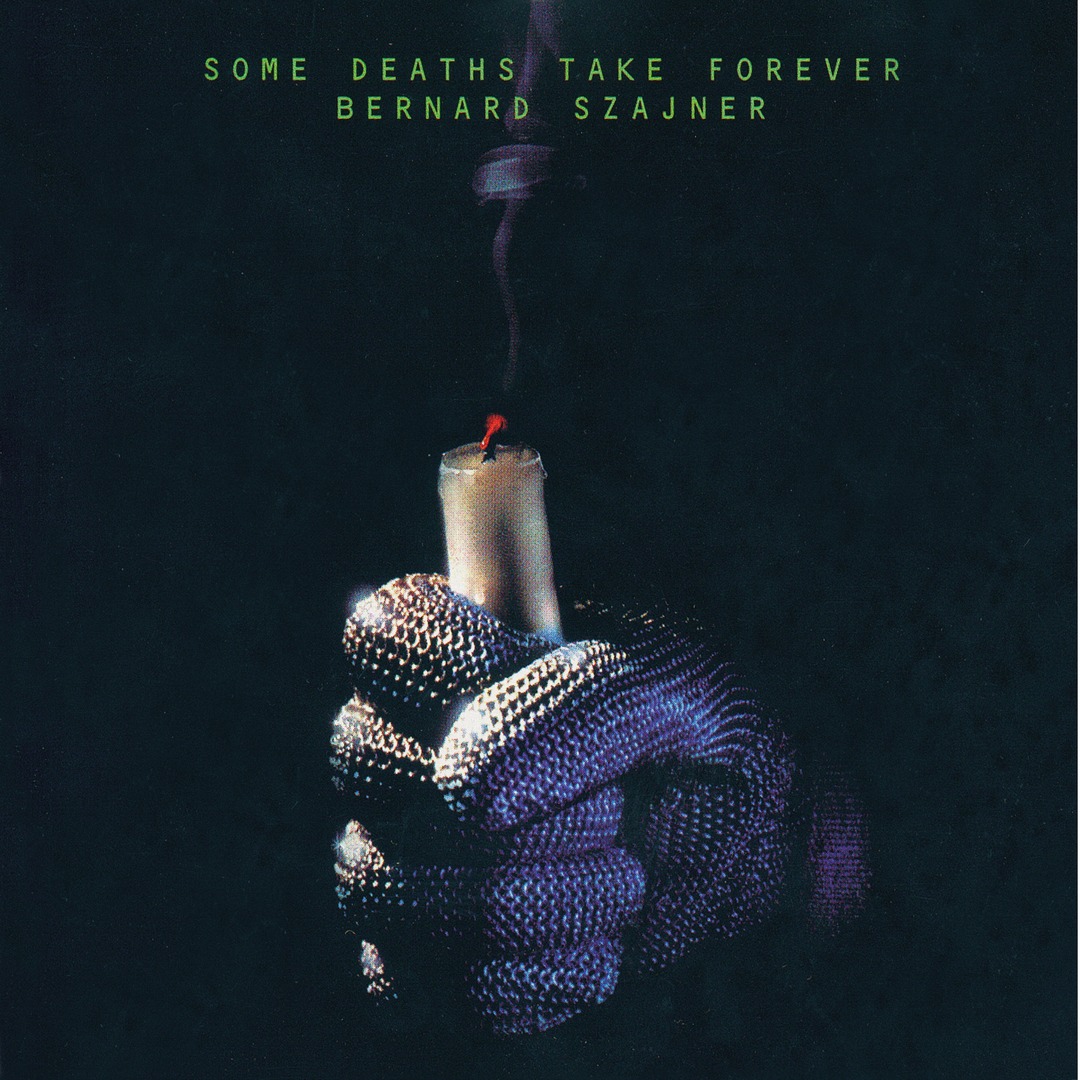
“‘Some Deaths Take Forever’ is a conceptual statement against capital punishment, inspired by Szajner’s encounter with an Amnesty International documentary in 1980.”
Cortizona's first ever vinyl reissue of Bernard Szajner's visionary 1980 album, 'Some Deaths Take Forever' is a thing of beauty that is likely to change how electronic and experimental music from the early 80s is perceived. Expanded to include a second LP of 5 previously unreleased tracks taken from the same sessions, as well as liner notes by Karel Beer and John Olson, it’s an essential missing link by a sinfully overlooked artist.
Since their launch in 2016, the Belgian imprint, cortizona, has issued a range of startlingly unexpected releases, spanning the contemporary, archival, and reissue. With less than a dozen LPs under their belt, they’ve managed to cover a vast amount of territory, from the singular efforts of Jean Hoyoux, to those of Freddie Hubbard, Nasca, Frederik Croene, Köhn, and Luz Azul, not to mention their reissue of the seminal “Noises” compilation, each as historically important as the next, while helping to sculpt a remarkably distinct image of musical context and interconnectivity. Now, rounding out 2020, the label is back with a killer, expanded reissue of 'Some Deaths Take Forever', the mind-bending second outing by French artist, Bernard Szajner, originally released on Pathé in 1980. This first ever reissue is now the most definitive edition to date of this truly visionary work. We can’t thank cortizona enough for offering this under-celebrated gem the love and attention it deserves, and placing it into the hands of a new generation of waiting fans.
Bernard Szajner has followed a fascinating trajectory through the history of 20th century music. He spent most of the 70's doing light and visuals for bands such as Magma, Gong, Pink Floyd and The Who, before launching his career as musician and composer with 1979’s ‘Visions Of Dune’, issued under the moniker of Zed. A brooding sonic journey that exploded the borders between ambient electronic music and the harsher territories of industrial music, it’s retained a cult status ever since. ‘Some Deaths Take Forever’, issued under his own name the following year, ventured further afield into experimental and more idiosyncratic realms. With hindsight, while entirely of its moment, it feels entirely singular within the context of electronic music that it emerged into at the dawn of the 1980s.
‘Some Deaths Take Forever’ is a conceptual statement against capital punishment, inspired by Szajner’s encounter with an Amnesty International documentary in 1980. Channeling the emotions of two prisoners waiting on death row, it’s a sonorous, psychological journey with almost no equivalent in the entire history of music, deftly sidestepping the presumed boundaries of genre, while handling its subject with as much delicate sensitivity as ambitious political potency. Imagine, if you can, the work late 70s / early 80s electronic pioneers like Manuel Göttsching, Wolfgang Riechmann, Harald Grosskopf, Richard Wahnfried, or Richard Pinhas, cannibalized and bred with the later work of Scott Walker, then peppered with a bit of funk and proto-techno. It’s weird, wild, and entirely its own thing, leaving little wonder why, despite its persisting obscurity, it’s been as influential as it has; not only cited by Carl Craig as his favorite album of all time, but also bubbling below the work of artists like Oneohtrix Point Never and beyond.
Originally published by Soundohm.