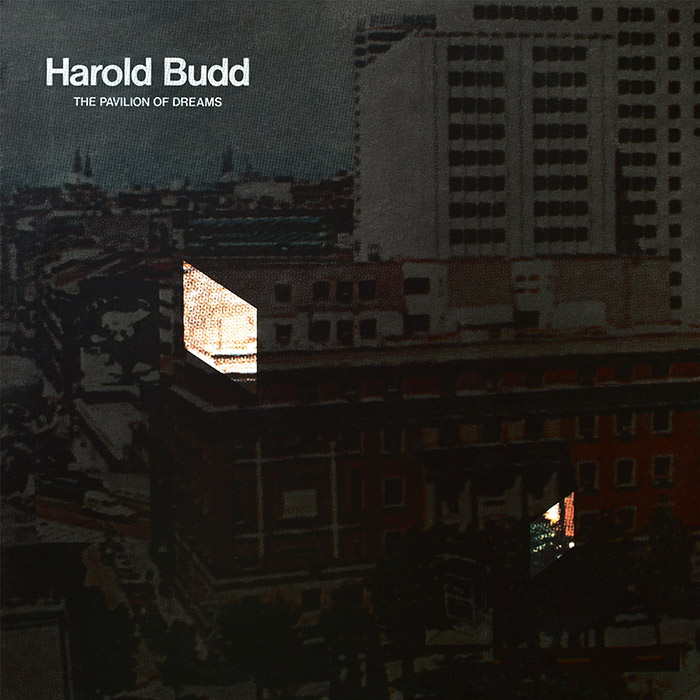
“An album of visionary creativity from which so much sprang, few objects can claim the historical importance held by Harold Budd’s “The Pavilion of Dreams”.”
In a truly monumental event, Superior Viaduct delivers the first vinyl reissue in 35 years (as well as a brand-new CD edition) of Harold Budd’s masterpiece “The Pavilion of Dreams”. Originally issued within Brian Eno’s seminal Obscure series in 1978, this stunning hybrid of minimalism, ambient music, and jazz - featuring the playing of Budd, Eno, Gavin Bryars, Marion Brown, Michael Nyman, and numerous others - is a creative artifact like few others, standing apart from the pack, while laying the groundwork for an entire generation working in its wake.
Over the last decade, Superior Viaduct has become synonymous with making the improbable and impossible real. One after another, spanning nearly every idiom of ambitious music, they’ve reissued some of the greatest holy grails in the history of sound. Their latest, the first vinyl pressing in 35 years of the legendary minimalist composer Harold Budd’s 1978 masterpiece, “The Pavilion of Dreams”, is yet another such case. One of the great artefacts of Brian Eno’s Obscure series - a defining canon of music at the juncture of minimalist and ambient music - through its startling structures and relationships, it stands as a rare illumination of 1970s West coast experimentalism, as well as a crucial challenge to the historical dominance of figures like Steve Reich and Philip Glass.
Harold Budd, who was among the many heartbreaking losses of the global pandemic, was as West Coast as they come. Born in Los Angeles and raised on the edge of the Mojave Desert, he was steeped in an early love of jazz, before cutting his teeth playing drums with Albert Ayler, whom he met in the army, while both members of the same regimental band. By the early 1960s, Budd’s gaze had shifted toward experimentalism and the avant-garde, prompting him to study composition under Ingolf Dahl at the University of Southern California.
Budd’s earliest known compositions are protominimalist works that owe a debt to composers like John Cage and Morton Feldman, a relationship that had all but disappeared by the time his first LP, 1970’s stunning “The Oak of the Golden Dreams”, had emerged. Recorded with an early model of the Buchla modular synthesizer at the California Institute of the Arts and a truly visionary work of minimal drone and eastern modalities, it would be nearly a decade before the world heard from him again. Soon after the album’s release, Budd gave up composition, reportedly disgusted by the "academic pyrotechnics" of the avant-garde community.
While “The Pavilion of Dreams” wouldn’t emerge until 1978, it seems that Budd’s disillusionment with the world of music was relatively short lived. Conceived as an extended cycle of works, the album’s four works - "Bismillahi ´Rrahmani ´Rrahim", "Two Songs", "Madrigals Of The Rose Angel", and "Juno" - were composed between 1972 and 1975. Somewhere along the way, Budd passed an early recording of “Madrigals Of The Rose Angel" to his friend, Gavin Bryars, who in turn passed it on to Brian Eno. Graced with one of the most forward-thinking ears in the industry, Eno immediately recognized Budd’s rightful place on his newly founded Obscure imprint, which had been conceived as a home for likeminded artists in the emerging field of ambient music.
Recorded in London in 1976 with an incredible cast of musicians - Budd, Eno, Bryars, Marion Brown, Michael Nyman, and numerous others - “The Pavilion of Dreams” was produced by Eno and carves out a fascinating territory at the juncture of jazz, ambient music, and minimalism, the likes of which had almost no equivalent in its moment.
Beginning with dreamy, meandering passages led by jazz giant Marion Brown’s stunning saxophone work, the album’s first work, "Bismillahi ´Rrahmani ´Rrahim" slowly evolves into a rippling universe of tonality and rhythm, moving at a glacial pace of immersive calm, before easing into the harp and vocal drenched chasmic spaces of "Two Songs", partially adapted by Budd from a composition by John Coltrane, which rounds out the first side of the LP.
Displaying an almost perfect continuum, the second side of “The Pavilion of Dreams” carries similar vocal treatments to a higher plane, blending them with the rich tonal and rhythmic densities that helped define "Bismillahi ´Rrahmani ´Rrahim”, slowly building across the composition’s length with long tones played against shimmering ambiences and instrumentation, before culminating the cycle with “Juno”, an astounding gesture that encounters the composer hybridizing high minimalism and spiritual jazz into a truly unexpected force.
An album of visionary creativity from which so much sprang, few objects can claim the historical importance held by Harold Budd’s “The Pavilion of Dreams”. Marking the beginning of a fruitful and lasting collaborative relationship between Budd and Eno that would deliver seminal records like “Ambient 2 (The Plateaux Of Mirror)” and “The Pearl” over the years to come, Superior Viaduct’s beautifully produced CD and vinyl reissues couldn’t come at a better time. These are some of the most beautiful and striking musical moments we can call to mind.
Originally published by Soundohm.