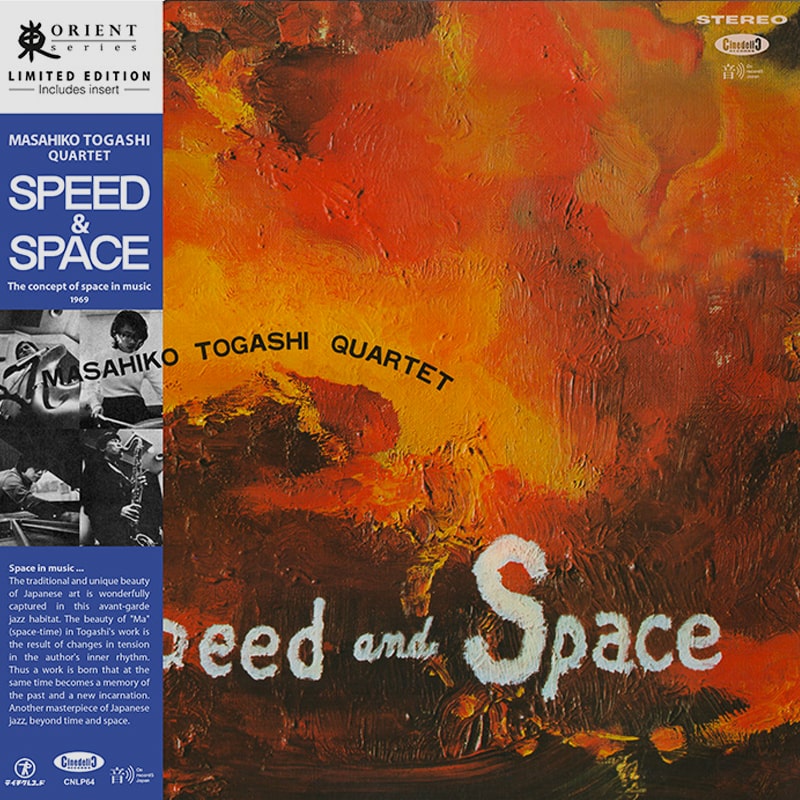
“Once heard, the last vestiges of a western centric notion of free jazz fall away, illuminating it as a truly global conversation, and Masahiko Togashi as one of the great band leaders of his time.”
Fresh from Cinedelic's newly launched Orient Series come long-overdue vinyl reissues of two of the greatest holy grails of Japanese free jazz, Masahiko Togashi Quartet’s “Speed And Space” and Masayuki Takayanagi And New Directions’ “Independence: Tread On Sure”. Engrossing listening and creatively brilliant, both albums were recorded in 1969 and are foundational landmarks within the scene to which they belong. Out of print for decades, whether collectively or on their own, each can be seen to establish the groundwork for the new and culturally special forms of free improvisation that have continued to emerge and evolve ever since.
For more than 20 years, Cinedelic has gained a remarkable reputation for illuminating unexpected trajectories within the world of avant-garde sound. While the primary body of their efforts has been dedicated to reissuing unconventional soundtracks and Italian library music, increasingly they’ve been casting their eye abroad. This was particularly noteworthy with the launch of their Orient Series in 2021, which endeavors to make seminal gestures of historic Japanese music available to a wider audience. It’s been an exciting ride so far, but their latest additions to the series - stunning vinyl reissues of Masahiko Togashi Quartet’s “Speed And Space” and Masayuki Takayanagi And New Directions’ “Independence: Tread On Sure” - are easily the most exciting to date. Hailing from 1969 and 1970 respectively, each is a landmark in the history of Japanese free jazz that has remained difficult to obtain outside of its country for decades.
Masahiko Togashi (1940-2007) was among the most important jazz drummers to emerge from post-war Japan. He first gained acclaim while still in his teens, playing with Sadao Watanabe, Toshiko Akiyoshi, and Tony Scott, as well as within the pickup bands of Ornette Coleman, Blue Mitchell, Lee Morgan, and Sonny Rollins on South-East Asian tours. During the late 1960s, alongside Masahiko Sato, Masayuki Takayanagi and Yosuke Yamashita, he became a central figure in the development of Japan’s unique vision of free jazz, producing remarkable work as a band leader, in addition to, over the decades, appearing on noteworthy recordings by Don Cherry, Steve Lacy, Charlie Haden, Mal Waldron and Paul Bley.
Togashi had a singular sound behind the drums, partially due to an accident in 1969 that cost him the use of his legs. As a result, he designed a new kit that would allow him to continue playing. His album, “Speed And Space - The Concept of Space in Music”, is a landmark in Japanese free jazz, and was recorded in Tokyo during November of that same year, encountering Togashi backed by Mototeru Takagi on tenor saxophone, bass clarinet, and cornpipe; Masahiko Sato on piano and gong; and Yoshio Ikeda on bass.
“Speed And Space - The Concept of Space in Music”, divided across five individual compositions, is an exploration of Togashi's notion of the “Time Law”; effectively a study into how texture, rhythm and differing rates of change affect our perception of the passage of time in music. After beginning with the brilliant, short piece, “Panorama”, which imbues a surprising amount of tension into its restrained structures and glacial pace, the quartet launches into a furious, fire laden explosion of free improvisation - grounded by Togashi’s varied percussion, as the rest of the ensemble pushes toward heightened states of abstraction - that immediately widens the perception of the emerging global conversation between the American scene (largely documented during that period by ESP, Delmark, etc.), Jazz Actuel / America era France, early Incus London, and adjacent scenes then emerging from Germany and Holland (ICP/FMP/etc.).
A particular stand out is ‘Expectation’, which closes the first side, which intertwines the tones and textures of percussion, bass and flute within a vast sense of space which recalls more object oriented improvisations that would take hold across the global free jazz scene of the ensuing decade.
The second side, in sharp contrast, features the two movements of the title track, encountering the ensemble diving into an expanse of tonality and driving rhythm that slowly gathers steam, moving post-bop ferocity into hard blown fire, that dances, pulls back, and explodes across the first movement, before easing into a stunning gesture of improvisational minimalism that illuminates what “Time Law” is all about.
Not unlike the work of Sunny Murray, Milford Graves, and Max Roach of this era, the drums play a particularly forward part in the ensemble’s progress across the length of “Speed And Space”, pushed forward by Togashi's vision and sense of energy, while giving him plenty of space. Once heard, the last vestiges of a western centric notion of free jazz fall away, illuminating it as a truly global conversation, and Masahiko Togashi as one of the great band leaders of his time.
There’s no better pairing with Masahiko Togashi’s “Speed And Space” than Masayuki Takayanagi And New Directions’ “Independence: Tread On Sure”, issued a handful of months later in 1970. Like the former, it is a landmark recording in the history of Japanese free jazz. For those less initiated in the sounds of that scene, many will remember those fantastic LPs dedicated to Takayanagi and the ensemble’s work, issued by Blank Forms over the last few years.
Between his emergence onto the scene during the early 1950s, until his passing in 1991, Masayuki Takayanagi remained one of the great visionaries of Japanese guitar - cutting his teeth with Lennie Tristano, before turning his back on traditional forms of jazz during the late 60’s - departing into a territory which ran roughly parallel with the innovations of Sonny Sharrock, Keith Rowe, and Derek Bailey. One of the first players on the international scene to deploy tabletop guitar for pure noise improvisation, it was Takayanagi, arguably more than any other, that laid the groundwork for the distinct sound and approach which would be built upon by players like Keiji Haino and Otomo Yoshihide, imagining a blueprint for free music as it only happened in Japan.
While having already been on the jazz scene for at least a decade and a half, “Independence: Tread On Sure” is the seminal document of Takayanagi’s movement into the world of free improvisation, and his debut recording as leader with The New Directions, the band that would be later described by the Japanese free jazz critic, Teruto Soejima, as “emit[ing] the smell of blood. Fresh blood, never blood that is old or crusted. This is not the desiccated shell of music, its sound through which pumps the blood of living human beings…. For these four musicians, playing together means feasting on each other’s blood. It is also a summoning to a secret blood oath, to the creation of solidarity with the audience.”
These sentiments unquestionably run like a river through the length of “Independence: Tread On Sure”, one of the wildest and most wonderful excursions into the free jazz universe that anyone could hear. Featuring Takayanagi on guitar, Motoharu Yoshizawa on bass, cello, percussion, and reeds, and Yoshisaburo Toyozumi on drums, the album is an auditory excursion into Takayanagi's theories about progressive art, as the group thrashes their way toward an entirely new Japanese methodology for improvisation.
What makes “Independence: Tread On Sure” so unique is a sense of impending violence that never fully explodes, as the three member’s instruments - electric guitar, bass / cello, and drums - enter into a conversation of jagged polyrhythm, bristling texture, and sour atonality, cocooned in a remarkable sense of space. Shifting between something that resembles call and response and free form chatter, Yoshizawa and Toyozumi spar with Takayanagi, rendering a truly singular palette of tonality into the mix, almost entirely reinventing the guitar’s sense of possibility at the time the album was recorded in 1969, crafting, in real time, free improvisation into an entirely new and culturally special form.
Fierce and boiling, intricate and locked in, a raw image of life and carefully aligned collaboration, more than half a century after its recording, “Independence: Tread On Sure” feels as fresh and vital as the day it was made, and offers a crucial counterpoint to the contemporaneous work of free jazz guitar giants like Derek Bailey and Sonny Sharrock.
Originally published by Soundohm.