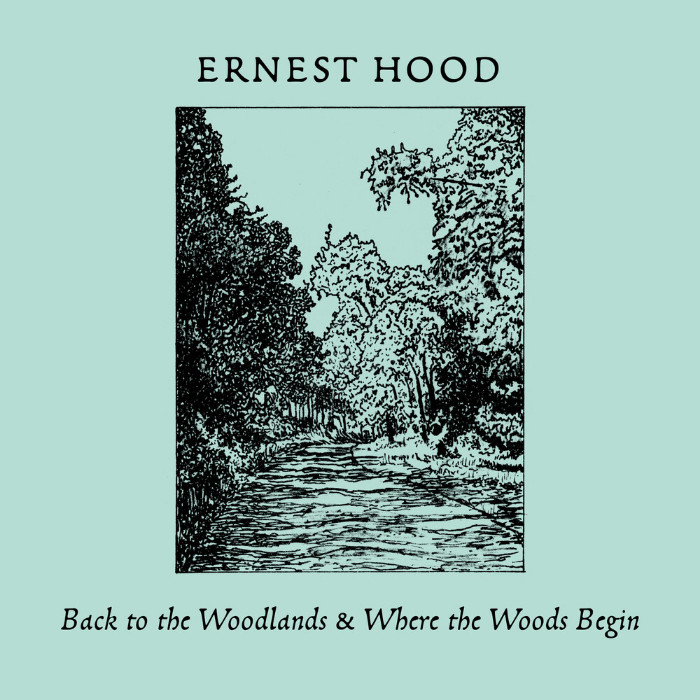
“Realized during the same era as “Neighborhoods”, its visionary combination of field recordings, zithers, and synthesizers, offers an unprecedented depth of access to its creator’s singular artistic mind.”
The always amazing Freedom to Spend returns on the back of an incredible year, having already brought us insanely good releases by Universal Liberation Orchestra and Cheri Knight earlier in 2022, with what is easily among their most ambitious and important albums to date, a never before released album by Ernest Hood, "Back to the Woodlands", created between 1972 and 1982, during roughly the same period that he recorded his legendary LP "Neighborhoods". Astoundingly beautiful, intertwining years of field recordings made of natural world and shimmering instrumentation, it might just be the most remarkable music we’ve heard from Hood yet. Issued in two beautiful editions for the first time - vinyl and a CD including a whole second album of unreleased material entitled "Where the Woods Begin" - FTS has blown our minds again.
Since launching a few years back, Freedom to Spend - the RVNG offshoot run by Pete Swanson and Jed Bindeman - has emerged as one of the most strikingly singular imprints in the contemporary landscape of sound, quietly assembling one of the most ambitious and revelatory catalogs of reissues and archival releases that we could call to mind. Relying on their incredible knowledge of underground and obscure music, they’ve delved into the shadows of history and come up with pure gold, issuing stunning artefacts by Cheri Knight, Universal Liberation Orchestra, Pamela Z, The Same, Michele Mercure, Marc Barreca, Pep Llopis, Richard Horowitz, Rimarimba, Tiziano Popoli, and numerous others. Back in 2019, FTS released one of their most beloved albums to date, the first ever vinyl reissue of Ernest Hood’s visionary 1975 LP, “Neighborhoods”. Long thought to be the only album that Hood produced, Pete and Jed have once again turned the table on end, now bringing forth an astounding, never before released album, “Back to the Woodlands”, that he recorded in Western Oregon between 1972 and 1982. Freedom to Spend has restored and remastered this never before released, lost masterpiece from the original tapes, issuing “Back to the Woodlands” in a beautiful vinyl edition, as well as on CD in combination with a full second previously unreleased album, "Where the Woods Begin" - created by Hood during the same period - both with new liner notes by Michael Klausman.
Ernest Hood was a fascinating, obscure figure in American music; a visionary outsider, who spent the majority of his life creating a remarkable body of work that almost no one heard in its day. Born into a musical family, Hood began a promising career as a jazz guitarist during the 1940s, touring internationally with his brother Bill and the saxophonist Charlie Barnet, before contracting polio in his late 20s. In the face of this adversity - making it impossible to play the guitar and confining him to a wheelchair for the rest of his life - he adapted and innovated, taking up less physically-demanding stringed instruments like the zither, and embarking upon the unprecedented step of incorporating field recordings into his work as early as 1956, making him possibly the first artist to do so in this way. Imbued with optimism and subtle cultural critique, these approaches and techniques - refined over the coming decades - would lay the groundwork for a sprawling body of radio work, unreleased recordings, and “Neighborhoods”, self-issued as a tiny edition on vinyl in 1975.
Neighborhoods, the record around which Hood’s legend would grow among small pools of record collectors over the coming decades, has few parallels; a sonic attempt to conjure a dream-like state of sensory memory and the joy in reminiscence. A nostalgic opus, built from intertwined, melodic lines of zither and synthesizer, threaded by a vast array of field recordings - screen doors opening and closing, passing motorists, crickets chirping, children playing, etc - the album is neither an ambient record, document, or work of musique concrète, but rather a product of a practice that Hood referred to as “musical cinematography”. Tragically, it was the only album to appear in Hood’s lifetime. Little did anyone know, he had continued to record and create at a rigorous pace for the remainder of his life, leaving behind a substantial body of recordings and a tiny number of completed albums lying in wait. It took the dedication and patience of Pete Swanson and Jed Bindeman to discover them and bring them back to life. As a result, decades down the road, the world is graced by the treasures that are “Back to the Woodlands” and its companion, only available on the CD edition, “Where the Woods Begin”.
Recorded between 1972 and 1982 in Western Oregon, “Back to the Woodlands” (with “Where the Woods Begin”) is one of only two surviving, previously unreleased albums created by Ernest Hood. Realized during the same era as “Neighborhoods”, its visionary combination of field recordings, zithers, and synthesizers, offers an unprecedented depth of access to its creator’s singular artistic mind.
Hood was graced with a remarkably democratic and nonhierarchical attitude toward the value of sound. While the practice of field recording dates to the earliest years of audio playback, and artists like Halim El-Dabh, Pierre Schaeffer, and Pierre Henry utilized non-instrumental and environmental sounds as the foundation of musique concrete during the late 1940s, Hood stands apart, possibly being the earliest artist to integrate field recording directly into more established forms of music, offering their presence equal value to instrumental counterparts. Decades ahead of its time, Hood’s radical approach to the materiality of sound and its organizations foreshadows approaches later adopted by artists like Jim Nollman and Don Robertson, as well as an entire generation of electroacoustic practitioners during the late 90s and early 2000s.
Unlike “Neighborhoods”, “Back to the Woodlands” leaves the modern world behind, delving toward Hood’s love for nature, and in so doing dramatically expands his concept of “musical cinematography” and brings it closer to Hood’s belief in the transportive qualities of sound; that field recordings could act as a vehicle for the imagination and liberation, particularly for those with similar mobile disabilities as his own. Across the album’s 12 compositions, the rippling harmonics of zither and synth - shifting between abstraction and playful melody - fold so seamlessly into the sounds of birdsong, bubbling brooks, and other environmental ambiences, that they often give the impression of having been recorded within the landscapes toward which they nod. Falling somewhere between the immersive calm of healing music and New Age - Joel Andrews, Laraaji, Donald Walters, etc. - and the jazz infected ambiences of Obscure / Editions EG era Harold Budd, the album sculpts an entirely singular proximity of music for its moment; a form of ambient sonic realism that draws the consciousness toward its surroundings as much as within. Also available for the first time within the CD edition is “Where the Woods Begin”, a second full, unreleased album created by Hood during the same period, which beautifully expands the same kind of stunning sonic explorations to roughly double their scale.
Truly astounding on every count, “Back to the Woodlands” is not only one of Freedom To Spend’s most remarkable releases to date - and that’s saying something - but it’s possibly the most beautiful and important archival release of the year.
Originally published by Soundohm.