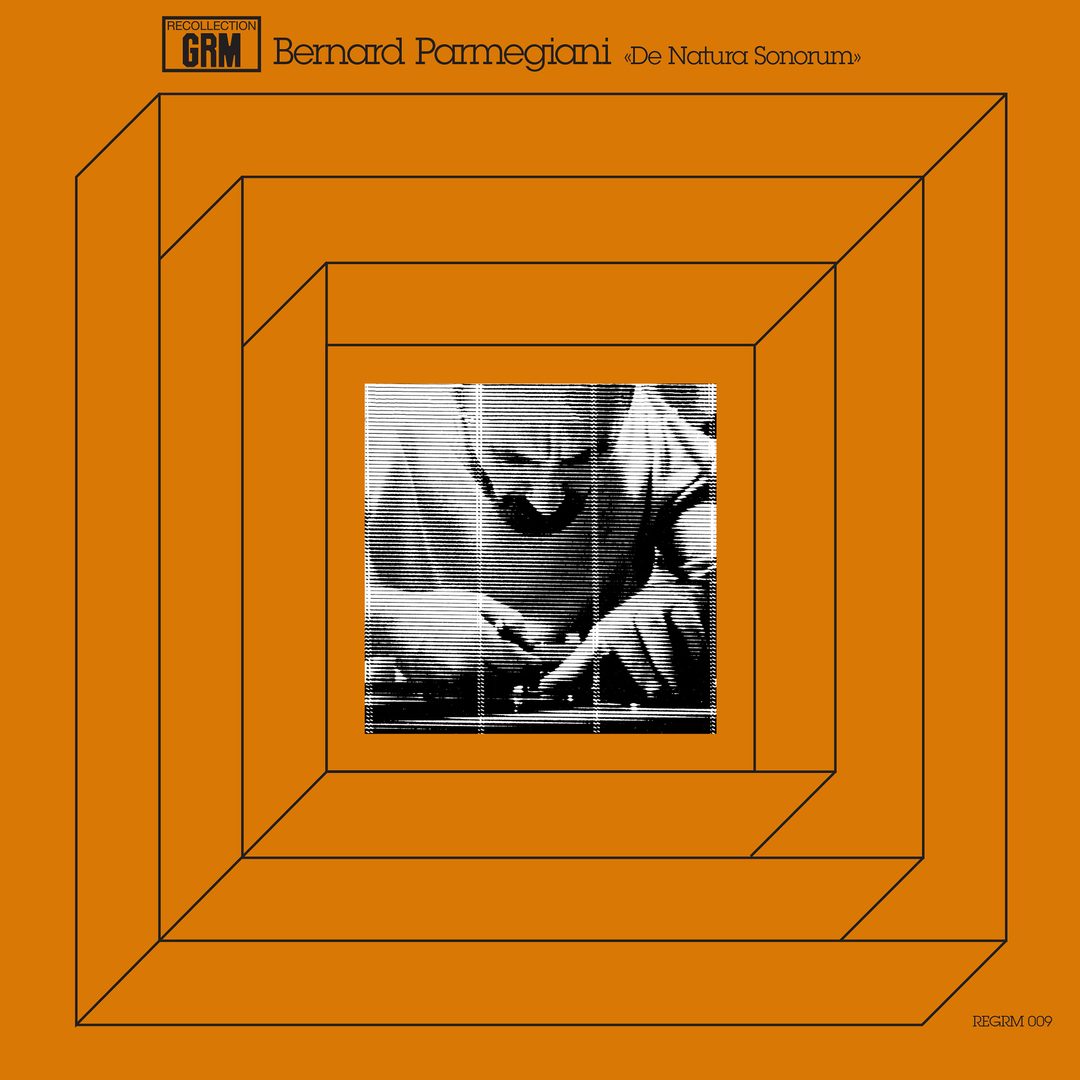
“Premiered in 1975 and originally released in half its form by INA GRM in 1978, it is regarded by many as Parmegiani's great masterpiece and among the most historically important electroacoustic works of all time.”
After remaining out of print for years, Recollection GRM returns with a beautiful repress of one of their most important releases, Bernard Parmegiani’s seminal “De Natura Sonorum”. Premiered in 1975 and originally released in half its form by INA GRM in 1978, it is regarded by many as Parmegiani's great masterpiece and among the most historically important electroacoustic works of all time. A truly thrilling immersion into instrumental, electronic and concrete sound, rigorously composed and balanced as an investigation into the very nature of sound, Recollection GRM's edition is the first vinyl release to issue the entire 12 movements together as the composer conceived them.
Originally founded in 2012 as a collaboration between Editions Mego, Peter Rehberg, and Groupe de Recherches Musicales, for more than a decade Recollection GRM has mined the back catalog of releases and archival material produced at the legendary Parisian electronic music studio, GRM, founded in 1951 by Pierre Schaeffer, Pierre Henry and Jacques Poullin. Along the way, they’ve illuminated some of the most important works of musique concrete, and electronic and electroacoustic music ever laid to tape. Now running as a collaboration with Shelter Press and INA GRM, the sheer popularity of Recollection GRM’s releases has driven them out of print nearly as fast as they come. Thankfully, they’re doing their best to remedy this with beautiful represses, most notably a brand-new pressing of their double LP expanded reissue of Bernard Parmegiani’s seminal “De Natura Sonorum”. Among the most visionary gestures of electroacoustic music ever composed, presented as it was conceived - twice the length of the original LP - it’s an immersive marvel of bristling sonority, the likes of which have rarely been achieved by anyone wading into this remarkable field.
The legacy of Bernard Parmegiani, who passed away in 2013, towers within the field of electronic and electroacoustic music. He was an artist of rare vision - riding the razor’s edge between radical singularity and playful humor - for whom recognition came late, due to his dedication to live, real time realizations of his work, in addition to primarily composing for film, television, and theatre. Initially trained in theatre and mime, he shifted toward music during the 1950s, becoming one of the first students to study under Pierre Schaeffer at Groupe de Recherches Musicales (GRM), shortly after its founding. Not long after, he joined the studio and collective as a full-fledged member, slowly assembling, over the next half a century, one of the most important and visionary bodies of electroacoustic music in history. Parmegiani's use of concrete, electronic, electroacoustic, and acousmatic techniques, was not only remarkably diverse - spanning numerous contexts and applications - but it was vast and second to none, often outstepping his precursors and peers, and influencing countless artists that followed in his wake.
While Parmegiani was incredibly prolific, the discography of releases issued under his name during his lifetime is surprisingly thin; one from end of the 1960s, five from the 70s, one from the 80s, four from the 90s, and a handful more over the last decade or so of his life. Among the most noteworthy of those produced in 70s was “De Natura Sonorum”, originally released as a single LP by INA GRM in 1978. Composed as a suite of twelve studies, divided into two series of six, that were premiered at the Salle Wagram in Paris on 3rd June 1975, the original LP only featured the first six suites, with the latter slowly added to subsequent editions during the cassette and CD eras. It wasn’t until Recollection GRM’s double LP version in 2013 that Parmegiani’s full composition appeared on vinyl for the first time.
Regarded by many as Parmegiani's towering masterpiece, “De Natura Sonorum” was conceived as an investigation of the nature of sound by intertwining opposing natural and artificial sounds - instrumental, electronic and concrete - via a rigorous approach to each element and its relationship to the next. Reflecting on the work years later in an interview with Rahma Khazam, published by The Wire in 1998, the composer stated: "In De Natura Sonorum I distanced myself from the power of sound, from what I call the power of Orpheus. Orpheus charmed the plants and animals with his lyre, and in the pieces I composed prior to De Natura Sonorum I was under the spell of the sounds I created. Sounds that evolved and that I found satisfying and I left it at that. People always used to compliment me on the beauty of my sounds in my first pieces! But beautiful sounds don't necessarily constitute interesting pieces of music. Whereas in De Natura Sonorum I set myself many more constraints: I placed the sounds as you do letters, one after the other, so as to create forms and sequences”.
Filled with all the power of the natural world, balanced against frenetic energy and groundbreaking possibility of technology, Parmegiani achieves something truly remarkable across the 12 movements of “De Natura Sonorum”, embedding each with pointillistic detail, sweeping amounts of space, and a perfectly balanced sense of density that transforms them into remarkable sonorous abstractions, where the identities of his sources shift in and out of focus with poetic grace.
A truly thrilling journey across four vinyl sides, it’s impossible to express how happy we are to have Recollection GRM’s beautiful edition of Parmegiani's masterpiece, “De Natura Sonorum”, back in print after far too many years. If there’s one defining work produced at Groupe de Recherches Musicales (GRM) during its long history that should be in every record collection, this might just be the one.
Originally published by Soundohm.