“Bordering on free-jazz, but far closer to non-idiomatic realms of spontaneous sonorous communication that Bailey advocated for over the length of his career, the outcome is remarkably engaging, ebbing and swelling with clattering, frenetic energy.”
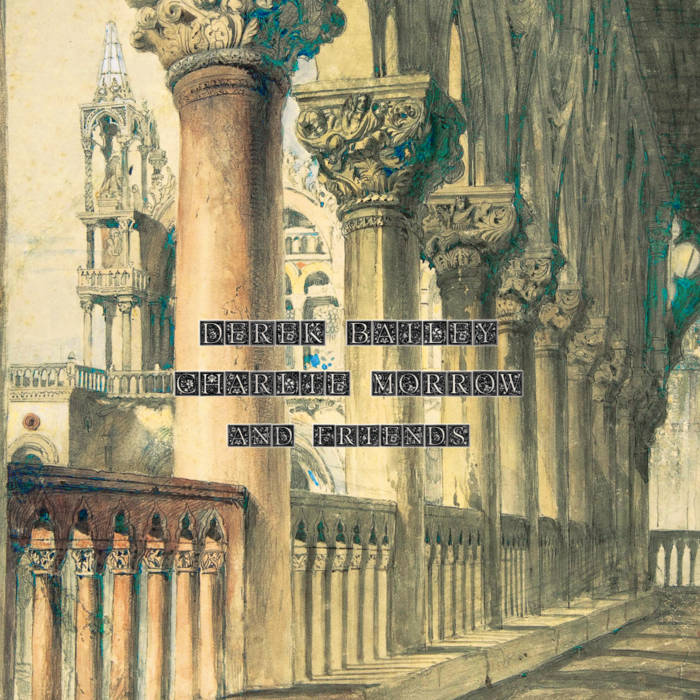
Recital returns with a truly magnificent musical gem, "New York 1982", a lost collaborative album created by Derek Bailey, Charlie Morrow, and an amazing cast of collaborators - Glen Velez, Steve McCaffery, Carol E. Tuynman, Patricia Burgess, and Michael Snow - in New York during the early 80s. An engrossing realization of Bailey's notion of non-idiomatic music, recorded live and in the studio, it's a visionary sound world of frenetic energy and perfectly placed interventions, that remains creatively radical four decades down the road.
Since its humble founding over a decade ago, the Los Angeles based imprint, Recital, has become an unmissable force in the landscape of experimental sound. Run by the composer Sean McCann, the label has continuously mined the contemporary contexts and shadowy histories of sound art, poetry, and musical experimentalism, bringing forth remarkable recordings by Dick Higgins, Daniel Schmidt, Philip Corner, Adriano Spatola, Geoff Hendricks, Loren Connors, Sarah Davachi, Jackson Mac Low, Roger Eno, Annea Lockwood, François Dufrêne, and a great many more. Running like a core through Recital’s output is the work of Charlie Morrow, a seminal figure in the American avant-garde whose output, until their release of “Toot! Too” in 2018, had become sinfully neglected. The initiative that began there, now continues with an absolutely incredible artefact, “New York 1982”, a full LP worth of recordings created in collaboration between Morrow and Derek Bailey. Effectively a lost album that has laid in Morrow’s archives since it was recorded, it’s nothing short of a monumental event, resurrecting true musical magic, unheard for 40 years.
Looking back, Charlie Morrow was at the centre of it all. Born in 1942, he attended Columbia College working under the composer Otto Luening and the ethnomusicologist Willard Rhodes, before, during the early 1960s, encountering notable figures from the New York avant-garde like John Cage, Alison Knowles, and Philip Corner. During the same period, he also met the poet Jerome Rothenberg, with whom he founded and ran The New Wilderness Foundation, staging concerts and releasing the legendary New Wilderness Audiographics cassette series between 1974 and 1989, as well as publishing EAR Magazine, run by Beth Anderson, Laurie Spiegel, and R.I.P. Hayman, and helping Charlotte Moorman organize her acclaimed annual Avant Garde Festival in New York City.
A facilitator, collaborator, and singular artist in his own right, Charlie Morrow’s projects have included chanting and healing works, museum and gallery installations, large-scale festival events, radio and TV broadcasts, film soundtracks, commercial sound design and advertising jingles, performed using conch shells, cow and goat horns, Jew’s harp, ocarina and homemade electronics, with a focus on breath, vocalization, gesture, and mental dream states. It is within the outer reaches of the realm that we encounter him with Derek Bailey and numerous others on Recital’s “New York 1982”.
In the history of free improvised music, there has been arguably no greater advocate for the idiom’s power and potential than the English guitarist Derek Bailey. Fiercely principled, between his emergence during the 1960s and his death in 2005, he cut a wide path, positioning this music as the height of creativity, transpiring in real time, and a means through which people from diverse backgrounds could come together, express, and commune. For Bailey, “playing is about playing with other people... improvisation is a process that gets relationships sorted out” and this was something that best transpired in a live context. All of this came together in truly unexpected ways across “New York 1982”.
Having been friends and collaborators for years, in 1982 Charlie Morrow and Derek Bailey organized a series of live concerts and studio sessions around New York, inviting a rotating cast of New Wilderness players to join them as they went, including frame drum percussionist Glen Velez, sound poet Steve McCaffery, publisher and artist Carol E. Tuynman, composer Patricia Burgess, and multimedia artist Michael Snow. Having rested, unheard in Morrow’s archives since they were recorded, those sessions and live recordings have now been sifted, sorted, and distilled by Recital into a single, truly marvelous LP.
The first side of the album captures a particularly raw and intense live concert by the group, with Morrow and McCaffery’s visceral sound poetry and Glen’s frame drum echoing off of Derek’s fret stabs, and Carol, Patricia, and Michael’s horns swirling through the air between. Bordering on free-jazz, but far closer to non-idiomatic realms of spontaneous sonorous communication that Bailey advocated for over the length of his career, the outcome is remarkably engaging, ebbing and swelling with clattering, frenetic energy.
Recorded at The Record Plant in New York that same year, the second side of “New York 1982”, feels markedly more produced and refined, utilizing panning and tape echo processing, in addition to experiments with water whistles and other devices. While the live performances on the first side gelled into a kind of group mind, here Bailey stands out and leads the charge in a series of duos and large ensemble works. Filled with a remarkable sense of space, each tonal, textural, percussive, and vocal element feels perfectly placed and chosen, as though no other would have met its required response.
Originally published by Soundohm.