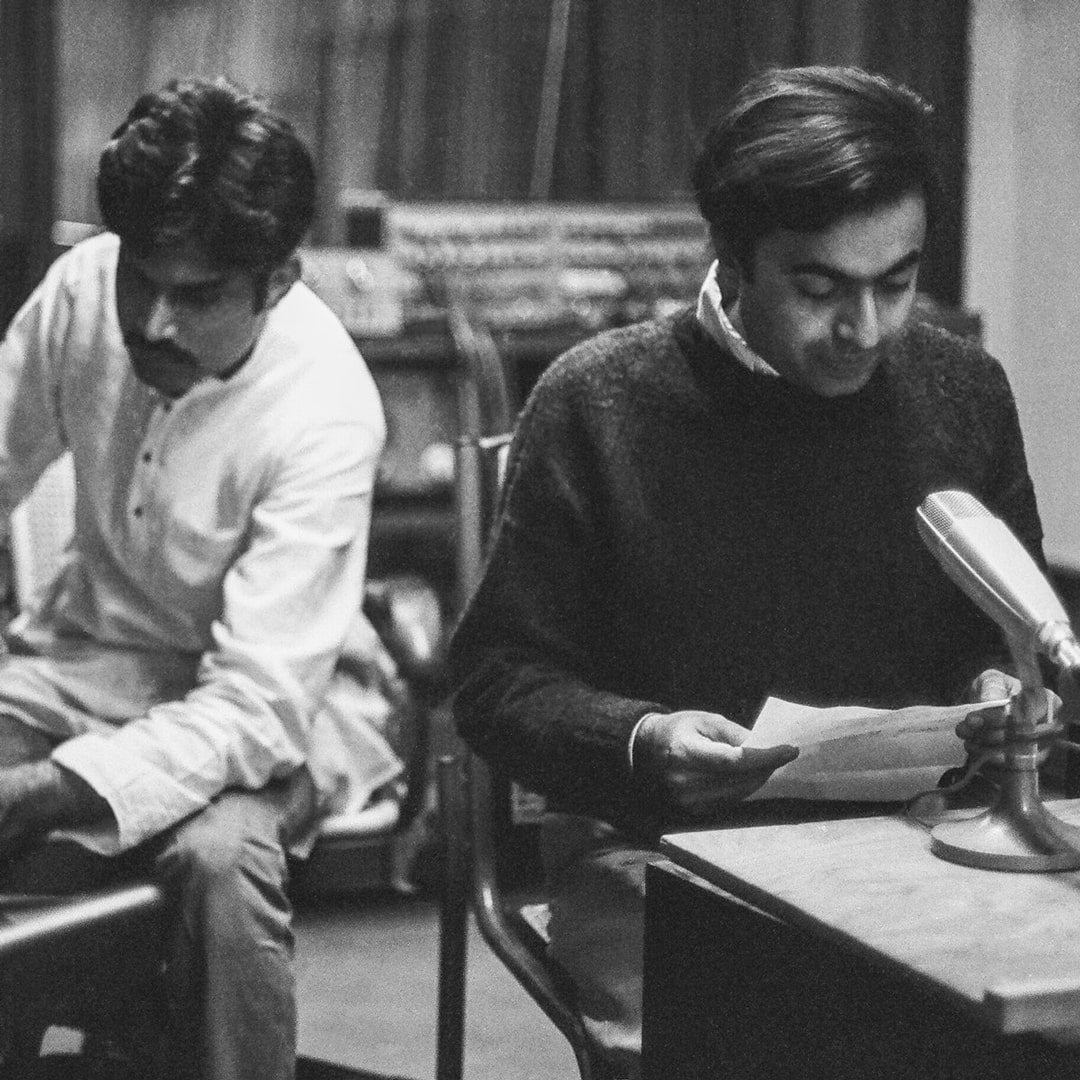
“Ranging from pure abstraction to more explicit flirtations with musicality, there isn’t a dull moment or a dud of a composition anywhere on “The NID Tapes”.”
The London based imprint, state51 Conspiracy, returns with what might just be the most important archival release of the year, The NID Tapes: Electronic Music from India 1969-1972. Comprising 19 newly discovered and never before released electronic pieces composed by a group of previously unknown Indian composers working within the country's first ever electronic music studio, during its brief existence between 1969 and 1972, following its founding by David Tudor at the National Institute of Design in Ahmedabad, on both historical and creative terms it is staggering and mind-blowing. Radically expanding the history of 20th Century experimental electronic music with a series of compositions that feel markedly ahead of their time and stand apart from most electronic and electroacoustic music concurrently emerging from other parts of the world, it's a marvel - issued as a beautifully produced double LP - of the highest order.
Despite emerging during the mid-20th Century as a means toward a universal and decisively accessible musical language and process of composing - actively undermining elitist, exclusionary practices that were endemic within Western classical music - the history of electronic and electroacoustic music has always privileged artists and studios in Europe and the United States, and thus letting the ideals and principles under which it was founded. The reality of happening was far more broad. In the decades following the Second World War, electronic music studios sprang up across the world - notably in Asia, Latin America, Canada, and behind the Iron Curtain - with their respective outputs forming an alternate and often lost history of the true successes of the idiom and the avant-garde. Over the last two decades, diggers, devotees, and record labels, with reissues and archival releases, have steadily plumbed the depths, bringing forth lost treasure that has helped to sculpt a more accurate history of electronic music that often reveals surprising happenings and connections. Among the best examples of this is the latest LP from the London based imprint, state51 Conspiracy, The NID Tapes: Electronic Music from India 1969-1972.
A contributing factor to the difficulty in accessing a complete history of experimental electronic music during the 20th Century is the fact that studios - fitted with complex and expensive equipment that was difficult to maintain, while often the fertile hotbed of radical ideas - often didn’t last for more than a handful of years, allowing them, alongside of the work produced there to fall into the shadows of memory. This was unquestionably the case for India’s first electronic music studio that existed for three brief years between 1969 and 1972 at the National Institute of Design in Ahmedabad. Rife with activity, it was virtually unknown outside of the country and quickly forgotten within.
Founded during the utopian years following India’s independence - a radical period of visionary experimentation and artistic free-thought - by the New York composer, David Tudor, who personally set up a Moog modular system and tape machine in the autumn of 1969, the studio’s history was discovered during a long-term research project by the British artist and electronic musician, Paul Purgas, who travelled to Ahmedabad over many years to explore the origins of electronic music in India, and subsequently uncovered the 27 reels of archive tape, spanning the three years of the studio's operational history, from which the material for state51 Conspiracy’s double LP compilation, “The NID Tapes”, were drawn.
The nineteen electronic pieces, composed by pioneering and previously unknown Indian composers like the musician and poet Atul Desai, NID teachers and technicians I.S. Mathur and S.C. Sharma, former John Cage student Gita Sarabhai, and the young architecture student, Jinraj Joshipura, present a remarkable and revelatory window into a lost moment of experimental musical practice in India during the second half of the 20th Century, comprising analogue synthesis, tape collages, voice experiments and field recordings that reveal a startling meeting point between Western and Indian avant-garde traditions, and offering a unique insight into South Asia’s post-colonial sonic imaginary.
Perhaps the most striking feature of the works comprised by “The NID Tapes” is how ahead of their time they feel and how much they stand apart from a great deal of the experimental electronic music concurrently emerging from other parts of the world. Each feels almost contemporary with the temperaments of this moment, peppered with elements that would emerge years later in the industrial and bedroom electronics scenes - Nurse with Wound, Current 93, etc. - rather than one that lies more than half a century behind us. Equally as noteworthy is the remarkable sense of almost minimalist restraint, displayed by these artists, a far cry from the textural and tonal / atonal densities that tended to define most post-war European and American experimental electronic music, which is especially well exemplified by the drone-scapes of Jinraj Joshipura’s “Space Liner 2001 I” and Gita Sarabhai’s “Gitaben's Composition II”, and S.C. Sharma’s Dance Music I, which hints at the coming of minimal techno.
Ranging from pure abstraction to more explicit flirtations with musicality, there isn’t a dull moment or a dud of a composition anywhere on “The NID Tapes”. It’s absolute gold and a completely engrossing listen, that further unfolds with every listen, from the first sounding to the last. A true marvel of the highest order with historical importance that goes way off the charts in its illumination of a lost history of electronic music in India.
Originally published by Soundohm.