“Absolutely revelatory, while challenging our perceptions of the "original instrument" every step of the way, each represents a groundbreaking gesture of experimental sound.”
Over the last few years, we've been blown away by the incredible work, traversing the borders of sound art and experimental music, appearing on Xing's vinyl only platform Xong. Their latest batch - issued in both standard and very special artist editions - comprising the Italian composer and sound artist Alessandro Bosetti’s “FasFari” and the Eritrean, Bologna based artists Muna Mussie and Massimo Carozzi’s “Curva Cieca Oblio ኩርቫ ዕውር ምርሳዕ”, draws their thematic focus toward the expressive possibilities presented by the human voice. Absolutely revelatory, while challenging our perceptions of the "original instrument" every step of the way, each represents a groundbreaking gesture of experimental sound.
Since their founding in 2000, the Bologna based cultural platform, Xing, has worked tirelessly in support of objects and events that embrace an interdisciplinary approach toward the issues of contemporary culture. More recently, their record label has expanded this initiative to amplify the voices of artists - both Italian and international - who are deeply engaged in the world of live performativity, a modus operandi that has now been offered even more focus with their Xong series, a vinyl-only collection that explores a geography of artists who present the sonic field as a means to expand their staging of free standing, intimate worlds. Easily some of the most exciting recordings we’ve heard in recent years, the series, via LPs like Lydia Mancinelli and Marcello Maloberti’s “Martellate. Scritti Fighi 1990-2020”, Kinkaleri & Jacopo Benassi’s “Once More”, Luciano Maggiore’s “Very Cheap Non-Human Animal Imitations”, Margherita Morgantin’s “Cosmic Silence 5, fluorescence 4”, and Valerio Tricoli’s “A Circle of Grey” - have taken us on a deep dive into a creative frontier that rests at the borders of the theatrical, sound art, experimental music, noise, the poetic, and the generatively performative.
The Milan born Marseille, France, based composer and sound artist, Alessandro Bosetti, has been working in the field of experimental sound for decades, exploring the musicality of language and sonorous aspects of voice and verbal communication. In addition to a striking body of work issued on imprints like Holidays, Unsounds, Sedimental, Die Schachtel, and numerous others, collaborations with the likes of Tony Buck, Chris Abrahams, Jennifer Walshe, Amelia Cuni, Axel Dörner, Annette Krebs, Giuseppe Ielasi, Phill Niblock, and Otomo Yoshihide, to name only a few, he has performed widely across the world and worked extensively at WDR's Studio Akustische Kunst in Cologne, Deutschlandradio Kultur in Berlin, and GRM in Paris. Bosetti conceives of the voice as an autonomous object and an instrument of expression, seeking to deploy it as a dialogue between notions of language, the unique properties that define a voice, and broader perceptions of sound, within complex tonal and formal constructions that are often threaded by an oblique sense of irony.
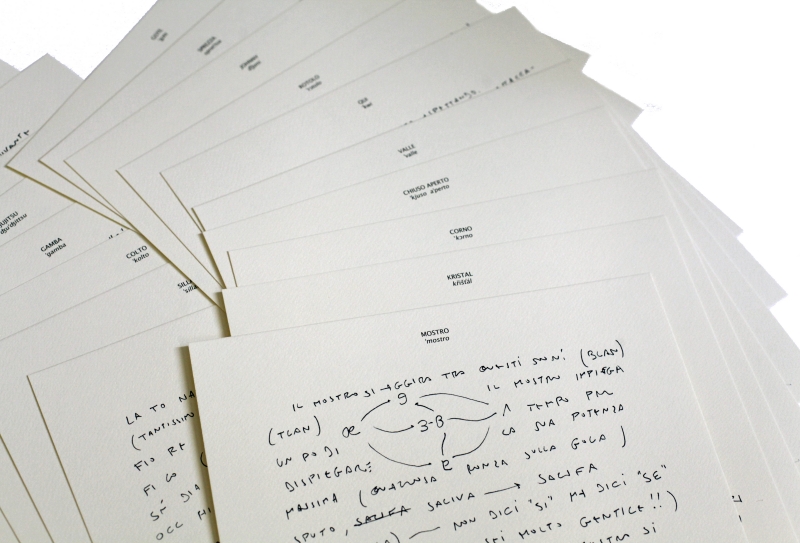
“FasFari”, Bosetti’s latest outing, comprises a body of short vocal emissions that contend with a form of speech before the act of saying: sound particles that invoke meaning without ever fully articulating it or suggesting the identity of the speaker. The work belongs to the artist’s larger body of work, “Plane Talea” - being its 36th incarnation - an archive/instrument that he has been building since 2016, made up of anonymous voices, sorted into thousands of utterances that live autonomously and are arranged and approached as an instrument. Bosetti conceives of these voices / instruments as a means to create a purely utopian vocal music: a polyphony constructed from all of the multiplicities carried by the human voice.
Despite “FasFari’s” deep conceptual underpinnings, the music encountered across the album’s length defies many of the expectations often aligned with phonically focused vocal experimentation and sound art: Joan La Barbara, Phil Minton, Maggie Nicols, etc. The album is surprisingly tonal and musical; Bosetti playing the “original instrument”, gathered from numerous individuals, with a kinship to how one might approach an organ. Embracing the source, rather than pushing toward abstraction, Bosetti’s material, falling together in long-tone harmonics, rising and falling structures, and flirtations with melody, the compositions encountered across the length of “FasFari” nod toward the minimalist approaches of composers like Philip Glass, Steve Reich, La Monte Young, and Roberto Laneri - shifting from durational vocal drones to joyous patterns and arpeggiations - while creating something entirely singular and new at the borders of sound art and poetry, imbued with a striking and unmistakable presence of deep humanity.
Absolutely engrossing on sonic terms and creatively visionary, Alessandro Bosetti’s “FasFari” is a revelation that represents some of the most striking music for human voice we’ve encountered in years.
Having worked together for more than 20 years, the collaborative partnership of Muna Mussie and Massimo Carozzi stands among the most enduringly fascinating sonically creative gestures to have ever emerged from Bologna. Mussie is a multidisciplinary artist whose work traverses ideas around gesture, vision and word, realised as sound pieces, performances, installations, and embroideries that investigate artistic languages as a means to explore the tension between the private and public, memory and oblivion, visible and invisible. Carozzi, on the other hand, is a sound artist, sound designer, and musician who explores the relationship between sound and image, sound and scene, sound and literature, sound and space, often working in the realm of film, as well as in sonic collaborations with artists like Andrea Belfi, Stefano Pilia, Valerio Tricoli, Dominique Vaccaro, Emidio Clementi, Margareth Kammerer, Susanna La Polla De Giovanni, Muna Mussie.
Curva Cieca Oblio ኩርቫ ዕውር ምርሳዕ, the duo’s first recorded outing, builds on many years of intersecting paths on the part of the artists, inquiring after material questions relating to collective and personal oblivion, and the deconstruction of macro narratives. Comprising three movements, the album opens with Cieca, a piece that moves blindly within the grammar of an adverse text and a continuous stumbling demolishes its meaning. The two subsequent pieces, Curva and Oblio, interrogate the different codes and practices that accompanied the production of this sound object. Curva is built on the fusion of a fragment taken from a piece of Tigrinya music with the mechanical rhythm of a sewing machine, creating a rhythmic homophony between asynchronies and coincidences, increasingly progressing toward more explicit expressions of musicality by incorporating the vocals of Eritrean Coptic ceremony, pulsing bass lines and polyrhythmic guitar patterns, while Oblio pursues processes of repetition as a means to capture the elusive, intertwining and layering vocal improvisations to reveal the harmonic connections of the voices, and reconstruct a vision of collective breath.
A thrilling body of creative sonority at the borders of conceptualism, and the visual and sound art worlds, Muna Mussie & Massimo Carozzi’s “Curva Cieca Oblio ኩርቫ ዕውር ምርሳዕ” is a deeply engaging and thought-provoking piece of work.
Originally published by Soundohm.