“nearly half a century on from their original releases, each remains groundbreaking and fresh as though they were only just laid to tape”
Continuing their dedication to the work of Joe McPhee and towering artefacts from the history of American free Jazz, the venerable Superior Viaduct returns with three, first ever vinyl reissues from McPhee's back catalog: 1975's “Black Magic Man”, 1976's “The Willisau Concert”, and 1977's “Tenor”. Easily some of the most enduring works from one of the most important artists working in avant-garde sound (then as much as today), traversing hard blown fire, lyrical spiritual jazz, and radical, forward-thinking experimentalism, nearly half a century on from their original releases, each remains groundbreaking and fresh as though they were only just laid to tape.
Over the last decade, Superior Viaduct has become synonymous with making the improbable and impossible real. One after another, spanning nearly every idiom of ambitious music, they’ve reissued some of the greatest holy grails in the history of sound, particularly the towering artefacts of avant-garde jazz. Over its years of activity, they’ve endeavoured to return crucial releases by artists like Sun Ra, Milford Graves, Byard Lancaster, Sonny Sharrock, Alice Coltrane, William Hooker, Marion Brown, Bill Dixon, and Charles Mingus to our ears. Back in 2019, this initiative saw their reissue of Joe McPhee’s seminal 1971 LP “Nation Time”. Now, five years on, they return their gaze to Joe McPhee’s astounding back catalog with the first ever vinyl reissues of the multi-instrumentalist’s first three LPs for the Swiss label Hat Hut, 1975's “Black Magic Man”, 1976's “The Willisau Concert”, and 1977's “Tenor”.
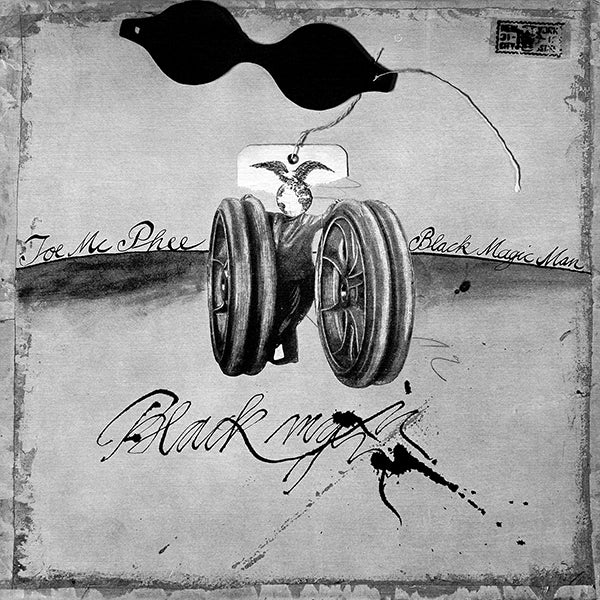
Joe McPhee - Black Magic Man (LP)
Born in Miami, Florida, in 1939, Joe McPhee began playing trumpet when he was eight, playing in various bands over the years, before making his professional debut as a member of Clifford Thornton’s band during the late 1960s. It was roughly during this period, rooted in his love for the music of John Coltrane, Albert Ayler, and Ornette Coleman, that he taught himself saxophone, laying the groundwork for the diverse palette of multi-instrumentalism that has helped define his sound and career over the decades since.
Beginning with his legendary debut as a leader, 1969’s “Underground Railroad”, McPhee has continuously forged his own path through the territories of freely improvised and avant-garde music, constantly rethinking the terms of radical music. While unquestionably one of the great contemporary torchbearers of the African American tradition of free jazz, of any member of his generation McPhee has arguably proven to be among the most willing to venture far from the idiom’s perceived boundaries, collaborating prolifically and fiercely with an astoundingly diverse range of artists over the years; Pauline Oliveros, Deep Listening Band, Graham Lambkin, Konstrukt, John Snyder, Chris Corsano, Mats Gustafsson, Susan Alcorn, Ken Vandermark, Arto Lindsay, Paal Nilssen-Love, Decoy, The Thing, John Butcher, Eli Keszler, Steve Lacy, Thurston Moore, Bill Nace, Peter Brötzmann, Michael Zerang, and so many others.
Following “Underground Railroad” McPhee released a further suite of celebrated LPs for CjRecord Productions, 1971’s towering “Nation Time”, 1972's "Trinity" and 1974's “Pieces Of Light”. While unquestionably worthy of the enduring devotion they’ve received, the legendary status of McPhee’s earliest releases has often overshadowed what came next: nearly a decade of work issued in close partnership with the then newly formed Swiss imprint Hat Hut Records.
Hat Hut, founded by Werner Xavier Uehlinger in 1975, having gone on to issue some of the most important avant-garde recordings of the last 50 years by artists like Anthony Braxton, Steve Lacy, Max Roach, Horace Tapscott, Cecil Taylor, Archie Shepp, Jimmy Lyons, Sun Ra, and numerous others, represents one of the most highly regarded catalogs in avant-garde music. Nearly every release is gold. But, the label began with Joe McPhee. As John Corbett describes in the liner notes of Superior Viaduct’s first ever vinyl reissue of “Black Magic Man”: “Uehlinger, a Swiss businessman who worked for Sandoz Pharmaceuticals… on a trip to the US, over dinner with McPhee, discussed putting out some of the unused tracks from the Nation Time sessions. With this casual encounter in 1975, Hat Hut Records was inaugurated. The new label's maiden release was Black Magic Man, dubbed Hat Hut A, the first in what would become Hat Hut's letter series."
Recorded in the same sessions that produced 1971’s “Nation Time”, “Black Magic Man” stands among the most noteworthy and creatively furious releases in McPhee’s catalog. Its three tracks - “Black Magic Man”, “Song For Laureen”, and “Hymn Of The Dragon King” - feature McPhee on sax, Mike Kull on piano, Bruce Thompson and Ernest Bostic on percussion, and Tyrone Crabb on bass, and yet, despite the fairly constrained scale of the band, manage to produce a towering sound. Beginning with the hard blown fire of the album’s title track, the first side takes an unexpected turn with the soulful, spiritual jazz ballad, “Song For Laureen” that pushed the ground first explored by the likes of John, Alice, and Pharoah into a thrilling new territory that is as considered and emotive as it is raw and direct. The second side of “Black Magic Man” features the equally astounding, single long-form improvisation “Hymn Of The Dragon King”, which begins with delicate timbral and textural work by the band, rises with a howling, furious energy that embodies all of the rage and political ferment of the African American consciousness of its day, in what is unquestionably one of the most striking free jazz moments ever laid to tape.
An absolute storming piece of work that feels as relevant and groundbreaking today as it did half a century ago, Superior Viaduct’s beautiful, first ever vinyl reissue of Joe McPhee’s “Black Magic Man” at long last returns one of the greatest artefacts of 1970s free jazz - not to mention one of the most striking records in the multi-instrumentalist’s back catalog - to the world and to a brand new generation of listeners.
Joe McPhee's relationship with Hat Hut was a windfall for the artist, garnering him an international profile from his relative isolation in Poughkeepsie, New York. Following the release of “Black Magic Man”, McPhee embarked upon a European tour in October 1975 with John Snyder playing an ARP 2600 synthesizer. The pair, despite the unexpected combination of instrumentation and creative touchstones, were well suited for each other - hinting at McPhee’s persistent seeking out similar, challenging collaborations over the ensuing decades - and tightly honed. Not only had they recorded “Pieces Of Light” the year prior for CjR, the two musicians had developed an extensive repertoire, playing diverse spaces in the Hudson Valley following its release.
During the duo’s 1975 European tour, as John Corbett recounts in the liner notes of Superior Viaduct’s first ever vinyl reissue of “The Willisau Concert”, issued by Hat Hut the following year: "McPhee and Snyder were invited to play at the Willisau Jazz Festival in Switzerland. If you compare this live record with Pieces Of Light, a studio effort, it's considerably more open. South African drummer Makaya Ntshoko is rolling thunder on the choral 'Voices,' shuffling under Snyder's bubbly beat on 'Bahamian Folksong.' It is quite a special combination, enough so that Hat Hut chose to release it as their next LP, Hat Hut B in their alphabetical series. The Willisau Concert represents the sound of Joe McPhee opening up, opening out, expanding his field of operations to include new figures, fresh experiences, new continents of sound."
Unsurprisingly, “The Willisau Concert” has remained one of McPhee’s favourites in his own catalog, not only because his playing is in top form - ranging from deeply soulful Afrocentric lines, to textural and temporal groundwork, played against the bubbling percolations of Snyder’s synth and Ntshoko’s brilliant drumming - but in all probability because it sounds entirely out of time, and certainly like nothing of its era, beyond perhaps Jon Appleton and Don Cherry’s “Human Music” (1970). Even here “The Willisau Concert” takes it to another level, imagining an entirely singular music that bridges technology and deeply human playing in the realm of real-time creativity that wouldn’t be widely approached within experimental music until decades to come.
Truly astounding and an absolute revelation on numerous levels, “The Willisau Concert” is an absolutely engrossing effort and one of those records that tells you everything you need to know about Joe McPhee and why he’s remained a vital force in the landscape of radical music for more than half a century.
Joe McPhee - Tenor (LP)
One of the significant developments during the American movement of 1970s free jazz was the solo LP. Leaving the player raw and exposed with nothing to hide behind or respond to other than their own minds and experiences unfolding, only the best of the best dared to take it on. Joe McPhee’s 1977 LP for Hat Hut, “Tenor”, encounters the multi-instrumentalist wading into the form on saxophone and further solidifying his remarkable and vital voice within the scene. John Corbett describes how it all came to be in his liner notes for Superior Viaduct’s first ever vinyl reissue of the album: "Tenor is McPhee's first solo record. He did not set out to make it. It was an afterthought, quite literally, born of a gathering of friends at the Swiss farmhouse of cellist Michael Overhage. A beautiful meal, some drinks, warm conversation, and ... why not, an impromptu recital.”
Comprising three stunning solos on the first side - “Knox”, “Good-Bye Tom B”, and “Sweet Dragon” - and the brilliant, side-long piece - “Tenor” - on the second, “Tenor” feels like a window into McPhee’s soul, unfolding in real time. While his playing is often raw and pushing the limits of his horn, for the most part the album is a deeply emotive and soulful affair, exposing the Blues roots lingering at the core of his work. Tracing through ideas and emotions as he goes, it’s hard to believe that this session was completely spontaneous and unplanned, with McPhee letting himself roll.
Absolutely beautiful and unquestionably one of the greatest LPs to appear in the free improvisation as solo form, “Tenor” is a master class on timbre and tone.
Originally published by Soundohm.