“once again Toop weaves a fascinating tale, rich with instance and ideas, and navigated with a razor-sharp sensitivity and intellect like only he has”
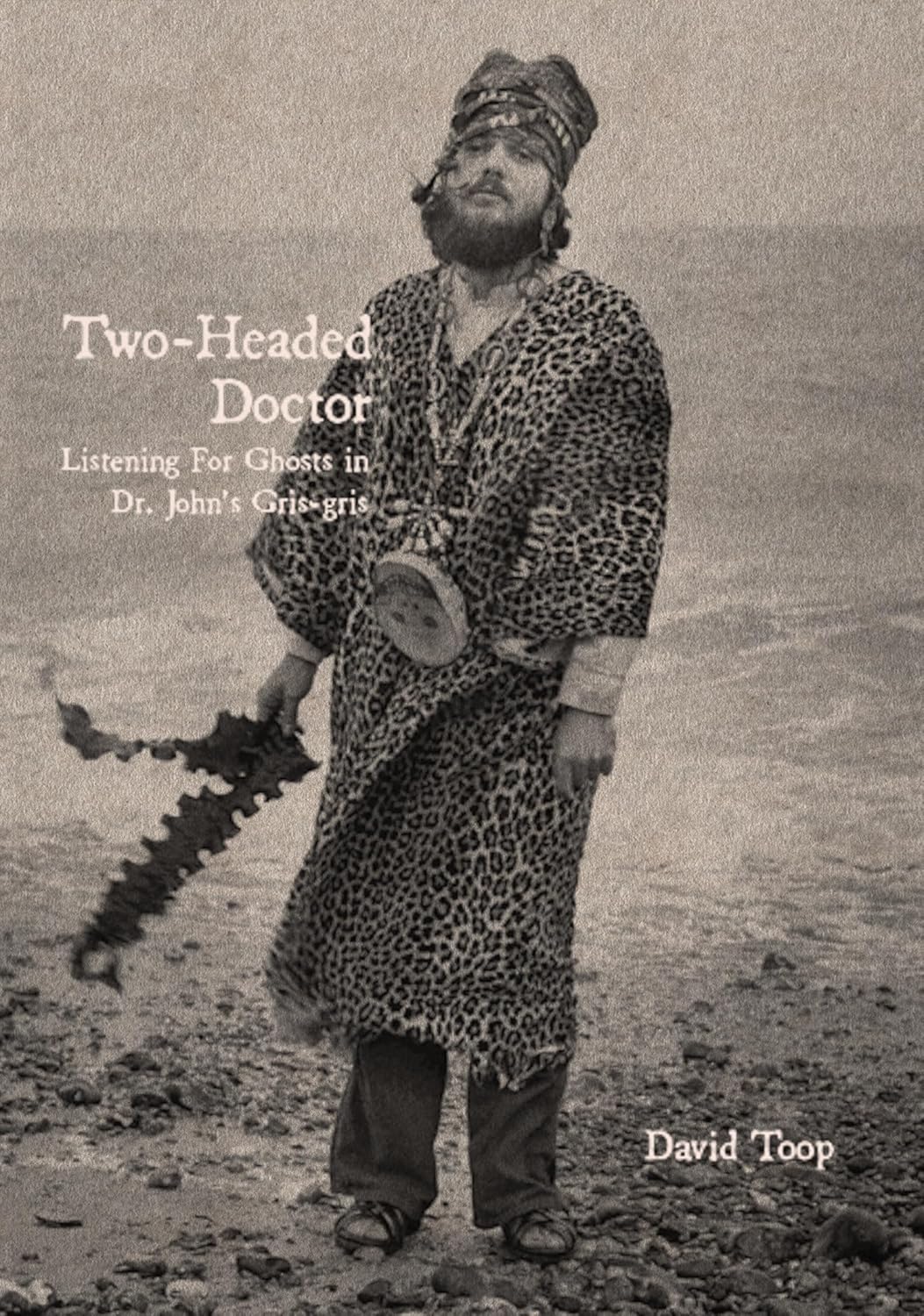
From MIT Press comes what is arguably David Toop’s most unexpected and engrossing book to date: “Two-Headed Doctor Listening For Ghosts in Dr. John's Gris-Gris". Delving into Dr. John’s astounding 1968 genre bending opus, “Gris-Gris” - a record steeped in mystery and a vast range of cultural implication - once again Toop weaves a fascinating tale, rich with instance and ideas, and navigated with a razor-sharp sensitivity and intellect like only he has.
If there is one thing we love, it’s strange and unexpected collisions of ideas and sounds. Over his long career, few have proven better at providing this than English musician and author David Toop. Among the most enduring and radical experimental artists working in sound on the London scene, since the publication of the iconic “New/Rediscovered Musical Instruments”, in 1974, which he coauthored and edited with Max Eastley, Toop has continuously traversed a vast range of subjects - from popular music to radical ends of the avant-garde - with a deft intellect, ear, and pen, publishing widely as a journalist and author. His latest, “Two-Headed Doctor Listening For Ghosts in Dr. John's Gris-Gris”, published by MIT Press, stands among the most engaging, focused, and surprising to date.
David Toop first emerged onto the British experimental and improvised music scene during the early 1970s as a member of a loose community of artists that also included Hugh Davies, Max Eastley, Paul Burwell, and a number of others, who took a radical new approach to the nature of instrumentation and sound sources. Perhaps most easily gleaned through the volume, “New/Rediscovered Musical Instruments”, published by Toop’s own Quartz/Mirliton imprint in 1974, which highlighted the ideas and approaches of Davies, Burwell, Eastley, Evan Parker, Paul Lytton, and Toop, the artist and writer, alongside of his concepts and sounds, was propelled into the public eye during this same period, due to the release of a split LP with Eastley that bore the same name, issued among the suite of albums to appear on Brian Eno’s legendary Obscure Records.
Over the years since, Toop has lived something of a double life, working as an artist and musician, notably as a member of Alterations, with Peter Cusack, Terry Day, and Steve Beresford, between 1977 and 1986, in collaborations with Rie Nakajima, Thurston Moore, Ryuichi Sakamoto, Akio Suzuki, Elaine Mitchener, and numerous others, as well as a solo voyager, and as a writer, theorist, and researcher, publishing a near countless number of articles in various magazines and more than ten books on a vast range of subjects relating to sound.
“Two-Headed Doctor Listening For Ghosts in Dr. John's “Gris-Gris” is a forensic investigation into a single LP: Dr. John’s now legendary 1968 gesture of Creole hybrid musicality “Gris-Gris”. While largely overlooked and undersold at the time, this marvel, which fused psychedelia with funk, soul, folk, jazz, and the blues, has come to tower in the cultural understanding of its era, forming the launching pad for its creator’s astounding career, cultivating a “ghostly presence of its so-called voodoo atmosphere hovers over numerous cover versions, samples, and re-invocations.” In many ways, while not falling within any of the aesthetic signifiers associated with the word, “Gris-Gris” is very much an experimental - visionary and looking far beyond the expectations of music itself, making it easily understood why a figure like Toop would be drawn toward it.
“Gris-Gris” is a record shrouded in mystery, misunderstandings, and false conclusions: a puzzle, experimental rhythm & blues disguised as rock, an elaborate hoax, recorded with many of New Orleans' finest musicians, including Shirley Goodman, John Boudreaux, Plas Johnson, Jessie Hill, Ernest McLean, and Tami Lynn, and an implicated cast of characters that includes Ornette Coleman, Lafcadio Hearn, Zora Neale Hurston, Cher, Sonny Bono, Sam Cooke, Ishmael Reed, Black Herman, Prince La La, and many others. From this loose foothold, Toop weaves a fascinating tale analysis, detailing, in a discursive style, the historical context of the music, how it came together, its literary sources, production and arrangements, and the nature of the recording studio as dream state, as well as examining a disturbing undercurrent the volatile issue of race in twentieth-century music, and the way in which it doomed relationships and ambitious projects, exploited great talents, and distorted the cultural landscape.
Once again, Toop delivers an engrossing read about an unexpected but truly necessary subject, “Two-Headed Doctor Listening For Ghosts in Dr. John's “Gris-Gris” is the perfect book to sink into to carry warmth forward as the summer months fade away.
Originally published by Soundohm.