
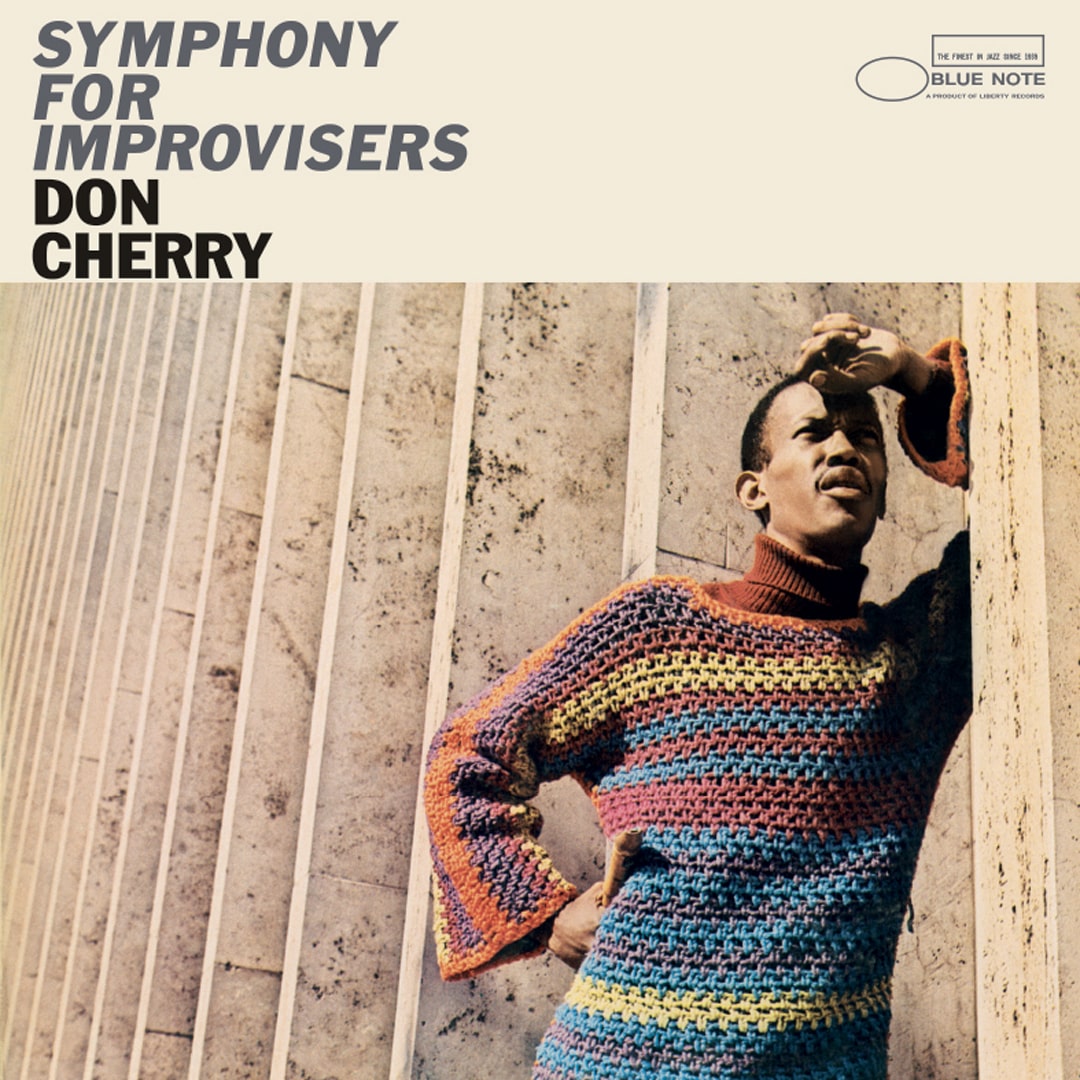
“Symphony For Improvisers” might be better described as a free-wheeling, joyous collage of numerous forms of jazz, restructured and blown with a furious fire and pace”
With an amazing suite of releases by Pharoah Sanders, Albert Ayler, and Eddie Gale only recently behind them, Elemental Music returns to their noble initiative to make important works from the Blue Note catalog available to a new generation of fans, with the first authorised vinyl reissue to appear in decades of Don Cherry’s seminal 1967 LP “Symphony For Improvisers”. Featuring one of the most noteworthy all-star bands ever assembled - Cherry, Pharoah Sanders, Edward Blackwell, Karl Berger, 'Gato' Barbieri, Henry Grimes, and Jean-François Jenny-Clark - many regard it as one of the most important gestures in both Cherry’s astounding body of recorded output, as well as within the canon of free jazz at large, making this nothing short of a historic event. Sophisticated, subtle, and hard blown, it’s a truly monumental and engrossing piece of work.
Within the canon of 20th Century jazz, few labels can claim to match the devotion and respect that Blue Note has been offered by fans and musicians alike. Founded by Alfred Lion and Max Margulis - two Jewish emigrants who had fled persecution in their native Germany and arrived in New York with a deep passion for African American music - over the course of the next 40 or so years - offering complete creative freedom to its artists - the label would produce more musical masterpieces than any other independent label on the planet by artists like John Coltrane, Miles Davis, Horace Silver, Jimmy Smith, Freddie Hubbard, Lee Morgan, Art Blakey, Grant Green, Hank Mobley, Herbie Hancock, Wayne Shorter, Bobby Hutcherson, Jackie McLean, and dozens of others. While Blue Note is arguably most closely associated with hard bop, particularly as the 1960s wore on, the label’s faith and trust in its artists often took it into the uncharted waters of emerging creative fields, including free jazz, fusion, and gestures infused with soul and funk. Among the most notable of these are three LPs - “Complete Communion” (1966), “Symphony For Improvisers” (1967), "Where Is Brooklyn?" (1969) - produced for the label by the legendary trumpeter, Don Cherry, hot on the heels of his groundbreaking work with Ornette Coleman. Not only are they among the most radical among the explicitly avant-garde releases in Blue Note’s catalog, but they effectively mark Cherry’s emergence as a band leader in his own right. Recorded by an all star septet of Cherry, Pharoah Sanders, Edward Blackwell, Karl Berger, 'Gato' Barbieri, Henry Grimes, and Jean-François Jenny-Clark, this absolute stunner has been regarded by many as "among the most important LPs Don Cherry made, if not among the most important in free jazz of the Sixties”, to quote the saxophonist and musicologist Ekkehard Jost.
Among the most significant figures to emerge from the context of jazz during the second half of the 20th century, Don Cherry was born into a musical family, and began his career early as a pianist, entering the world of jazz while still living in Los Angeles during his teens, joining Art Farmer’s band, before making the leap to trumpet under the mentorship of Clifford Brown. It was only a few short years later, at the tail end of the 1950s, that he made his first significant mark on the history of music, as a central member of Ornette Coleman's legendary quartet; the band that singlehandedly set the blue print for the emerging idiom of free jazz. Not only did Cherry contribute to an entire rethinking of what jazz could be, but, even more significantly, the entire potential of music itself. Laying down the trumpet parts across the near entirety of Coleman's seminal early output, during the same era he doubled down as a sideman, making equally astounding contributions to the canon of 1960s avant-garde jazz with Sunny Murray, Prince Lasha, Albert Ayler, among others, as well as a member of the New York Contemporary 5, before venturing out on his own as a leader in 1966 and beginning the body of recording that would leave a permanent mark on the world, and change nearly everything in its wake.
Cherry was a player of astounding touch and sensitivity - reportedly could play anything back, note for note, after hearing it once - who was far more interested in where music could go and what it could emote, than technique. His playing is raw, profoundly human, and direct, tapping something basic and human that strips all artifice as it dives toward the heart, drawing countless traditions from across the globe to create a music that stood beyond the locating forces of place, time, or aesthetics. The first significant glimpse of this towering talent, unleashed entirely under his own direction, grew from three recording sessions during late 1965 and 1966, that gave way to three LPs released by Blue Note - “Complete Communion” (1966), “Symphony For Improvisers” (1967), "Where Is Brooklyn?" (1969) - the reissue of the second and often most celebrated of which rests before us now.
From a distance, the band that entered the studio to record “Symphony For Improvisers” in September of 1966 reads like an all-star who’s who. In reality, this incredible group of artists was effectively a significant part of Cherry’s inner circle. He and Henry Grimes had recently worked together in Sonny Murray’s band, as well as both having worked with Albert Ayler. Pharoah Sanders and Cherry had been playing together for years; Edward Blackwell had belonged to Ornette Coleman’s groundbreaking band, alongside the trumpeter, and would remain Cherry’s faithful collaborator for most of his life; Cherry, Karl Berger, Jean-François Jenny-Clark, and ‘Gato' Barbieri had all been working together, in different configurations, for a handful of years, collectively offering insight into why “Symphony For Improvisers” has such a heavy, locked in sound for a single free jazz session. At the time of its recording, these players knew each other well.
While “Symphony For Improvisers” technically features eight original pieces penned by Cherry - “Symphony For Improvisers”, “Nu Creative Love”, “What's Not Serious” and “Infant Happiness” on the first side, and “Manhattan Cry”, “Lunatic”, “Sparkle Plenty”, and “Om Nu” on the second - each side of the LP flows from start to finish, with no breaks between tracks, giving a remarkable sense of flow and cohesiveness, despite the astounding range and breadth the band engages in their playing. In many ways far more connected to his work in Albert Ayler and Ornette Coleman’s bands, and as such more fiery and free than much of Cherry’s subsequent work as a leader, “Symphony For Improvisers” is still something entirely new, especially in its moment, drawing on the trumpeter’s various listening habits and love of diverse musics, that always seemed to find their way into and flirt within his work.
Described by Ollie Bivens, writing for All About Jazz, as “a lesson in controlled chaos”, “Symphony For Improvisers” might be better described as a free-wheeling, joyous collage of numerous forms of jazz, restructured and blown with a furious fire and pace. As each player pushes the limits, elements of swing, bebop, the dixieland dirge, post-bop, and the Blues bubble and percolate from below, distilling the sounds of creative history and the struggle of the people who lay at its roots, into a single, truly remarkable form, culminating as some of the most emotive and dynamically and thematically broad free jazz ever laid to tape. While everyone holds their own, it’s hard not to single out how absolutely amazing and fierce Pharoah Sanders’ playing is across both sides, especially when his sax locks in with Cherry’s shimmering trumpet lines.
No matter how much free music you’ve listened to, nearly 60 years on, “Symphony For Improvisers” - featuring one of the most noteworthy groupings of musicians ever assembled under one roof - remains a gripping and revelatory listen, not to mention a crucial, hugely significant work within Don Cherry’s absolutely astounding catalog of releases as a leader.
Originally published by Soundohm.