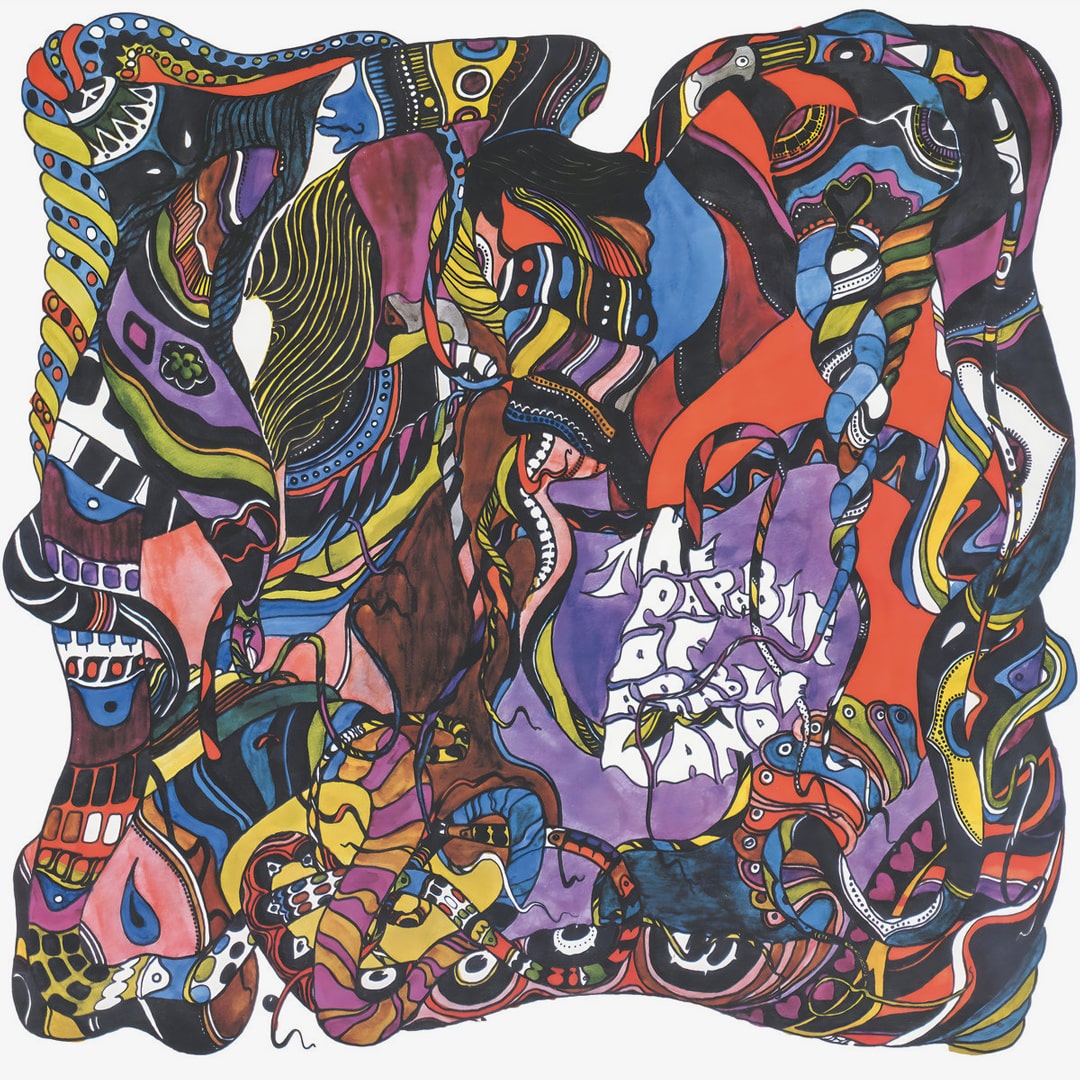
“After remaining out of print for years, Charley Records delivers a glorious vinyl reissue of Red Crayola’s legendary 1967 debut, “The Parable of Arable Land”.”
After remaining out of print for years, Charley Records delivers a glorious vinyl reissue of Red Crayola’s legendary 1967 debut, “The Parable of Arable Land”. One of the greatest expressions of experimental music to have ever existed in the popular realm, threading heavy psych with explosive, free form improvised jams by the band’s expanded, 50 person iteration - "the Familiar Ugly" - it might just be one of the most important, groundbreaking, and influential records ever laid to tape.
It hardly needs to be said that, on cultural, creative, and political terms, the 1960s set the world on its head. It was a rare moment when the countercultural underground went above ground, and where radical politics and creative experimentation infused themselves within popular music and rode the airwaves toward audiences of a scale not seen before or since. Among the radical and groundbreaking bands to emerge in the United States during the era was The Red Crayola, whose groundbreaking 1967 debut - “The Parable Of Arable Land” - originally issued by International Artists, by incorporating elements of noise, psychedelic free-form freak out, and free improvisation, entirely shifted the musical landscape and laid the groundwork for numerous forms of underground music that would emerge over the coming decades.
Hailing from Houston, The Red Crayola was founded in 1966 as the trio of singer/guitarist Mayo Thompson, drummer Frederick Barthelme, and bassist Steve Cunningham. Belonging to the then emerging Texas psychedelic scene, alongside 13th Floor Elevators, with whom they were friends and label mates, in its early years the band went through a handful of changes, and radically expanded its participation and membership to incorporate a secondary group of evolving membership of around 50 people, "the Familiar Ugly", which performed with the band on or near the stage, using experimental techniques and instruments. It is this remarkable, expanded line-up and expansive sense of musical strategy that defines the landmark sound of their 1967 debut on International Artists, “The Parable Of Arable Land”.
Particularly when regarded from the vantage point of today’s tame and overly corporatised landscape of popular music, it’s hard to imagine a major label signing a group like The Red Crayola, let alone releasing an album like “The Parable Of Arable Land”, it getting airplay, and selling roughly 50,000 copies when it was first released: all quiet and uncomfortable proofs that the march of time does not always give way to more progressive things.
Regarded as a precursor to avant-garde/noise & industrial rock, “The Parable Of Arable Land” is effectively a continuous, flowing work comprising six gritty, overdriven, and often pummelling tracks of psychedelic rock, broken by seven improvisations dubbed ‘Free Form Freak-Out’: wild jams with pounding drums, distorted guitars, and whistling sounds, electronic and tape process, embarked upon by the roughly 50 members of “The Familiar Ugly”, that included 13th Floor Elevators frontman Roky Erickson on harmonica and organ. Wildly avant-garde and experimental, pushing the outer boundaries of the perceptions of rock & roll, it’s a truly glorious immersion into real-time creativity and radical thinking that not only accelerated and inspired music of its moment and what was to come, but also laid the remarkable groundwork for the band’s future trajectories, first with its equally as legendary follow up, 1968’s “God Bless The Red Krayola And All Who Sail With It”, but also, following its relaunch during the late 1970s, groundbreaking work with Art & Language, and efforts through the 90s and 2000s with collaborators like Albert Oehlen, David Grubbs, Jim O'Rourke, John McEntire, Stephen Prina, and numerous others.
Resting alongside roughly contemporaneous albums by The Fugs, The Velvet Underground, Faust, Third Ear Band, and Brigitte Fontaine, as well as artefacts like Don Robertson’s “Dawn” and Malachi’s “Holy Music” (on which Red Crayola’s Steve Cunningham also plays), “The Parable Of Arable Land” remains one of the great byproducts of avant-garde and experimental music’s brief meeting with popular music during the late 1960s and 70s.
Originally published by Soundohm.