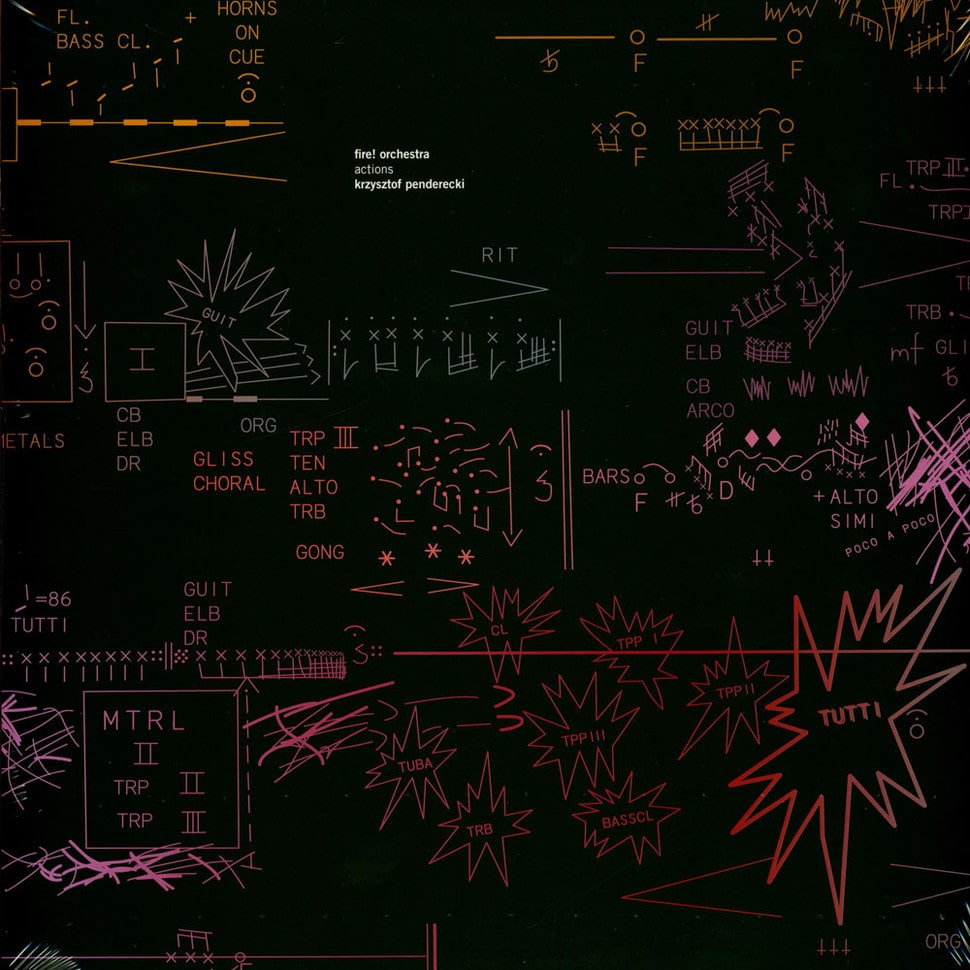
“In the simplest sense, “Actions” is the meeting of masters.”
Capturing an astounding conjunction of American and European free jazz giants with one of the great figures of the post-war European classical avant-garde, live in Germany in 1971, Intuition Records’ Master Series delivers a fully remastered, much needed vinyl reissue of “Actions”, the legendary LP by Don Cherry and the Polish composer, Krzysztof Penderecki, working with The New Eternal Rhythm Orchestra, featuring Peter Brötzmann, Gunter Hampel, Willem Breuker, Moki Cherry, Gerd Dudek, Kenny Wheeler, Albert Mangelsdorff, Paul Rutherford, Fred Van Hove, Han Bennink, and numerous others. A truly visionary recording, resonant with both Cherry and Penderecki’s groundbreaking work from this period, not only is it creatively stunning and an engrossing listen, but few historical documents set the long-standing narratives attending to avant-garde music quite like this!
Despite being intuitively contradictory to the utopian ideals that rest at the roots of its many movements, the historical narratives attending to avant-garde music have a tendency to segregate and distinguish in ways that aren’t always true to fact. This is most notable in long-standing perceptions regarding the historical relationship between 20th Century avant-garde chamber and orchestral music and the movement of free jazz instigated by African Americans during the late 1950s, 1960s, and 70s. Rather than conversant, with artists from both movements drawing inspiration from the other, as was so often the case, they have been largely cast, retrospectively, as distinct and relatively unrelated. This, perhaps more than any other reason, is why albums like “Actions”, recorded live at the Donaueschingen Festival in Donaueschingen, Germany, during the Autumn of 1971 by the seminal trumpet player, improviser, and composer, Don Cherry, and the legendary Polish composer, Krzysztof Penderecki, working within The New Eternal Rhythm Orchestra - such a crucial artefact. Truly monumental and singular on creative terms, it equally reveals crucial connections and conversations between two worlds that were never as distinct from each other as the authors of history might lead us to believe. Filled with astounding energy, virtuosic playing, and a vast range of human emotion, across the entire spectrum - from the joyous and spiritually ecstatic to bonding existentialism - it is nothing short of an astounding piece of work.
In the simplest sense, “Actions” is the meeting of masters. Don Cherry was among the most significant figures to emerge from the context of jazz during the second half of the 20th century, making his first mark upon history at the tail end of the 1950s as a member of Ornette Coleman's legendary quartet; the band that singlehandedly set the blue print for the emerging idiom of free jazz. Not only did Cherry contribute to an entire rethinking of what jazz could be, but, even more significantly, the entire potential of music itself. Laying down the trumpet parts across the near entirety of Coleman's seminal early output, during the same era he doubled down as a sideman, making equally astounding contributions to the canon of 1960s avant-garde jazz with Sunny Murray, Prince Lasha, Albert Ayler, among others, as well as a member of the New York Contemporary 5, before venturing out on his own as a leader in 1966 and beginning the body of recording that would leave a permanent mark on the world, and change nearly everything in its wake, sculpting a world of sound that drew democratically on numerous traditions from across the globe, resting at the juncture of free and spiritual jazz.
Krzysztof Penderecki, born in 1933 and only three years Cherry’s senior, couldn’t have belonged to a more different world to his primary collaborator on “Actions”. Largely educated at the Academy of Music in Kraków as a student of violin and composition, following the conclusion of his studies in 1958 Penderecki emerged into a fairly singular creative context. On one hand, he composed behind the Iron Curtain, on the other, he found himself in a newly liberated creative context, following the overthrow of Stalinism in Poland in 1956, that lifted strict cultural censorship and allowed for a radical embracing of the avant-garde in that country, despite remaining under communism. The composer’s earliest works displayed a strong influence of Anton Webern and Pierre Boulez, but by 1960, with the premiere of “Threnody to the Victims of Hiroshima” written for 52 string instruments that utilize extended techniques and tone clusters - bringing him immediately to International acclaim not yet out of his 20s - Penderecki distinguished himself as a unique voice in the European avant-garde. Over the coming years, he would embrace an even greater sense of orchestral density as well as the use of non-instrumental sound sources and magnetic tape, going as far as provoking a riot among listeners in Warsaw in 1962.
Fascinatingly, despite the context within which he worked, and generally standing somewhat aside from most of his peers in the world of avant-garde chamber and orchestral music beyond the iron curtain, Penderecki received a great many accolades within Poland for his radical and often deeply emotive music that often embraced the controversial use of spiritual themes, before becoming disillusioned with the avant-garde during the mid 1970s, feeling that it had become destructive toward the utopian ideals on which it had been founded. In the spirit of the utopianism that Penderecki so valued, it’s hard to think of a better example than his collaboration with Don Cherry and The New Eternal Rhythm Orchestra at the Donaueschingen Festival in Donaueschingen, Germany, during the Autumn of 1971, originally released later that same year under the title “Actions” by Philips.
“Actions” comprised three pieces: "Humus - The Life Exploring Force”, penned by Don Cherry; “Sita Rama Encores" a traditional, arranged by Don Cherry, and Krzysztof Penderecki’s "Actions for Free Jazz Orchestra”, which he penned after hearing a performance by the Globe Unity Orchestra, the free jazz ensemble founded in 1966 by Alexander von Schlippenbach, that included many of the same members as The New Eternal Rhythm Orchestra - Peter Brötzmann, Gunter Hampel, Willem Breuker, Gerd Dudek, Kenny Wheeler, Albert Mangelsdorff, Tomasz Stańko, Paul Rutherford, Fred Van Hove, Han Bennink - the band that would be assembled for this concert.
The first piece, "Humus - The Life Exploring Force”, falls firmly within the realms of musicality plumbed across albums like “Eternal Rhythm” and “Relativity Suite”, created during roughly the same moment. Pushing further into furious free jazz explosions than subsequent works, while equally foreshadowing them with a sense of joyous song-craft and chanting vocals, as well as integrating aspects of Balinese, African, and Indian traditions, "Humus” stands slightly apart from Cherry’s other compositions via its playful integration of German folk sensibilities, almost flirting with klezmer in moments. The sum total is quintessential Cherry at the outset of the 1970s, filled with fire at his best, soaring high with an absolutely stellar band. Launching the second side of the LP is “Sita Rama Encores”, a piece the spirit of which will be familiar to fans of Cherry’s live recordings, encountering him interacting with the audience, singing and teaching them a sixteen-beat Hindustani teental pattern, before the band explodes in a brief, furious storm of rhythm and tone.
The remainder of the second side is dedicated to the performance of Krzysztof Penderecki’s "Actions for Free Jazz Orchestra”, in what seems to be its first and only performance. It also notably marked the composer’s debut as a conductor. Featuring some pretty exceptional, stripped back work by Terje Rypdal on guitar, Buschi Niebergall on bass, and Han Bennink on drums, Penderecki, despite having spent his creative life within an adjacent context, attempted to maintain the flavor of jazz, while also notating pitches and rhythms. The result is a brilliant and often explosive storm that feels very much in the free jazz tradition, but one that tends to focus more on discrete, restrained and small-scale interactions, heavily focused on texture, aligning more closely with European tradition over the American from which Cherry, featuring beautifully on trumpet, came. A truly thrilling listen of unquestionable historical importance, "Actions for Free Jazz Orchestra” equally illuminates the complex distinctions and difficulties in navigating between the realm of the composer and group improvisation. After the fact, a number of musicians commented that their usual freedom to improvise was constrained to an uncomfortable degree, while Penderecki stated that if he had granted more freedom to the players, it would not have been his piece. Any way you cut it, the outcome was a success.
Originally published by Soundohm.