“Wonderful, immersive, and profoundly meditative, Antti Tolvi’s interpretation of Morton Feldman’s ‘Intermission 6’ is a recording within which to get lost and through which to be transformed.”
Having already had a pretty bang up year with stunning releases by Marc Sabat, Magnus Granberg, Timothy McCormack, Ferdinand Schwarz, John Cage, Evan Johnson, Kory Reeder, Apartment House, and others, the venerable Another Timbre returns with two of the best releases of 2025: 'Blanca', the debut solo full-length by the renowned German born, Brussels based violist, Julia Eckhardt - famed for her extensive work with Éliane Radigue, among others - and the multifaceted Finnish artist Antti Tolvi’s towering rendering of Morton Feldman’s ‘Intermission 6’, pushing one of the composer's earliest and most open scores to a remarkable 72 minutes. Each rich with incredible ideas and radical approaches to sound, as well as bending time, proximity, and contextual interplay in markedly different ways, in each instance we are faced with immersive sonorities by two of the most singular artists working today.
For more than a decade and a half, Another Timbre has carved out a singular place in the landscape of recorded sound, issuing a startling array of releases, bridging the fields of modern classical composition, free improvisation, and numerous forms of rigorous experimentalism. In the label’s early days, it offered particular focus to the English scene from which it sprang - the label’s inception having been inspired by a performance by John Butcher - issuing contemporary works by Butcher, Max Eastley, Phil Minton, Rhodri Davies, Angharad Davies, Evan Parker, Clive Bell, and numerous others. Before long, however, Another Timbre cast its ambitions further afield, spanning geography and time, assembling an incredibly significant body of recordings attending to musicians and composers from across the globe, ranging from the little known to the historically renowned. Their latest two releases are a perfect encapsulation of what the label is all about.
It shouldn’t be overlooked, that decades into her career, and as an artist possessing her stature, virtuosic ability, and standing within the landscapes of experimental and contemporary chamber music, ‘Blanca’ is the first solo album by the German born, Belgium based, violist, Julia Eckhardt. Regarded as highly for her extensive output as a writer - ‘The Second Sound’, ‘Grounds for Possible Music’, ‘Éliane Radigue: Intermediary Spaces’, etc. - as she is for her work as an instrumentalist, Eckhardt worked extensively, in collaborative capacities and arrangements with artists like Phill Niblock, Rhodri Davies, Robin Hayward, Michael Pisaro, Angharad Davies, Dominic Lash, and numerous others, across the 2000s and 2010s, before embarking upon the deeply intimate work with Eliane Radigue on numerous ‘Occam Ocean’ pieces, for which she has gained a great deal of affection and renown since the latter 2010s. She is also a curator, teacher, and lecturer in the field of the sonic arts, and a founding member and artistic director of Q-O2 workspace in Brussels.
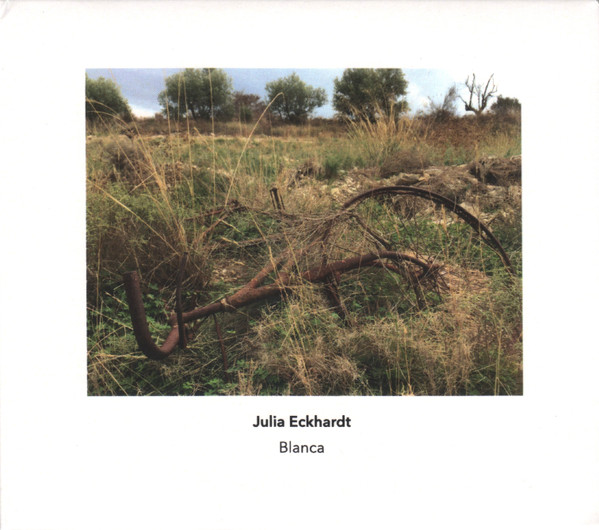
‘Blanca’ - a suite of eight, roughly five minute compositions - was conceived while Eckhardt was on a residency in rural Spain, in November of 2022. Offering insight into the album’s inception, she explains: “I spent a month as an artist in residency at Centro Negra in the small town of Blanca in the South-East of Spain. I undertook a daily protocol of walking without plan or destination which took me into the wide, majestic, and slightly intimidating hills outside the town. Each day, after a set amount of time I stopped to make a field recording and a detail photo, and upon my return to Centro Negra, recorded an improvisation on the viola echoing the energy of that accidental place. Recording, image and improvisation became three ways of creating imprints of memory. Improvising felt similar to walking into the unknown; adventurous and slightly fearful at the same time, with the wind in the wide and karstic landscape, unhampered by the sparse vegetation, being a constant presence. Eight of these improvisations became the compositions on this release in which the wind patterns of Blanca are a guiding presence."
While it’s hard to know if its being Eckhardt’s first solo outing is a byproduct of circumstance or design - neglect or a lack of forthcoming opportunity, versus a preference to work collaboratively, etc. - it is difficult not to, at least partially, regard ‘Blanca’ in relation to the encounters with her playing prior to its release: the exacting rigor and meticulous precision for which she has become known, particularly across Eliane Radigue’s ‘Occam Ocean’ pieces, as well as the recent release of ‘Asymptote Versatile’ - the composer’s earliest known work - led by Rhodri Davies. While no less rigorous or exacting, ‘Blanca’ opens new dimensions of access and understanding of Eckhardt’s practice, playing, temperament, and inner world. The album’s eight pieces, largely subtitled after phenomena encountered in nature, weave a startling sense of sonic location and texture between a palpable presence of the space within which they were recorded. Capturing the ambiences, resonances, and reverberance of the room, as well as a deep sense of intimacy with the instrument on which they are played, each of Eckhardt’s recordings embraces a sonic imagism of multiple vantage points, as though simultaneously listening from within her viola and from far off.
Taking the form of deeply personal and responsive, improvised sonic meditations, ‘Blanca’ unfolds as a manifestation of Minimalism within which timbre and tonality enter into complex relations, and where density enters states of tension with restraint. Balancing a delicate line with imagism, while never fully indulging it - embracing abstraction while retaining an ethereal relation to the phenomena and experiences that inspired each piece - it is the sense of openness and ease, filtered through Eckhardt’s sense of rigor, precision, and virtuosic ability that delivers the profound expressions encountered across the length of ‘Blanca’, activating the strongest sense of her remarkable artistry of any release that has borne her name to date.
Beautiful and captivating from the first sounding to the last, ‘Blanca’ is everything we might have hoped for from Julia Eckhardt’s debut full-length and more: a joyous listening experience propelled by artistry of the highest and rarest form. It’s left us longing for more and waiting on bated breath for what the violist delivers next.
Within the chamber and orchestral traditions of Western classical music, great names tend to dominate and take center stage, deferring to a defaulted belief that a musician or ensemble is the conforming vehicle to the gravity of a work and the personality of its creator. In truth, this is rarely the case. No matter how strict a score, or when it might have been composed, there is always an element of collaboration and interpretation, the result of which is shared. Notions of authorship and who bears the most influence over the rendering of a work becomes that much more complex within the music of the 20th Century avant-garde, which often encountered composers embracing varying degrees of openness, improvisation, and interpretation within their scores. To whom then does a work belong when it was written by a composer whose name carries a profound weight and gravity, but allows for such a thing, as is the case with Morton Feldman’s ‘Intermission 6’? While certainly not the first recording of this piece, nor even the first released by the label - both John Tilbury and Philip Thomas have already bent it to their wills within the catalog - Another Timbre’s latest release, Finnish artist Antti Tolvi’s monumental rendering of the work, pushes it into a maximalist state where the player’s interventions are so great and distinct that they must be regarded as equal in presence to the composer’s original ideas.
Surprising for where we encounter him now, Antti Tolvi’s name is not widely associated with chamber music. Born in ’77 in Panelia, on the west coast of Finland, Tolvi is a self-taught, multi-faceted musician who has played in numerous projects, including Lau Nau, Rauhan Orkesteri, and Lauhkeat Lampaat. Early in his career, he traveled to India to study Hindustani Classical music, which marked a turning point in his perception of music, first embracing free improvisation and free jazz, before embarking upon a practice of solo improvisation - deriving inspiration from, in Antti’s own words, “harmonies, overtones, going into sound, no ends, no starts, from nothing comes something, just perfect, peace”. Last we heard from him, back in 2022, he issued the startlingly beautiful, ‘Spectral Organ / Feedback Gong’ - rooted in investigations into real-time acoustic phenomena - on Room40, that left the artist rooted in our minds. Approaching a composer with the towering reputation of Morton Feldman, however, is not what we’ve come to expect from Tolvi, making it that much more of an exciting event.
Morton Feldman, of course, needs little introduction. Born in New York City in 1926 to Jewish, Russian immigrants, Feldman began studying piano at a young age and became a devotee of the avant-garde, thanks to encounters with the work of Arnold Schoenberg and Anton Webern, relatively early on. In 1950, he met John Cage and quickly joined the composer’s circle, including artists like Robert Rauschenberg and Philip Guston, and the composers Henry Cowell, Virgil Thomson, and George Antheil. Not long after, Feldman began composing the radical body of work for which he would become famed - characterized by floating rhythms, soft pitch shadings, and slow evolutions and developments centered around recurring asymmetric patterns - placing him at the centre of the experimental New York School of composers, alongside Cage, Christian Wolff, and Earle Brown. While not always the case during his lifetime, arguably of any of them, Feldman has endured and become appreciated and celebrated the most, prefiguring minimalism, with spacious, often profoundly durational pieces of music, that continue to gather and captivate fans and musicians alike.
‘Intermission 6’ is the final work in a suite of ‘Intermissions’ that date among the earliest works in Feldman’s catalog, created between 1950 and 1953. However, despite only flirting with some of the elements that would come to define Feldman’s output as a composer, it holds distinction as being one of his most open scores, comprising a single page with fifteen short passages (events) arranged across it that can be performed by one or two pianists. Offering very little instruction of how the work’s contents might be approached, the score states: “Composition begins with any sound and proceeds to any other. With a minimum of attack hold each sound until barely audible. Grace notes are not played too quickly.” There is no indication of order or sustain within (though some rests are notated) or duration of the piece itself and if or how many times the clusters of notes may be repeated on the score itself, though he indicated elsewhere that “The pianist, or pianists, begins with any sound on the page, will hold until barely audible, then proceed to whichever other sound he may choose. Sounds may be repeated.” Historically, performances of 'Intermission 6' have ranged between four and ten minutes making Antti Tolvi’s astounding extended version of the piece to 72 minutes - to a duration more typical of Feldman's later music - that much more striking and monumental.
While very different in the character of its outcome, both in loose visual resemblance of the score and its openness and approach, ‘Intermission 6’ represents a clear prefiguration of Terry Riley’s ‘In C’, embracing an elegant form of conceptual generation of musical event, allowing for freedom of navigation and result on the part of the player or players. Tolvi’s rendering also feels more imbued with space, air, and sustain than many by other players, similarly nodding toward the composer’s later efforts. Remarkably beautiful, with notes hanging in the air and time stretching to points where relationships between punctuations become abstracted and strained, the piece unfolds at a glacial pace of almost freestanding tonal events, often accentuated by Tolvi’s forceful sense of attack. In many ways, perhaps because of his diverse musical past and background - far different than most pianists who tackle Feldman - Tolvi’s rendering makes a forceful advocation for the lasting importance of the openness and versatility of modernist works, allowing for endless interpretation and continued relevance in our lives.
Wonderful, immersive, and profoundly meditative, Antti Tolvi’s interpretation of Morton Feldman’s ‘Intermission 6’ is a recording within which to get lost and through which to be transformed. Every return reveals something new.
Originally published by Soundohm.