“there’s little question why Gábor Szabó’s ‘Jazz Raga’ continues to be chased and loved by successive generations of fans”
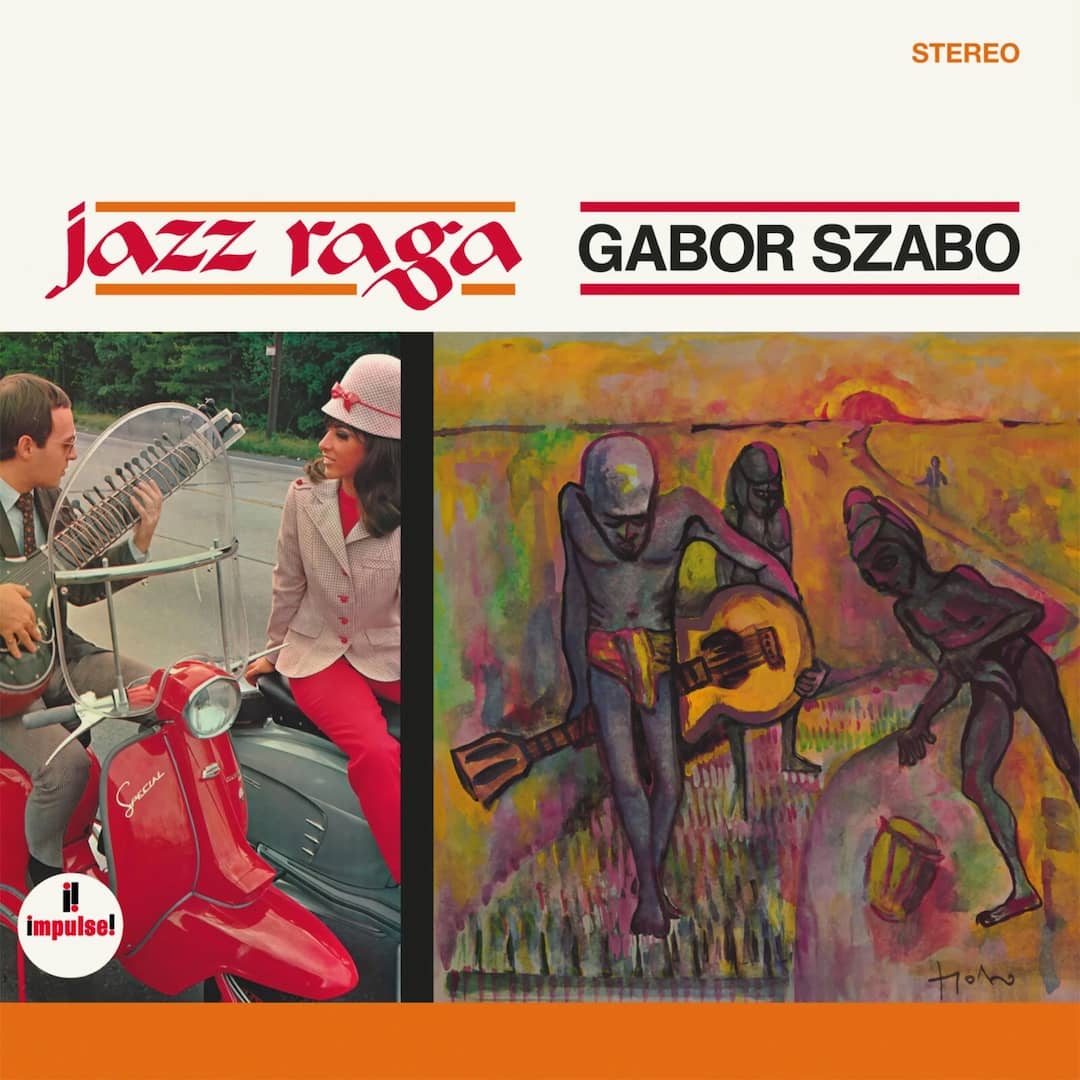
After remaining out of print for years, Vampisoul delivers a much needed vinyl reissue of one of the greatest documents of modal, Eastern inspired jazz: Gábor Szabó’s iconic, 1967 LP, ‘Jazz Raga’. A landmark of heavy grooves and mind-altering meditation - interweaving touchstones drawn from numerous folk idioms, psychedelic rock, jazz, and Indian Classical music - more than half a century after it was laid to tape by Rudy Van Gelder, it remains a visionary statement that rings through time.
Within the arts, the 1960s were a time of exploration and growth, often witnessing artists exploring and incorporating aspects of cultures far beyond the borders of their own. This was certainly the case within jazz, a music that sprang from African American communities, became a universal language for countless musicians across the globe, and entered into constant states of evolution and hybridity as it went. Among the most important cultural touchstones of this period was, unquestionably, the music of India, particularly its classical tradition of the raga, first introduced to broad listenership in Europe and the United States during the 1950s by Ravi Shankar and Ali Akbar Khan. Unsurprisingly, John Coltrane got there first, recording ‘India’, which features drones and scales that nod toward Indian ragas, in 1961. Equally noteworthy, guitarists seemed particularly drawn to the Raga form. Following the Beatles’ famous use of the sitar on "Norwegian Wood" in 1965, the instrument was everywhere, populating the popular imagination, while guitarists like Peter Walker, Sandy Bull, John Fahey, Max Ochs, and Robbie Basho endeavored to make the Raga their own. Perhaps the most iconic meeting of all these worlds - jazz, the guitar, the Indian Raga, and the popular imagination - is the Hungarian-American guitarist Gábor Szabó’s iconic, 1967 LP, ‘Jazz Raga’, originally issued by Impulse. Nothing short of a landmark that laid the groundwork for countless artists that followed in its wake - threading Szabó’s virtuosic playing into touchstones drawn from numerous folk idioms, psychedelic rock, jazz, and Indian Classical music - it’s a towering statement that, despite going fairly unnoticed at the time of its release, has become one of the most sought after and beloved releases of its kind. Entirely defying any easy definition within the terms of genre, spinning intoxicating sounds that are as creatively rigorous and challenging as they are spell binding - it’s a slab of pure musical joy, transporting the heart and mind to other dimensions every step of the way.
If ever there was a great example of the cross cultural and transnational potential activated by the idiom of jazz, it has to be the Hungarian-American guitarist Gábor Szabó. Born in Budapest in 1936, Szabó began playing the guitar at the age of 14, eventually falling in love with jazz when encountering it on European broadcasts of Voice of America. Following the occupation of Hungary by the Soviet Union in 1956, the guitarist fled, becoming a refugee in Austria before making his way to California. Following great difficulties finding work in music as a recent immigrant in the United States, he worked as a janitor until he had saved enough money to attend the Berklee School of Music in Boston. From there, the sky was the limit. By 1961 he was a member, alongside Charles Lloyd, of Chico Hamilton's quintet, before eventually joining Gary McFarland’s band, and then forming a quartet with the all-star line up of himself, Lloyd, Ron Carter, and Tony Williams.
It’s likely that his years recording with Chico Hamilton for Impulse led to Szabó’s own signing to the label in 1966, leading to an astounding run of full-lengths as a leader for the label, including Spellbinder, Gypsy '66, The Sorcerer, and More Sorcery, before departing to found his own label, Skye Records, with Cal Tjader and Gary McFarland, in 1968. Of all of the incredible creative statements made by Szabó during his two short years with Impulse, 1967’s ‘Jazz Raga’ stands among the most celebrated and beloved. It may even beat out 1968’s ‘Dreams’ as the defining statement of his entire career.
Perhaps more than any member of his generation, Szabó had his ear to the ground and drew equally from across numerous sonic spectrums, especially popular music and rock. This was so much the case that the music he produced as a leader feels almost entirely outside of the basic perimeter of genre. Yes, ‘Jazz Raga’ is roughly what the title indicates - jazz that draws influences from Indian music - but somehow it’s also a great deal more and doesn’t easily sit within its own definitions. Among the most striking nods to popular music is the fact that the album comprises eleven tracks across its two sides, and thus features pop song length pieces, rather than the longer forms particularly common during this period within jazz. This becomes that much more noteworthy when noting the second side features a cover of The Rolling Stones’ ‘Paint it Black’, alongside Duke Ellington’s ‘Caravan’, and the George Gershwin penned standard, ‘Summertime’, all nestled amongst an astounding stream of originals.
Recorded over two days in August 1966 at Rudy Van Gelder’s legendary studio in Englewood Cliffs, New Jersey, in sessions produced by Bob Thiele, ‘Jazz Raga’ encounters Szabó splitting the difference between a nylon strung acoustic and sitar, backed by the bassist, Johnny Gregg and the drummer Bernard “Pretty” Purdie, with occasional second guitar interventions by Bob Bushnell. Setting the tone with the album’s opener, ‘Walking on Nails’, the band unfurls with mid-tempo modal grooves and phasing, offset by Szabó’s half-spoke half chanting poetic vocals, before launching into the latin infused rhythms of ‘Mizrab’, which plays the sitar against the rise and fall of brilliant electric guitar lines, steadily rising in pace toward an outright jam. Equally striking is ‘Search For Nirvana’, a stoner infused dirge that inspires heavy sways in the body and mind. From here the band dives deep into the pulse of 60’s jazz, playfully nodding to popular zeitgeist within the complexity and virtuosity of their lines, before taking a deep dive into a sitar infused reimagining of The Rolling Stones’ ‘Paint it Black’, setting it off kilter with a striking sense of pulse and unexpected tonal combinations, before picking up the pace to ten with the driving, Szabó penned ‘Sophisticated Wheels’. As the second side continues its journey, darting across a vast palette of touchstones and references, perhaps the most surprising is the utterly captivating and hypnotic rendition of Duke Ellington’s ‘Caravan’, entirely transforming the work into a groove heavy meditation, infused with a heavy dose of psychedelia, that remains entirely mind-blowing, roughly sixty years after it was first laid to tape.
Ebbing and flowing across its towering two sides - wide open while tightly locked in - heard all these years on, there’s little question why Gábor Szabó’s ‘Jazz Raga’ continues to be chased and loved by successive generations of fans. No matter how many years pass, it remains a captivating landmark, feeling so fresh, while providing such a joy in listening, it’s hard not to flip straight back to the first side, the moment the second ends. While often overshadowed by so many astounding records by John and Alice Coltrane, Pharoah Sanders, and numerous others within the Impulse catalog, this is certainly one of the greatest records that the label ever produced, illuminating its vision and creative bravery across its two sides.
Originally published by Soundohm.