“Quite simply, it’s one of the greatest albums of its kind ever laid to tape: an absolute marvel by one of the great, enduring geniuses of the form.”
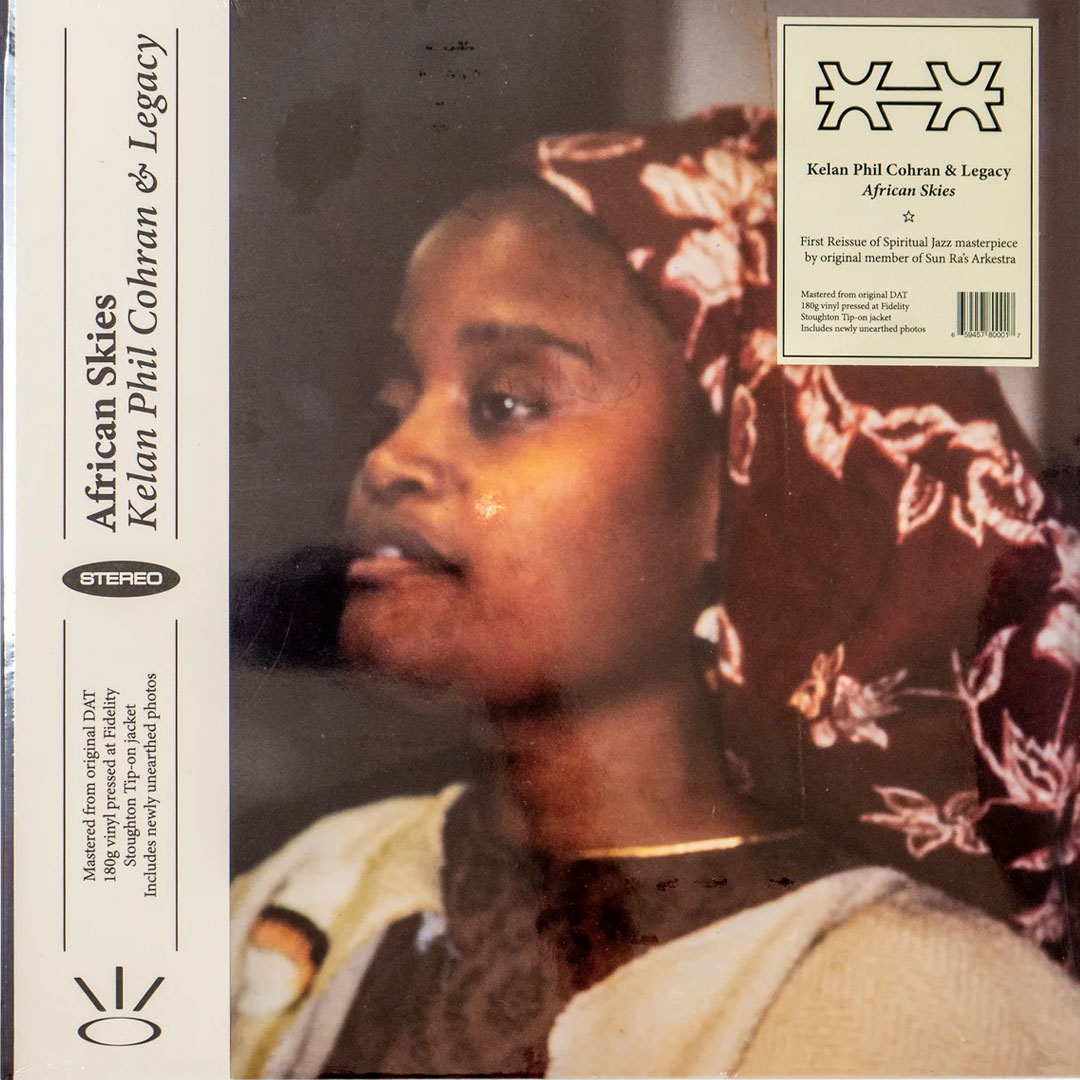
Launching with some seriously unprecedented fire, Listening Position - a brand new imprint in the Stone’s Throw family - delivers what might just be the most hotly anticipated reissue of the last decade or more: an astoundingly produced new edition of Philip Cohran & Legacy’s ‘African Skies’. Among the most strikingly singular records in the history of spiritual jazz, drawing unprecedented range from its unique instrumentation and approach to rhythm, harmonics, and structure, recorded in Chicago in 1993, before its first release in 2010, this absolute masterpiece has sent collectors scrambling for the last decade and a half for good reason. Now fully remastered and restored from the original tapes and back in the world, behold the intoxicating sounds produced by one of jazz’s greatest unsung talents and his truly remarkable band.
Within the history of avant-garde jazz from the second half of the 20th Century, there are legends and the lost, and there are legends who become lost before celebrated again. Among the latter, few figures are more iconic than Kelan Phil Cohran, a figure who traced his way through some of the most significant happenings within the Chicago scene as one of the earliest members of Sun Ra’s Arkestra and as a principal founder of Association for the Advancement of Creative Musicians (AACM), before his principled beliefs in music and politics embedded him deep within his community on the South Side of the city and out of the historical and cultural awareness beyond its borders. For decades he worked tirelessly, playing constantly, producing a slim, privately released discography with his group The Artistic Heritage Ensemble, with very little reward. It wasn’t until the early 2000s, when a small collection of passionate fans instigated a series of reissues and releases, and a group made up of nine of his sons - Hypnotic Brass Ensemble - emerged to prominence, that justifiable attention began to come his way, during the years prior to his passing at the age of 90 in 2017. Fascinatingly, while the majority of the available recordings attending to Cohran’s output date from the late 1960s - a high point in jazz - one of the most celebrated and sought after of his releases, ‘African Skies’, was recorded in 1993 - a period generally not highly regarded or attended to within the history of jazz - illuminating the enduring vision and genius of the trumpet player and composer upon its release in 2010. Capturing Cohran and his group, Legacy, live at Chicago's Adler Planetarium, weaving astounding movements on harp, trumpet, kalimba (Frankiphone), double bass, vocals, and various other acoustic instruments, it stands among the greatest spiritual jazz records ever laid to tape.
Born in Mississippi in 1927, Kelan Phil Cohran, like many of his peers, joined the “Great Migration” while still young, slowly making his way, alongside his parents, from the southern American states into the Mid-West. By all accounts Cohran displayed a prodigious talent on the trumpet from the start, first joining the band of the jazz pianist Jay McShann (which had previously fostered the talents of Charlie Parker, Bernard Anderson, Walter Brown, and Ben Webster) during the early 1950s, before making his way to Chicago, where he formed a friendship with the legendary saxophonist John Gilmore, who introduced him to Sun Ra, his first true immersion into the emerging avant-garde. Between 1959 and 1961, Cohran became a principal member of that early iteration of the Arkestra, playing alongside emerging luminaries like Ronnie Boykins, Marshall Allen, and Gilmore, and appearing on seminal early releases like ‘Fate In A Pleasant Mood’, ‘Angels And Demons At Play’, ‘We Travel The Space Ways’, ‘Interstellar Low Ways’, ‘The Nubians Of Plutonia’, and ‘Holiday For Soul Dance’. While Cohran would choose to remain behind and follow his own path when the Arkestra left Chicago (first for New York and then Philadelphia) in 1961, the creative rigor and afrocentric focus that he acquired during his years in the group would help guide his work over the remainder of his career, later reflecting: "Sun Ra taught me the one thing that really made a difference in my life, and that is: Whatever you want to do, do it all the time."
Among the earliest iterations of Cohran’s fiercely principled focus on afrocentric self-determination and its relationship with music occurred in 1965, when, alongside Muhal Richard Abrams, Jodie Christian, and Steve McCall, he co-founded the seminal collective, The Association for the Advancement of Creative Musicians (AACM), helping lay the foundation for one of the most radical and forward thinking movements of free jazz in the history of that music. While he would depart the collective not long after due to creative and philosophical differences - particularly his deep belief in playing from a position connected to both African and jazz tradition, rather than seeking pure originality - his influence remains felt within that sphere to the present day, while the differences encountered there would help codify the singular vision and social position that would emerge within his work over the coming years through his foundation of Afro-Arts Theater in 1967 - an interdisciplinary hub for Black music, dance, theatre, culture, and political activism - and the foundation of his group, the Artistic Heritage Ensemble, with whom he would play and record over the coming years, producing the remarkable LPs ‘On the Beach’ and ‘The Malcolm X Memorial (A Tribute In Music)’, as well as a handful of singles, issued by his private imprint, Zulu, in 1967 and 1968, respectively, and ‘Armageddon’ and ‘The Spanish Suite (Martina, Delores, & Marguirite)’, which would remain unreleased for decades.
Cohran’s music represents a crucial bridge within the histories of spiritual jazz, the Afrofuturism charted by Sun Ra, and the fiercely political Black Arts movement of the 1960s and 70s. For many fans of artists like Alice Coltrane and Pharoah Sanders, unaware of it until now, Cohran’s work will likely be the missing piece of the puzzle they’ve been searching for: a sonic spectrum perfectly charted by ‘African Skies’. An album guided by a profound lyrical sensibility, heavy grooves, and rippling lines on the kalimba (Frankiphone) and harp, ‘African Skies’ was commissioned by Chicago's Adler Planetarium, which asked Cohran to score a program of the same name, pairing sounds with sweeping astronomical footage from observatories across Africa. This rare opportunity offered Cohran the opportunity to channel his longstanding studies of "the true vision of history" which conjoined musicology, astronomy, and archaeo-astronomy, leading him to state: "Music is the language of life. It is how everything communicates."
Intertwining the consciousness between galaxies and neighborhoods, and between ancestral rhythm and modern invention, the seven movements that would play at Adler Planetarium for four years, comprising ‘African Skies’ are truly singular in both their instrumentation - rooted heavily in the use of two harps, two basses, kalimba, trumpet, flute, guitar, and various other instruments, alongside astounding vocals - and their structural approach, moving between hypnotic passages guided by transcendent rhythms, brilliant deployments of Unisono (two or more voices and / or instruments working in unison) and harmonic conjunction, moments of deeply meditative sonority, and a soaring sense of lyricism, collectively forming a body of music that “feel both ceremonial and weightless, rooted in mortal pulse and breath while reaching toward something infinite.”
Truly profound on creative terms, not to mention an absolutely engrossingly joyous listen, as timeless as it feels, ‘African Skies’ doubles as an unexpected vision of what was largely an untraveled road within the history of Spiritual jazz. Where the majority of that movement’s central figures followed alternate (and far less interesting) paths beginning in the late 1970s and 80s, Cohran forged forward revealing otherwise uncharted depths and potentialities from this territory of sound, relentlessly embracing its mission like few others ever did. As such, the two sides of the album reveal something profound and refined, drawing upon not only the entire history of jazz - avant-garde and otherwise - but the entire history of music itself, flowing from the deep spring of Africa countless millennia ago, under the same stars by which its pieces were inspired. Quite simply, it’s one of the greatest albums of its kind ever laid to tape: an absolute marvel by one of the great, enduring geniuses of the form.
Originally published by Soundohm.