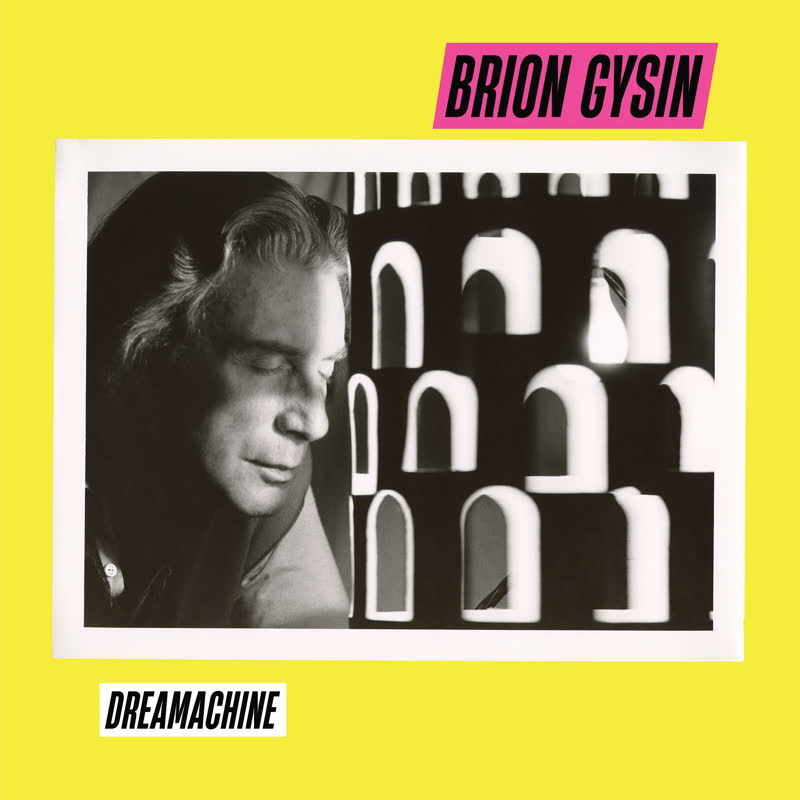
“‘Dreamachine’ offers a greater sense of focus and clarity, offering what is arguably the highest creative achievement produced by the pair.”
Continuing their deep dedication to the work and legacy of the legendary artist, poet, and writer, Brion Gysin, Wewantsounds returns to the incredible body of recordings made toward the end of his life during the mid-1980s with the visionary composer and artist Ramuntcho Matta. Offering a tangible bridge between Surrealism, Beat culture, Post-War sound and concrete poetry, pop-culture, and the sonic avant-garde of its moment, this astounding LP brings two of the most striking tracks by the pair to vinyl for the first time: weaving Gysin's voice into a tapestry of rhythmic Minimalism, as well as radically experimental expanses of tape manipulation and saxophone, created in collaboration with none other than free jazz giant Steve Lacy.
Contrary to the way that the radical march of 20th Century creative innovation is most often described - successive breaks, with each moment leaving the defining features of its predecessors behind - one of the most striking aspects of this period is how interconnected the arts and counterculture actually were. Rather than one generation rejecting those who came before, there are clear lines of connection everywhere you look: evolutions and social connections building upon what came before and inspiring what was to come, criss-crossing nearly every discipline of intellectual pursuit. This is clearly illustrated by the life and work of Brion Gysin, a cult figure who began his creative journey as a member of the Surrealists in Paris during the 1930s before becoming a central figure of the Beat literary movement during the Post-War period. Yet, as the wealth of material he left behind clearly illuminates, Gysin’s connections and influences didn’t end there. During the last two decades of his life, preceding his death in 1986, the painter, writer, and poet established strong connections within the realms of music and sound, inspiring a diverse range of artists like David Bowie, Mick Jagger, Brian Jones, Laurie Anderson, Genesis P-Orridge, and John Zorn, and forging collaborative relationships with Steve Lacy, Don Cherry, Lizzy Mercier Descloux, and Ramuntcho Matta. In 1986, these aforementioned collaborations would culminate in a series of recording sessions produced by Matta that would eventually be released on CD in 1993 as Vol. 33 of the Belgian imprint Crammed Discs’ legendary Made To Measure series. Back in 2024, Wewantsounds delved into these sessions, issuing two sides’ worth of their material on vinyl for the first time with ‘Junk’. Now, at long last, the label returns to this remarkable body of work once more with ‘Dreamachine’, pressing two of the most striking and noteworthy pieces produced by these sessions on vinyl for the very first time: the hypnotic 32-minute journey, ‘Dreamachine’, which reconfigures the hallucinatory effects of Gysin's legendary strobe device into an engrossing audio experience, as well as "The Door," made with Steve Lacy, building upon the pair’s longstanding work together, which includes their 1981 duo LP, ‘Songs’, issued by Hat Hut. An absolute auditory marvel of towering historical importance, drawing attention to little known aspects of the practice of one of the 20th Century’s most groundbreaking artists, this one is a treasure trove for the ears, heart, and mind.
Born at the Canadian military hospital in England, during 1916 at the height of the first world war, Brion Gysin moved to Paris in 1934 to study at the Sorbonne; quickly making literary and artistic contacts and joining the Surrealist Group not long after. Still in his teens, he exhibited alongside Max Ernst, Picasso, Hans Arp, Hans Bellmer, Victor Brauner, Giorgio de Chirico, Dalí, Marcel Duchamp, René Magritte, Man Ray and Yves Tanguy within a year of his arrival, before being expelled from the Surrealists by its leader André Breton: a happening that would haunt his conscience for the remainder of his life. Despite these early setbacks, Gysin’s creative and intellectual journey was only beginning. Following the Second World War, he embarked upon numerous scholarly projects, as well as Japanese calligraphy, which later influenced his visual artwork, before relocating to Tangier, Morocco, following a visit to his friend, Paul Bowles, in 1950, where he would remain until 1958 when he returned to Paris and fell into close contact with William Burroughs, resulting in close collaborations that would alter both of their subsequent creative lives.
While both living at the Beat Hotel in Paris during the late 1950s and early 60s, Gysin and Burroughs codeveloped a Dada inspired literary “cut-up” technique, where they collaged existing texts into new configurations to make new meaning. It would be used in Burroughs’ ‘Naked Lunch’ and many of his subsequent works, as well as Gysin’s legendary debut novel, 1969’s ‘The Process’. Some of the further byproducts of this technique would appear as radio realizations on the BBC in the 1960s - laying early groundwork for his efforts in the auditory realm - and find sharing space alongside a radical emerging generation of sound and concrete poets like François Dufrêne, Bernard Heidsieck, and Henri Chopin. It was also during this same period that he developed, with Ian Sommerville, the Dreamachine - "the first art object to be seen with the eyes closed" - which produced light flickers to alter the consciousness in its viewers.
Sometime during the 1960s, Gysin began working with the legendary saxophonist Steve Lacy. While it’s hard to know the exact nature of those collaborations, or if they lay at the root of Gysin’s further musical efforts, the pair entered the studio in 1979, backed by the stellar line-up of Steve Potts, Bobby Few, Irène Aebi, Jean-Jacques Avenel, and Oliver Johnson to record what would become ‘Songs’, issued in 1981 by Hat Hut. Only a handful of years later Gysin found himself back in the studio with the composer and visual artist, Ramuntcho Matta. The pair had met while Matta was still in his teens, introduced by a teacher. As the composer later recalled: “We started by studying the Tibetan Book of the Dead and the Egyptian Book of Breathing. It took Brion ten years to die so we had time to study this and other things. He had spent 23 years of his life in Morocco, initiating himself to the keys of invisibility, and to the keys of time… Brion had been writing songs since the 1940s but he never had the courage to sing them. So I wrote the music to try and put him on the track he had feared. Music is, for me, one of the keys, but the key to what door?” Their early experiments grew into “Ramuntcho Matta Presents Brion Gysin”, released in 1985. The following year they would enter the studio again, accompanied by Steve Lacy, Don Cherry, and Lizzy Mercier Descloux.
It is from this larger body of recordings that Wewantsounds has drawn the selections - ‘Dreamachine’ and "The Door" - their newest, first ever release attending to them. ‘Dreamachine’, a 32-minute journey conceived to reconfigure the hallucinatory and hypnotic effects of Gysin’s legendary visual device in the auditory realm, features Serge Salibur on bass, Michel Peteau on percussion, and Matta on guitar and programming, laying a minimal, heavily rhythmic blanket below Gysin’s spoken words. While unquestionably bearing the production creative hallmarks of its moment, the track stands as one of the most timeless produced by the Ramuntcho Matta sessions, unfurling at a steady pace over its duration, with repetition and a strong sense of beauty and constraint guiding the vocal material forward, establishing a striking balance that shifts perception over time.
Offering a strong counterpoint, ‘The Door’, made with Steve Lacy, stands as one of the most pointedly avant-garde efforts produced by both these sessions and within Gysin’s brief recording career. Created as a trio of interplay between the sounds produced by tape manipulation, Gysin’s reciting voice, and Lacy’s subtle but truly enthralling timbral and tonal work on sax, it’s also among the most sonically striking and creatively ambitious. Much like ‘Dreamachine’, the momentum of Gysin’s voice acts to coax the piece forward and through time, while the subtle, highly detailed tapestry formed by Lacy and the tape effects stutters forward and back, sculpting startling alternate effects.
Where Wewantsounds’s previous immersion into Brion Gysin’s singular sessions with Ramuntcho Matta, 2024’s ‘Junk’, offered a sense of breath and overview to the material produced by them, ‘Dreamachine’ offers a greater sense of focus and clarity, offering what is arguably the highest creative achievement produced by the pair. Not only does this incredible LP defy most historical perceptions connected to its author, but it establishes a tangible through line between the Surrealist scene of Paris during the 1930s, Beat culture, Post-War sound and concrete poetry, and the sonic avant-garde working in Europe at the juncture of pop culture during the 1980s. If ever there were a means through which to reproach Gysin’s many important contributions, this has got to be it.
Originally published by Soundohm.