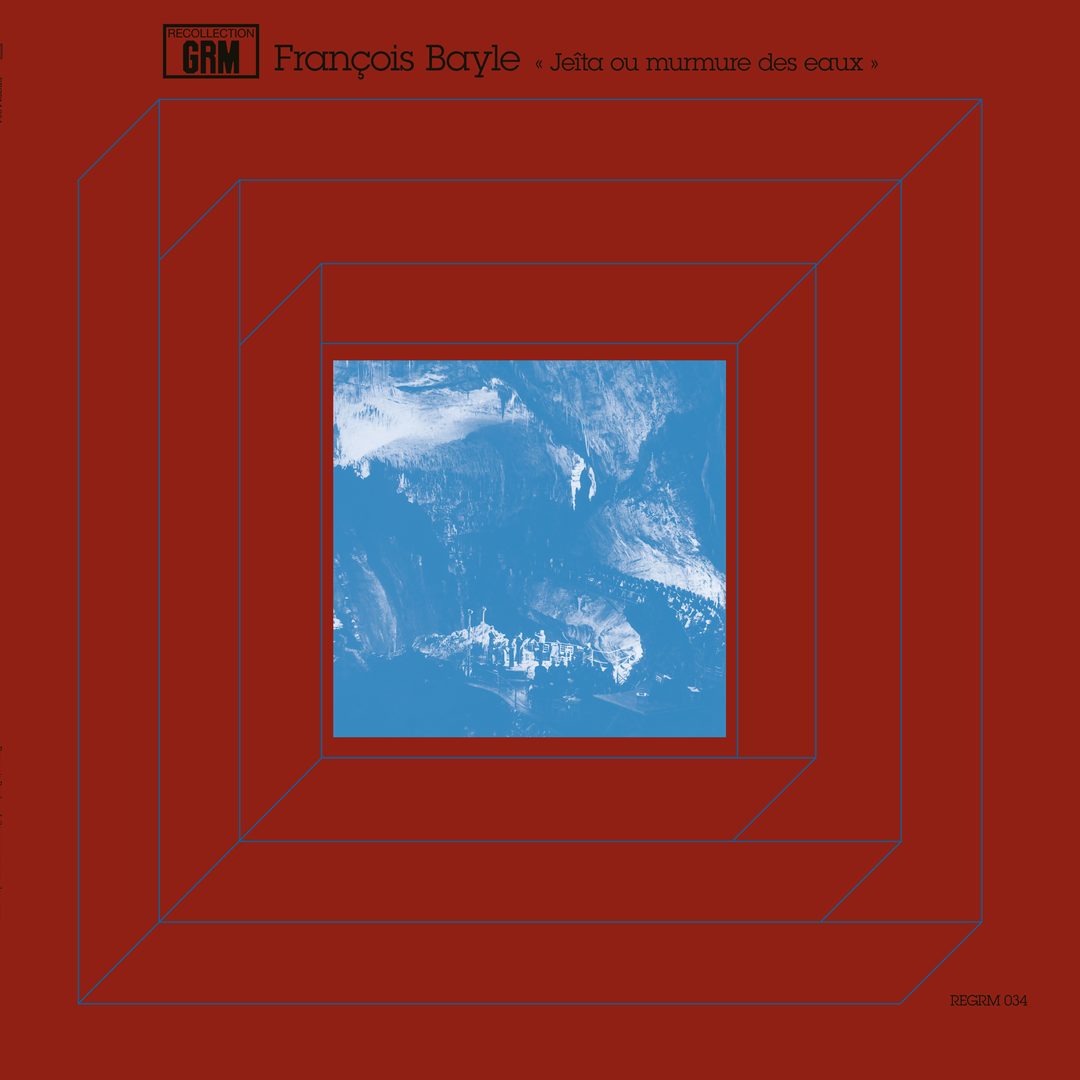
“‘Jeita ou Murmure des Eaux’ is a true landmark within the history of electroacoustic and acousmatic music.”
Never to disappoint, Recollection GRM returns with one of the most historically important and creatively captivating releases of 2026 so far: the first ever vinyl reissue of François Bayle’s groundbreaking work, Jeita ou Murmure des Eaux, originally issued in 1971. Drawing upon a remarkable hybrid practice of field recording and synthesis, as well as being rooted in Bayle’s deep dedication to the act of listening as resting at the centre of an electroacoustic work, there are few works within the canon of experimental electronic music that have remained as lastingly influential, laying the groundwork for numerous generations of artists working in its wake.
Originally launched as a collaborative labor of love by Editions MEGO, Peter Rehberg, and Groupe de Recherches Musicales, since 2012 Recollection GRM has mined the back catalog of releases and archival material produced at the legendary Parisian electronic music studio, GRM - founded in 1951 by Pierre Schaeffer, Pierre Henry and Jacques Poullin - sculpting a remarkable catalog that includes some of the most important works of musique concrete, and electronic and electroacoustic music ever laid to tape. Now running as a collaboration with Shelter Press and INA GRM, back in 2024 the label dropped the monumental work, ‘Divine Comédie’, composed in 1973 by Bernard Parmegiani & François Bayle. Now, after a quiet year since, they return in 2026 to their longstanding dedication to the incredible efforts of Bayle - among the most important composers to emerge from the context of GRM - with the first ever vinyl reissue of his groundbreaking work ‘Jeita ou Murmure des Eaux’, originally released in 1971 by the French arm of Philips, within their legendary Prospective 21e Siècle (silver foil) series. Conceived for acousmatic playback and regarded as a cornerstone of that tradition, not to mention being one of the composer's most singular and spatially ambitious efforts, this new, limited edition brings this incredible work of electroacoustic practice - processing field recordings through modular synthesis in groundbreaking ways - roaring into the present, drawing out new dimensions that reveal how truly ahead of its time it remains.
Few names are as synonymous with Groupe de Recherches Musicales as François Bayle. A key member in the second generation of innovators working at the Parisian studio, producing a visionary, highly distinct body of electronic and electroacoustic music over his more than thirty years there, his legacy represents a significant, if not foundational, pillar within the history of this territory of sonic practice.
Born in Madagascar in 1932, during the 1950s Bayle studied with Olivier Messiaen, Pierre Schaeffer and Karlheinz Stockhausen, before joining the Office de Radiodiffusion Télévision Française at the outset of the following decade, and then, in 1966, taking charge of GRM. In 1975, when the studio was integrated with the Institut national de l'audiovisuel (INA), Bayle became the new body’s head - a post he held until 1997 - playing a central role in the expansion of broad musical research in France, as well as on an international scale. Perhaps most significantly, he refined the theoretical and practical foundations of acousmatic music, the majority of which remain intact today, leading to his designing GRM’s now legendary speaker playback system, the Acousmonium, in 1974. Fittingly, given its strong relationship to Recollection GRM, he was also the founding originator of the seminal Collection INA-GRM record series.
Prior to the launch of Collection INA-GRM toward the end of the 1970s, the discographies of most of the composers associated with Groupe de Recherches Musicales were remarkably thin, revealing a context that provided few opportunities to release their works. One of the most important exceptions to this was the Prospective 21e Siècle series - devoted to electro-acoustic and avant-garde music - launched by the French arm of Philips in 1967, housed in stunning silver foil sleeves. Curated by Bayle and Pierre Henry, over the course of its brief years of activity, the label would become one of the most important means of distributing avant-garde activity in the world, leading to a longstanding dedication to its output by collectors and fans of electroacoustic music. It was here that Bayle’s remarkable second full-length, ‘Jeita ou Murmure des Eaux’, originally appeared in 1971.
‘Jeita ou Murmure des Eaux’ was composed by Bayle following a concert at the Jeita Grotto in Lebanon in 1969, staged to mark the opening of the cave's newly discovered upper gallery. Bayle was deeply committed to an acknowledgment of the listener, and the act of listening, as resting at the centre of an electroacoustic work. ‘Jeita ou Murmure des Eaux’ is a clear articulation of this position, as the cave, from which Bayle drew recordings of water, stone, and resonating air, provides the architecture within which those sounds became subsequently transformed beyond states of recognition, following their processing by synthesizers at GRM.
It’s worth remembering how radical the use of field-recordings was in 1970 when Bayle embarked upon the process of composing ‘Jeita ou Murmure des Eaux’. Luc Ferrari had pioneered the use of the practice within musique concrete only a handful of years prior, the results of which were still regarded somewhat hesitantly by his peers at GRM, a sentiment further heightened by the appearance of his landmark work, ‘Presque Rien No.1’, in 1970, which allowed them to retain the clear presence of their sources. Bayle’s embracing of the discipline is a clear historical marker of a turning of the tide within electroacoustic practice that would lay groundwork for generations to come, particularly via his approach to synthesis as a means for processing, rather than tape manipulation, which would emerge as a core approach for countless composers over the coming decades.
While it’s always tempting to point toward mirrors within works that feature manipulated field-recordings - one sound becoming similar to another - Bayle’s treatments of his recordings of dripping water, fossilized resonances, and the low hum of the cave’s enclosed space are otherworldly and rigorously abstract. The piece’s seventeen tracks form “a single continuous body rather than a sequence of discrete pieces: a topography, not a playlist” across which texture and flirtations with tonality assemble as nodes of complex, detailed punctuations within the work’s total structure and consuming sense of ambience and space. It might be said that rather than creating relational mirrors of specific sounds, across the length of ‘Jeita ou Murmure des Eaux’ Bayle creates a mirror for the act of listening and experiencing within a cave like Jeita Grotto, tapping experiencing deep within ancient human experience, transformed into radically forward-thinking forms.
Building bridges between the early groundbreaking efforts of Luc Ferrari, the slightly later sonic archeologies of artists like Walter Maioli, and countless artists who have since utilized synthesis as a means for processing field-recordings, ‘Jeita ou Murmure des Eaux’ is a true landmark within the history of electroacoustic and acousmatic music. It seems confounding that it has remained out of print on vinyl for as many decades as it has.
Originally published by Soundohm.