
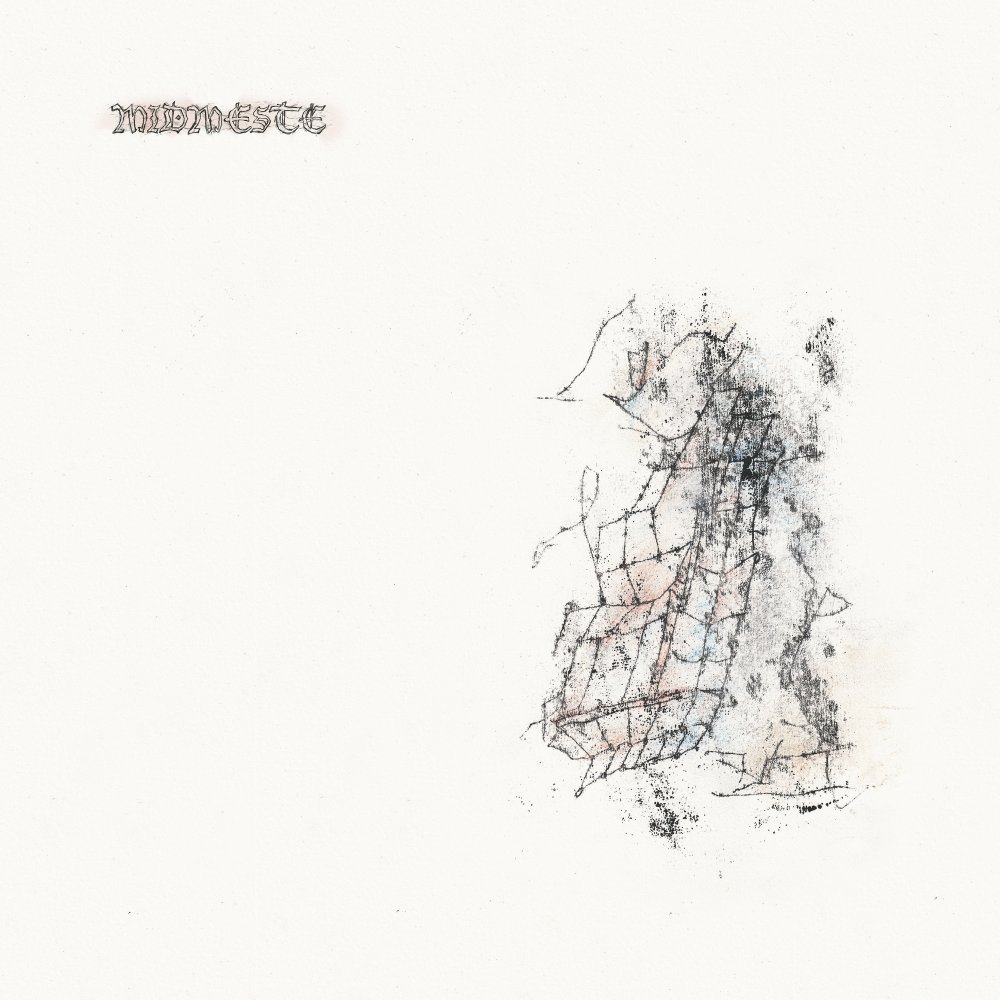
“‘Midmeste’ is, in its essence, music that transcends all bounds, moving toward the otherworldliness of the unknown: the intra and extra worlds of Hamann and Rushford entering into a dialog on previously unexplored ground.”
Having already delivered stellar releases by Hans Reichel, Oren Ambarchi, and the Oslo-based trio of Andrea Giordano, Kalle Moberg, and Jo David Meyer Lysne, so far this year, Black Truffle returns with one of the most singular and striking records we’re likely to encounter this year: Midmeste, the debut outing of the duo of Judith Hamann and James Rushford. A profound gesture of minimalist restraint that forgoes nearly all of the signifiers that have been associated with Minimalism, performed on cello and various organs, across the duration of this stunning LP Hamann and Rushford unfurl the distinct sonic vocabularies and attentiveness to the instrumental body and performance space with virtuosic grace, delivering a glacial work that stands outside of time, reframing experimental music within an ancient continuum of connectedness, rather than the one of fracture and change.
Among all the labels currently supporting adventurous territories of sound, Oren Ambarchi's Black Truffle leads the pack as a great force for good. Guided by an artist’s ear, for more than a decade and a half, the imprint has displayed a deep commitment to creative diversity and ambition, delivering a steady stream of deeply important contemporary and archival releases that forward a clear sense of collaboration, community, friendship, family, and mutual respect between the artists in Ambarchi's world. It’s hard to think of two figures who better illuminate Black Truffle’s core values than the Australian, Berlin based musicians and composers Judith Hamann and James Rushford. Among the most talented and distinct artists working in the field of experimental music today, marked by virtuosic skill on their respective instruments - Hamann on cello and Rushford on organ - and awe inspiring displays of creative vision and rigor, the pair is bound by friendship and a longstanding collaborative relationship that has finally brought them together for ‘Midmeste’, their much-anticipated debut as a duo. A masterstroke in minimalist restraint, rooted in a shared interest in alternative tunings, psychoacoustic phenomena, the physical properties of their instruments, and the peripheral sounds generated by the performing body, while entwining the distinct, personal musical languages that both have developed and refined in recent years, it’s an engrossing listen that challenges perception and continues to evolve in the ear, heart, and mind with every return. Issued by Black Truffle in a beautiful vinyl only edition, it stands high among our favorite contemporary releases to land in our hands so far this year.
James Rushford first emerged onto the Australian scene during the first decade of the new millennium, gaining distinction for a forthright sense of radicalism balanced against a highly sophisticated sense of control, via a body of work built around focused investigations of concrète, improvised, avant-garde and collagist languages - threading the borders between electronic processes and acoustically generated sound - while increasingly, in recent years, placing his own highly distinct approach to the organ - ranging from small harmonium, portative, and electric organs, to large scale pipe organs - at its center: “Rushford’s work subtly exaggerates seemingly liminal aspects such as atmosphere and the bodily presence of the performer until these take on a weight equal to musical elements such as pitch, rhythm and timbre”. In addition to his solo work, he has gained particular note for his collaborations with artists like Klaus Lang, Annea Lockwood, David Behrman, Tashi Wada, Joe Talia, Oren Ambarchi, Kassel Jaeger, Anthony Pateras, Will Guthrie, Graham Lambkin, Francis Plagne, and crys cole. Much like Rushford, Judith Hamann emerged onto the Australian experimental music scene during the 2000s, but unlike her friend remained something of a quiet force in the background for roughly a decade - a considerable portion of which she spent in the United States - offering her talents to releases by Rushford, Plagne, Ambarchi, Lambkin, Tashi Wada, Alvin Lucier, and numerous others, while working in the live ensembles of Ambarchi, Dennis Cooper, Arnold Dreyblatt, Jürg Frey, Lambkin, Lucier, Seijiro Murayama, Toshimaru Nakamura, Michael Pisaro, Ilan Volkov, and La Monte Young, while also entering into duo projects with Rosalind Hall, Anthea Caddy, and Lori Goldston. It wasn’t until her relocation to Berlin that she finally stepped out into centre stage. In a single year alone - 2020 - she delivered four debut solo releases, "Peaks" on Black Truffle, "Shaking Studies" and "Music For Cello And Humming" on Blank Forms, and "Days Collapse" on Another Timbre, each as astounding and groundbreaking as the next. Few could argue anything but that a truly singular and important talent had hit the scene. Over the years since, in addition to the stellar, solo full length ‘Aunes’ - issued by Shelter Press in 2024 - Hamann has contributed her virtuosic and singular approach to the cello to fantastic duo releases with Marja Ahti and Joshua Bonnetta, as well as a trio with BJNilsen and Sigtryggur Berg Sigmarsson.
In addition to being longtime, close friends, Rushford and Hamann have maintained a collaborative relationship that now stretches across the better part of two decades. Hamann first appeared on Rushford’s ‘Vellus’ back in 2009, and then again on his duo with Oren Ambarchi, ‘Wreckage’ three years later. The pair also make up two thirds of the trio project, Golden Fur, with Sam Dunscombe. Despite their long and enduring history together, ‘Midmeste’ is their first release as a duo. Fittingly, the album’s title is a Middle English word for ‘the middlemost point’, alluding to the spirit of the balanced conjoining of two highly distinct voices and deep mutual respect with which it was made. Performed on cello and a variety of pipe organs, the work - extending across the LP’s two sides - was developed during two shared residencies by Rushford and Hamann at Akademie Schloss Solitude, Stuttgart in 2020 and La Becque on Lake Geneva in 2023, integrating recordings made (at the invitation of the Biennale Son) on the world’s oldest playable organ, dating from the early 15th century, at the Basilica St Valere in Sion, Switzerland, as well as Rushford's portative organ.
‘Midmeste’ belongs to an enduring performance practice on the part of Hamann and Rushford, engaging with pre-Classical European music, through which they reference or radically expand upon works by various composers belonging to that tradition. In the past they have worked with compositions by Solage, Louis Couperin, and Johann Conrad Beissel, among others. Here, bubbling beneath and emerging across the duration of ‘Midmeste’, we encounter ‘O rosa bella’, a 15th century song by John Dunstaple: “distorted, aerated and splayed into new forms”. For the work’s earliest tonal constellations - beginning with a sequence of austerely vibrato-less harmonics from Hamann's cello, trailed by Rushford's whistling portative organ tones - there is the immediate impression of timelessness, enacted through the spaciousness and glacial pacing of the pair’s playing, as well as the presentation of sensibilities that simultaneously feel ancient and fundamental, while experimental and forward thinking. In its unwinding and tightening balance between states of abstraction and the melodic, ‘Midmeste’ remains grounded to the physical properties of each of its instruments, the given environments within which the album was recorded, and the physicality of the performers themselves. This gains the sharpest sense of clarity in the case of the Basilica St Valere and its ancient organ, played by both Hamann and Rushford to accentuate the instrument’s idiosyncratic features, notably integrating the sounds of its bellows, pumped manually using massive wooden beams, through amplification, alongside the creaks and thumps created by its players.
Durational tones, placed into complex harmonic arrangements that produce the gentle beating of psychoacoustic phenomena, never fully indulge themselves long enough to be classified as drone. As Hamann and Rushford’s notes enter into a dance that, at times, resembles a sorrowful lament, fleeting melodies unfold and elongate, but seemingly never repeat, before entering states of deconstruction, imbued with intricate harmonic and timbral conjunctions, alongside locating beacons of environmental sound. Moving through a series of distinct episodes, ‘Midmeste’ verges on feeling almost theatrical in the most undramatic sense of the word, as though two characters defined by the particularities of the sounds they are capable of generating engage in an emotive dialog: at times challenging and at others meditative and filled with poetic grace.
‘Midmeste’ is, in its essence, music that transcends all bounds, moving toward the otherworldliness of the unknown: the intra and extra worlds of Hamann and Rushford entering into a dialog on previously unexplored ground. Even the album’s limited sonic palette of organs and cello - instruments that carry the inextricable weight of association - manages to frame these sonorities beyond the historical frame - pushed to a maximized notion of their potential without ever feeling overwrought or labored - while presenting a deep acknowledgment and debt to those precise relationships. As such, in all of its deeply personal elements, linking to the respective practices of its creators and their longstanding relationship, ‘Midmeste’ illuminates contemporary experimental music within an enduring continuum, rather than the music fracture that has defined so many of its iterations. We’ve waited a long time to hear what these two would come up with as a duo and they haven’t disappointed. ‘Midmeste’ is a profound piece of work, which is, of course, not entirely surprising given what remarkable talents both Hamann and Rushford are.
Originally published by Soundohm.