“‘In The Midst’ is a distillation of “late” Budd at his very best.”
For devoted followers of what we do here at SoundOhm, the work of the American composer, Harold Budd, needs little introduction. Over the course of his more than five decades long career, Budd continuously broke new ground in remarkably humble and understated ways, ushering in radical rethinking of Minimalism and contributing a distinct voice central to the development and emergence of ambient music with albums ‘The Oak of the Golden Dreams’, ‘The Pavilion of Dreams’, and ‘The Plateaux Of Mirror’, all of which are stuff of legend and changed the landscape of recorded music forever. Endlessly evolving, pushing, and adapting to technological developments and shifts in the cultural landscape, during the last decade and a half of his career, Budd entered one of the most remarkable and prolific periods in his career, propelled forward by close collaborative relationships with artists like Clive Wright, the Cocteau Twins’ Robin Guthrie, and an incredibly supportive relationship with Darla Records who released no less than thirteen albums of his solo and collaborative work between 2008 and his tragic passing in 2020. Out of print for years and amounting to some of the most remarkable work Budd ever composed, ranging from pastoral Minimalism, sprawling ambient works, and bristling electroacoustic gestures, Darla has just lovingly launched a stunning reissue campaign bringing many of these astounding albums back into our lives.
Over the course of its history, minimalist music has embraced a diverse number of defining features, emerged in distinct contexts across the globe, and continued to evolve and transform. Following the movement’s initial appearance in New York during the 1960s - collectively amassing the work of composers like Terry Riley, La Monte Young, Philip Glass, Tony Conrad, and Steve Reich - among the earliest, most important, highly distinct, and sinfully overlooked iterations of Minimalism, began to appear on the American West Coast during the late 1960s and early 70s, with a constellation of composers that included Daniel Lentz, Peter Garland, Ingram Marshall, John Adams, and James Tenney, among others, shifting and expanding perceptions of what this music might be. Among the most celebrated of this group was the composer Harold Budd (1936-2020), who over the course of his long career not only became one of the first minimalists to introduce the use of electronic synthesis and elements of jazz within the idiom, but also represented an important bridge between the American and English contexts, pioneering, through his relationship with artists like Brian Eno and Gavin Bryars, the development of ambient music. Fascinatingly, during the last decade or so of his life, Budd embarked upon one of his most prolific periods, finding an unexpected platform of support with the American indie rock imprint Darla Records, ultimately issuing an astounding five solo full-lengths, five collaborative duo releases with Robin Guthrie of the Cocteau Twins, and three collaborative duo releases with the American musician Clive Wright. Amounting to some of the most compelling and spellbinding work that Budd ever produced, now after having remained out of print for a number of years, Darla has launched a beautiful reissue campaign celebrating this body of work, delivering much needed, brand new pressings of seven of those releases: ‘A Song For Lost Blossoms’ (2008), ‘Little Windows’ (2010), ‘In The Midst’ (2011), ‘Bandits of Stature’ (2012), ‘Jane 12-21’ (2013), ‘Avalon Sutra’ (2014), and ‘Another Flower’ (2020).
Born in Los Angeles and raised between the city and the edge of the Mojave Desert, Harold Budd began his musical career as a drummer while still in his teens, playing jazz in bars and clubs in south-central Los Angeles, before being drafted into the army, where he met and befriended Albert Ayler - a member of the same regimental band - with whom he played numerous gigs during his late teens and early 20s. By the early 1960s, Budd’s gaze had shifted toward experimentalism and the avant-garde, prompting him to study composition under Ingolf Dahl at the University of Southern California. After completing his degree in composition in 1969, Budd took a teaching position at California Institute of the Arts (CalArts), joining one of the great social, creative, and educational experiments of the era alongside interdisciplinary artists Allan Kaprow, Simone Forti, John Baldessari, Miriam Schapiro, Nam June Paik, and Alison Knowles, in addition to the composers Morton Subotnick and Charlemagne Palestine. It was there that he created ‘The Oak of the Golden Dreams’ - marking his broad public appearance as a composer, created on CalArts’ specially created Buchla modular synthesizer, and thus rendering one of the first purely electronic and synthesized minimalist works. A truly visionary work of minimal drone and eastern modalities, it would be nearly a decade before the world heard from him again. Soon after the album’s release, Budd gave up composition, reportedly disgusted by the "academic pyrotechnics" of the avant-garde community.
While ‘The Pavilion of Dreams’, Budd’s follow up to ‘The Oak of the Golden Dreams’ wouldn’t emerge until 1978, it seems that Budd’s disillusionment with the world of music was relatively short lived. Somewhere along the way, Budd passed an early recording of “Madrigals Of The Rose Angel" to his friend, Gavin Bryars, who in turn passed it on to Brian Eno. Graced with one of the most forward thinking ears in the industry, Eno immediately recognized Budd’s rightful place on his newly founded Obscure imprint, which had been conceived as a home for like minded artists in the emerging field of ambient music, and invited Budd to come to London and record. The resulting album, ‘The Pavilion of Dreams’, while unquestionably minimalist, encounters Budd seeding his new vision of an understated expression of the classical avant-garde with elements of melody drawn from his long love affair with jazz, enlisting his friend Marion Brown to play saxophone, alongside contributions by Bryars, Eno, the composers John White and Michael Nyman, among numerous others. ‘The Pavilion of Dreams’ marked Budd’s emergence onto the world stage and remains, alongside a number of other releases in the Obscure catalog, among the most celebrated albums of that era.
Only two years later, he would release ‘The Plateaux Of Mirror’, a duo collaboration with Eno, the second (of four) in the English musician’s ‘Ambient’ series, formally marking the official emergence of that idiom onto the cultural landscape, with Budd helping to guide it into being with all the particularities that defined him as a composer - notably his singular style of piano playing that he termed “soft pedal” (slow and sustained) - followed over the coming decade by a highly celebrated suite of releases: ‘The Serpent (In Quicksilver)’ (1981), 'Abandoned Cities' (1984), 'Lovely Thunder' (1986), 'The White Arcades' (1988), and ‘By The Dawn's Early Light’ (1991), as well as ‘The Pearl’ - made in 1984 with Brian Eno and Daniel Lanois - and 1986’s ‘The Moon And The Melodies’, made with members of the Cocteau Twins (Elizabeth Fraser, Robin Guthrie, and Simon Raymonde). While he remained prolific and visionary over the coming decades, Budd seems to have entered a new phase of invigorated activity during the last decade or so of his life, prior to his tragic passing due to contracting Covid in 2020, in no small part due to his flowering (and perhaps unexpected) relationship with the American indie rock imprint Darla Records.
Released in 2008 by Darla, ‘A Song For Lost Blossoms’ is the first of three duo albums that Harold Budd made with his friend, the guitarist, composer, and producer Clive Wright, the pair having originally met as co-residents of the remote Southern California desert community of Joshua Tree. Created between 2004 and 2006 at both artists’ homes, various studios, and live at the REDCAT theatre in Los Angeles, the album’s seven pieces - issued on CD - range from the sprawling, more than half-hour duration of its opener, ‘Pensive Aphrodite’, to discrete and concise temporalities of the title track and ‘Of Many Mirrors’, which clock in at just under five minutes. Building on both artists’ long, respective histories in the field of ambient music, Budd’s restrained piano lines and fragmented melodies gather careful alignment with Wright’s elongated guitar tones and meandering passages, as each player’s contributions become cocooned sheets of reverb, sonic artifacts, and percolating elements that have been processed beyond the point of recognition, culminating in fully immersive states of bliss across the album’s whole.
‘A Song For Lost Blossoms’ is a near perfect emblem of West Coast Minimalism and ambient music, resting at a balance of each idiom, while being imbued with both Budd and Wright’s distinct sensibilities and influences of the desert environments within which much of it was made. It’s hard to express how happy we are for Darla to return this absolutely beautiful body of music to our ears with a brand new CD edition: the format for which it was originally made.
Appearing in 2010, ‘Little Windows’ is the final installment of the trilogy of albums made by Harold Budd and Clive Wright during the second half of the 2000s, beginning with ‘A Song for Lost Blossoms’ and carried forward by 2009’s ‘Candylion’. Recorded between Wright's Desert Sky Studio in Joshua Tree, California, and Knobworld Studio in Silverlake, California, the album features Budd on piano and various keyboards, and Wright on guitar, but takes a fairly distinct departure in its conceptual structure from its predecessors. Only two of its nine tracks are collaborative, with Budd contributing three stunning solo piano pieces and Wright contributing four ethereal works for guitar. Also notable is the fact that a considerable amount of the album was conceived for Echoes, a nightly music soundscape from Public Radio International heard on over 120 public radio stations, where it originally aired during the autumn of 2009.
Despite its distinctions, the immersive and sublime audio experience of ‘Little Windows’ falls into perfect harmony with its predecessors, while also offering brilliant moments that highlight each of its creators’ remarkable talents and sensibilities. Even the moments of clearest aesthetic distinction - Budd’s works for unprocessed solo piano - meld effortlessly into the sprawling ambiences of the pair’s collaborations and Wright’s solo guitar pieces, culminating as a stunningly beautiful “collage of aural landscapes and moods.. silent, serene, pristine and austere yet opulent in unique beauty and humble spirit... delightfully minimal, subversive, beautiful and without distraction.” Absolutely stunning in all of its moments and as a collective whole, this is a truly overlooked gem within Budd’s remarkable recording catalog that we’re so happy to see come back into print.
Originally released in 2011, ‘In The Midst’ is the first of five solo albums that Harold Budd would create for Darla over the subsequent decade, following on a brilliant string of collaborations with Robin Guthrie and Clive Wright. In many ways, this is the album that seems to have launched a profound period of creative activity that would define his remaining years. Addressing the album as a whole, it’s immediately clear of the ambition with which Budd approached the project, entwining numerous aspects of his compositional practice across the album’s two sides.
Recorded and mixed by Michael Coleman at Orangewood Studio, Mesa, Arizona, during March of 2011, ‘In The Midst’ is divided into three distinct sections: ‘The Whispers’, comprising five solo piano pieces; ‘Gunfighters’, comprising three piano compositions with sparse electronic effects and percussive elements; and ‘Shadows’, gathering five string quartets, played by Linda J. Lambie on violin, Hisami Lijima on violin, Peter Rosato on viola, and Richard Bock on cello. Reflecting back on the album’s process, Budd stated: “Tone bending: Interesting. Mike and I spent a lot of time getting a particular feel or sound I thought should be there. It all began with the 4tets on the first day's recording. I love string music but I hate the sceeching sound of string 4tets, thus we got to work after lunch. Took the highs out, softerned some attacks... very slight chorus reverb... then I asked for a harmonizer set at 101: no harmonizer, so: on Mike's program we simulated that, or close to it, and that was it. In fact, except for the first piece, we used it for the entire mix (not every piece "harmonized", however, -- piece-by-piece adjustments, alterations...)."
‘In The Midst’ is a distillation of “late” Budd at his very best. The album’s solo pieces are gems of resonance and restraint, carefully placed notes allowed to hang in the air like dreamy whispers, sustained within the lingering tails of their own ambience, and intervened with by gentle, warbling pitch bends. The three works that comprise ‘Gunfighters’ encounter a composer constantly updating and revising under the influence of advancing technology and the shifting tides of the cultural landscape, interspersing delicate electronic textures and processes as a backdrop for his piano tone, infusing his primary instrument’s temperaments with complex elements of emotion and mood. Given their composer’s complex relationship with the form, it’s unsurprising that the five string quartets that comprise ‘Shadows’ are no less visionary and distinct. Drenched in ambience and sustain, each player’s contribution joins the next in the presentation of sorrowful and engrossing moods, at times framing the kinds of pacing explored by composer Morton Feldman, combined with more direct connections to emotion and the self. Absolutely stunning from its first sounding to its last, ‘In The Midst’ - pressed on glorious vinyl - is truly one of the greatest statements by Budd from the final decade of his career.
As though fortified by the final works issued on its predecessor, ‘In The Midst’, 2012’s ‘Bandits of Stature’ fully embraces Harold Budd’s efforts composing for string quartet, comprising no less than fourteen compact pieces, created for and played by Formalist Quartet, across its two sides. Each piece is quintessential Budd, transforming the notions of Minimalism through its approach to structure, form, tonal duration, and resonance, which becomes markedly transformed when applied to strings, illuminating aspects of his approach that might be overlooked in his efforts for piano. All of these avant-garde string quartets embrace fascinating approaches to subtle tension, abstraction, and pastoral, otherworldly moods, collectively amounting to being the composer’s most melancholic body of work to date. ‘Bandits of Stature’ “is a work that can only come from an artist with such unique vision and maturity as he. Whether deep dark or bright light, the listener is as always transcended to an enlightened state within the balance of empty space and substance, presented at times with wistful nostalgia, often with great idealism and persistently with love and beauty.” Immersive and as beautiful as it is challenging, ‘Bandits of Stature’ has been pressed in a stunning new vinyl edition by Darla, witnessing Budd at his most distinct and at the height of his powers.
‘Jane 12-21’ is the second part and companion to ‘Jane 1-11’, a stunning suite of works for piano and avant-garde electronics composed by Harold Budd, both issued in 2013. Ranging from sparse piano works to bristling electroacoustic gestures, drawing their textures from a vast array of sonic sources, and sprawling ambient works that seem to have been entirely generated through electronic instrumentation, as the composer himself described: "It's simple. I broke out and broke back to my earlier days: A triangle of risk, improvisation and joy -- as I say, very simple. My rules to myself were: No plan, no notes, no ideas, no microphones; except for Jane 1 I stuck to it. My other rule -- the most important one -- was: At least one piece per day, finished, mixed and not to be revisited again. Jane 7, 8, 9 were done in one day... Brad Ellis was my guide through this: An untiring day, ready to go again... To quote a letter to me from Mark Tobey: ... "It fell off the edge of my brush." Offering yet another piece in the puzzle of Harold Budd’s monumental efforts - feeling both cohesive and remarkably diverse - ‘Jane 12-21’ is an absolute stunner that, in moments, throws everything we think we know about Budd up in the air.
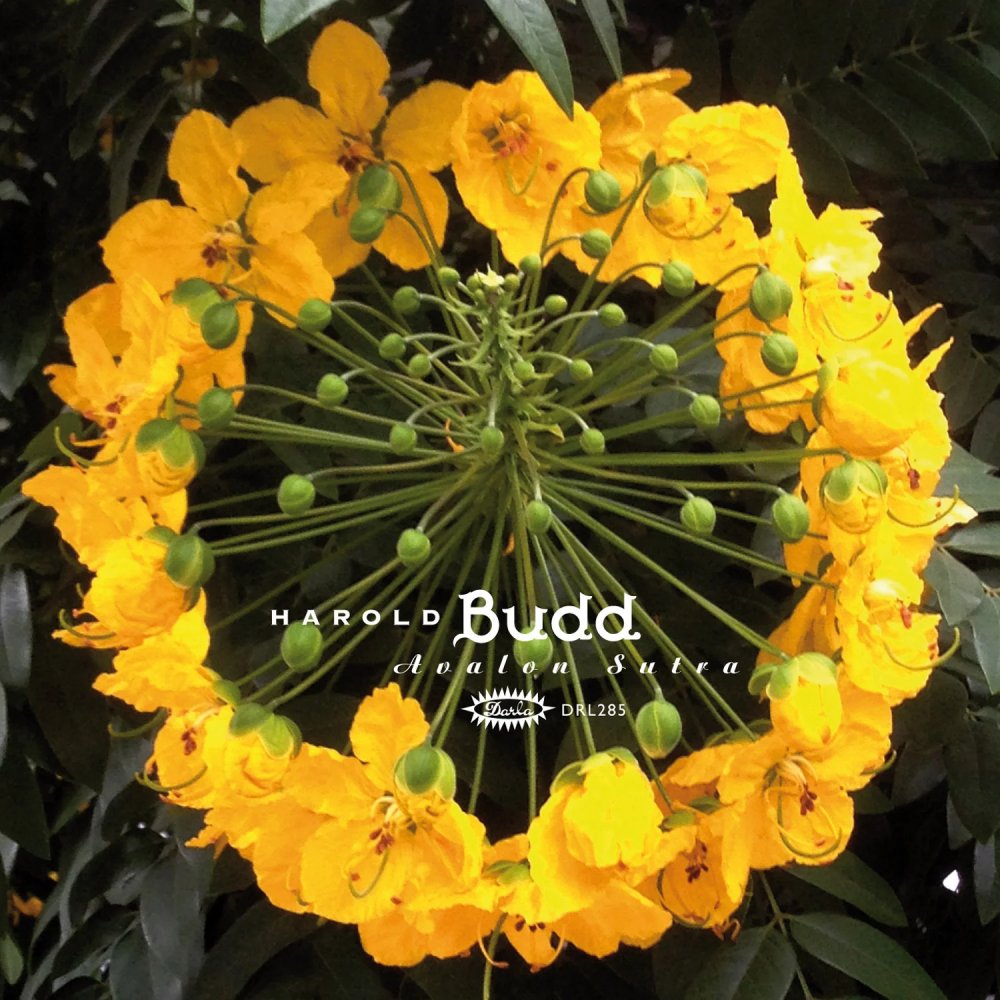
Originally released in 2005, when it was announced as Harold Budd’s last recorded work, before being reissued by Darla just under a decade later, ‘Avalon Sutra’ reveals both an artist at the height of his powers, and perhaps one shrouded in a dark mood, filled with doubts regarding his own worth. Issued as a stunning double LP and CD set, the album comprises a suite of short, heartbreaking ambient pieces, featuring Budd’s delicate piano improvisations, lush string arrangements and warm electronic drones, as well as a startling coda by LA based electronic composer Akira Rabelais, sending Budd’s arrangements into Feldmanesque eternities of sound.
On Avalon Sutra, Budd created brief, snapshot like compositions, made all the more fragile and impermanent by his glistening piano work, embracing a bittersweet, autumnal quality - the composer’s trademark “loveliness” deepened and perturbed by the brevity of these pieces. If “ambient” music characteristically works to sustain a mood of intimacy, warmth, meditative ecstasy, such moods, which are certainly present in Budd’s work, are never allowed to last too long on Avalon Sutra. There’s a cumulative sadness and beauty to the way that these mood pieces linger briefly, stop and transform into something new. Budd’s gorgeous, angular string arrangements amplify this feeling. Avalon Sutra was expected to bring to a conclusion 30 years of sustained musical activity. Asked why, Budd said only that he felt that he had said what he has to say. With characteristic humility, he concluded, “I don’t mind disappearing!” Fortunately, Budd was soon inspired to record again, entering the prolific phase that was propelled by Darla over the coming decade and a half. That said, whatever its original intentions or the emotions that underscored its creation, it remains one of the most striking, beautiful, and remarkably diverse releases of the composer’s astounding and endlessly groundbreaking career.
Harold Budd’s relationship to the Cocteau Twins - a band that emerged from the ashes of the first wave of English punk to produce some of the most distinct sounds of the Post-Punk era - feels both surprising and entirely logical. Over the course of his long career, Budd remained deeply open to, and engaged with, the constant shifts in the musical landscape around him. The Cocteau Twins, on the other hand, while very much a product of their own era and its temperaments, pushed Post-Punk to an almost ambient state, embracing many of the same sonic sensibilities as Budd. This unexpected meeting point first resulted in one of the most beloved artifacts of all of its artists’ respective careers, ‘The Moon And The Melodies’, Budd’s collaboration with Cocteau Twins members Elizabeth Fraser, Robin Guthrie, and Simon Raymonde, issued by 4AD in 1986. While, for many years, that album seemed like a one off, nearly two decades later, in 2004, Guthrie and Budd would come together again to compose the soundtrack for Gregg Araki’s subversive indie film ‘Mysterious Skin’. It seems like something clicked into place. Over the coming decade and a half, the pair entered into a prolific working relationship that stands as one of the most rewarding and fascinating of their respective careers, producing seven albums together preceding Budd’s passing in 2020. The last of these to be released was ‘Another Flower’, created at Guthrie’s studio in France in 2013, but remaining unreleased for seven years.
Like the albums that preceded it - ‘Bordeaux’, ‘After the Night Falls’, ‘Before the Day Breaks’, ‘Mysterious Skin’, ‘The Moon and the Melodies’, etc. - ‘Another Flower’, which Guthrie describes as having been “recorded during a rainy summer in Brittany”, builds upon both of its artists’ distinct artistic characteristics and approaches to tonality, resonance, texture, space, and ambience. Presenting an interesting and illuminating counterpoint to Budd’s work with Clive Wright through its primary instrumentation of piano and guitar, while difficult to fully locate, the balance of joy, introspection, and sorrow that helped define Guthrie’s contribution to the Cocteau Twins continuously bleeds through like a breath of fresh air, both complementing and offering counterpoint to Budd’s more naturally somber airs. Comprising nine pop song length pieces, it’s a sublime immersion into the endlessly evolving possibilities presented by Minimalism and ambient music, and while it was made seven years earlier, serves as a fitting final statement in Budd’s remarkable career, witnessing him endlessly pushing and evolving and updating his thinking to a given time.
Originally published by Soundohm.