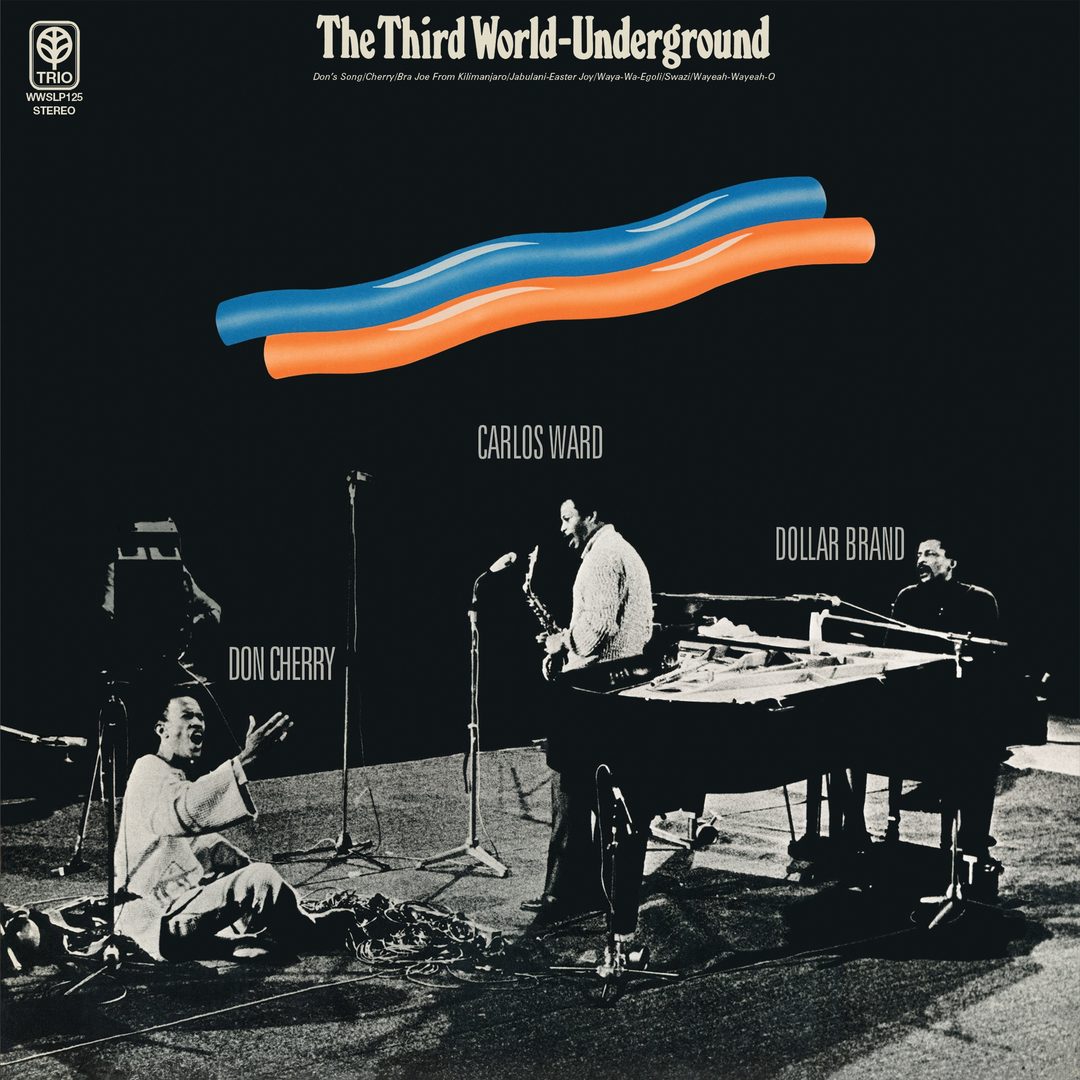
“Comprising seven, mind-melting tracks, ‘The Third World-Underground’ unfolds as a roving exploration by three players, locked in an intimate dialog.”
Continuing to defy the odds and make the stuff of dreams real, Wewantsounds returns with what might just be their most exciting release to date: the first ever reissue of Don Cherry, Dollar Brand, & Carlos Ward’s legendary 1974 full-length The Third World-Underground. Capturing the short-lived, all-star trio at Jazzhus Montmartre in Copenhagen, before appearing as a virtually unattainable Japanese only LP via Trio Records, it has long been regarded as one of the greatest creative artifacts of its creators’ respective careers. Rooted in Pan-African unity, riding the crest of heavy modal grooves, complex conjunctions, and shimmering lines, Wewantsounds has dropped what might just be the most important reissue of the year.
At their best, reissue labels do far more than simply returning beloved albums to print: they travel through time, excavate history and illuminate remarkable artifacts that most of us never knew were there, becoming vehicles for learning and historical reappraisal. It’s hard to think of a better example of this than the Paris based imprint Wewantsounds. Since launching into action a decade ago, the label has plumbed the depths of 20th Century music, assembling a remarkably diverse catalog of releases by artists hailing from nearly every corner of the globe. Looking far beyond simple notions of genre or taste, what binds the label’s forward-thinking approach to multiplicity is creative singularity and ambition. Along the way, they’ve returned plenty of collector “white whales” to print, but their latest - ‘The Third World-Underground’ - might just be the greatest to date. An absolutely stunning document of the short-lived, all-star trio of Don Cherry, Dollar Brand, & Carlos Ward, recorded live at Jazzhus Montmartre in Copenhagen, during 1972, before being originally issued in a now incredibly rare Japanese only edition by Trio Records two years later, it has long been regarded as one of the greatest releases in each of these artists’ respective discographies, and has been chased across the decades at eye watering prices by the collector market.
While ‘The Third World-Underground’ is jointly billed between its three artists, from the first sounding there’s little question that Don Cherry is the album’s guiding force. Among the most significant figures in 20th century jazz, Cherry initially emerged within the Los Angeles scene before relocating to New York, where at the tail end of the 1950s he made his first significant mark on the history of music, as a central member of Ornette Coleman's legendary quartet; the band that singlehandedly set the blueprint for the emerging idiom of free jazz. Not only did Cherry contribute to an entire rethinking of what jazz could be, but, even more significantly, the entire potential of music itself. Laying down the trumpet parts across the near entirety of Coleman's seminal early output, during the same era he doubled down as a sideman, making equally astounding contributions to the canon of 1960s avant-garde jazz with Sunny Murray, Prince Lasha, Albert Ayler, among others, as well as a member of the New York Contemporary 5, before venturing out on his own as a leader in 1966 and beginning the body of recording that would leave a permanent mark on the world, and change nearly everything in its wake.
Cherry was a player of astounding touch and sensitivity, far more invested in where music could go and what it could emote, rather than chops or technique. His playing was raw, profoundly human, and direct, tapping something basic and human that strips all artifice as it dives toward the heart, drawing countless traditions from across the globe to create a music that stood beyond the locating forces of place, time, or aesthetics. It is the profound distillation of these elements that appears across the length of ‘The Third World-Underground’, capturing Cherry in trio formation with the South African pianist, Dollar Brand, and the Panamanian saxophonist Carlos Ward.
Dollar Brand, who began working under the name Abdullah Ibrahim toward the end of the 1970s, was among the most important figures to emerge within the field of South African jazz during the 1950s and 60s, before fleeing his home country’s oppressive conditions of racial apartheid in 1962. Following three years in Europe, touring widely and gathering great acclaim for his remarkably unique approach to the piano, Brand moved to New York, playing the Newport Jazz Festival in 1965, and fell into close contact with many of the visionary figures of that moment, including Don Cherry, Ornette Coleman, John Coltrane, Pharoah Sanders, Cecil Taylor and Archie Shepp, as well as becoming increasingly engaged with the ideas connected to African American liberation movements which provoked him to begin incorporating African elements into his music. While Brand would move between South Africa and the US over the coming years, a great deal of his time was spent touring Europe, among the most notable cases being a short lived tour during 1972 with Don Cherry and the Panamanian saxophonist Carlos Ward that lasted only a handful of dates, and produced one of the most striking recordings in any of its artists’ careers, ‘The Third World-Underground’, recorded live at Jazzhus Montmartre in Copenhagen, before being released two years later by the Japanese imprint Trio Records.
While Cherry, Brand, and Ward would all continue to work together in different configurations and groups over the coming decades, what emerges across ‘The Third World-Underground’ is relatively unique - three tonal players, without a rhythm section, delivering a profound statement of human pulse. While elements of Brand’s ‘Bra Joe From Kilimanjaro’ reveal themselves across the set - fully realized in the piece’s rendering at the start of the second side - Cherry’s vision reveals itself as a driving force across the entirety of the first side - combining the joyous exuberance and creative rigor, expressed through sound, that defined his work during this era, featured on such classic albums as ‘Organic Music Society’, ‘Eternal Now’, ‘Blue Lake’, and ‘Orient’, not to mention stellar, contemporaneously recorded, later additions to his discography like ‘Om Shanti Om’ and ‘The Summer House Sessions’ - before laying back and letting the visionary pianist steer the ship.
Comprising seven, mind-melting tracks, ‘The Third World-Underground’ unfolds as a roving exploration by three players, locked in an intimate dialog. Beginning with groundwork laid by Brand’s modal piano lines - quickly evolving into sheets of minimalist, repeating arpeggios - Cherry and Ward’s trumpet and sax dance and challenge each other, before the group falls together into exuberant grooves that carve their way, shifting and evolving with subtle inflections, across the remaining first side. The second side begins with an absolutely astounding rendering of Brand’s ‘Bra Joe From Kilimanjaro’, featuring an extended passage of solo piano - delivering tonal compilations and structural movements that reveal the brilliance of a truly singular artist at the top of his form - before Cherry and Ward begin to subtly chime in with fiery utterances and cyclical figures - climbing and singing - reimagining notions of collective unison.
While remaining fresh and remarkably prescient more than half a century after it was originally laid to tape, ‘The Third World-Underground’ is also very much a product of its era, providing, not only through the clear allusions of its title, a crystalline vision of the creative and political meeting of Pan-Africanism embraced by its three players: artists of African heritage from South Africa, Panama, and the United States carving a new collective language drawing on the distinct aspects of the cultures from which they were from. Gentle, rooted, communal, and quietly radical, since its original Japanese only release in 1974, ‘The Third World-Underground’ has remained one of the defining artifacts of Cherry, Brand, and Ward’s respective careers, while also being one of the most difficult to obtain. Thankfully, at long last, Wewantsounds has remedied this long enduring sin with the album’s first ever reissue, released in beautifully produced, fully remastered, vinyl and cd editions that immaculately reproduce the original, adding a four-page booklet of new bilingual notes by the writer Jacques Denis. A true joyous marvel of collective sonority, we’ve waited a long time to see this one come back and it doesn’t disappoint.
Originally published by Soundohm.