“It certainly represents some of the most striking and unique efforts of musique concrete produced in Italy during the ten-year period that it spans.”
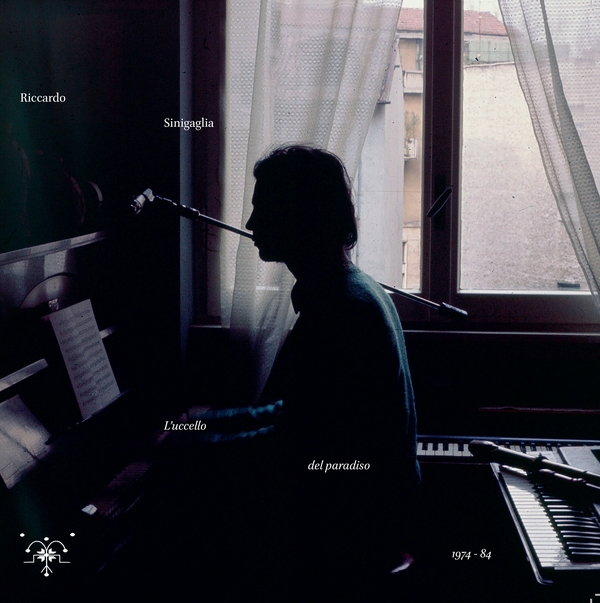
Returning to their longstanding dedication to the composer Riccardo Sinigaglia - one of the most important and influential figures to emerge within the movement of Italian Minimalism - Black Sweat drops one of the most engrossing archival releases of the year: L’Uccello Del Paradiso, comprising three astounding, previously unreleased tracks created by Sinigaglia between 1974 and 1984. Preceding and overlapping with his efforts as a member of Futuro Antico, and falling just before his visibly early solo albums ‘Watertube Ringspiel’ (1985) and ‘Riflessi’ (1986), these astounding gestures of musique concrete are not only the earliest to have appeared from the composer, but arguably his most experimental and abstract, unlocking access to the foundations for all that has come since.
Over its years of activity, the Milan based imprint, Black Sweat, has displayed an unparalleled dedication to the distinct form of musical Minimalism that emerged and evolved across Italy over the course of the 1970s, 80s, and 90s, becoming a goldmine of some of the movement’s most remarkable artifacts. From the very beginning, this initiative has offered particular attention to a radical group of artists who came together within, and orbited around, the group, Futuro Antico - Gabin Dabiré, Riccardo Sinigaglia, Walter Maioli - not only reissuing most of the trio’s known catalog of recordings and previously unissued material, but also additional solo and collaborative material by Maioli and Sinigaglia, as well as adjacent projects by Fred Gales, Art Of Primitive Sound, and the legendary Ethnoelectronics full-length. Their latest, ‘L’Uccello Del Paradiso’, returns the ear to the remarkable world of Riccardo Sinigaglia. Intertwining his complex relationship to psychiatry with various musical touchstones taken from his travels through Africa and Asia, this beautifully produced vinyl edition gathers some of Sinigaglia’s most explicitly experimental works: rigorous electroacoustic abstractions, rooted in the approaches and techniques of musique concrete, that dazzle the mind and stand apart from almost anything being produced at the time. Adding crucial insight and access to one of Italy’s most important and visionary artists, once again Black Sweat has peeled back the skin of history and rewritten the books with this truly engrossing immersion into Sinigaglia’s early inner world.
First appearing on the cultural landscape at the outset of the 1980s as a member of the trio, Futuro Antico, with Gabin Dabiré and Walter Maioli, for more than four decades Riccardo Sinigaglia has remained one of the most important figures of Italian minimalism and experimental music. In addition to his widely celebrated body of solo composition that began to appear during the mid-1980s - ‘Watertube Ringspiel’ (1985) and ‘Riflessi’ (1986) - he divided much of his first decade or so of activity between Futuro Antico; the equally groundbreaking project, The Doubling Riders - his collaboration with Francesco Paladino and Pier Luigi Andreoni - and the intermedia project, Correnti Magnetiche, with visual artist and musician Mario De Leo, before entering a period of recording silence that wouldn’t come to a close until the mid-2010s when a new, reinvigorated interest in his work began to swell.
Anyone aware of Sinigaglia’s efforts will appreciate the composer’s singular vision, marked by artistic ambition and creative rigor, that has produced some of the most striking experimental music to emerge from Italy over the last half century. His output - be it in Futuro Antico, The Doubling Riders, Correnti Magnetiche, or as a solo composer - has continuously integrated challenging abstraction with sonic seduction, and immersive ambiences within intricate experimentalism, all the while confounding the boundaries between minimalism and maximalism. ‘L’Uccello Del Paradiso’, drawn from the composer’s archives, comprises three of his earliest, previously unreleased solo compositions - ‘Laing’, ‘Simbol’, and ‘Fluttuazioni’ - created between 1974 and 1984, offering unprecedented access to the wellspring from which so much of his subsequent work sprang.
The three pieces gathered across the length of ‘L’Uccello Del Paradiso’ are a fascinating snapshot into the ideas and influence that captivated Sinigaglia during the time that they were composed, particularly the ideas of RD Laing, Carl Jung's theory of archetypes, and the composer’s travels, during which some of the fragments of recordings - echoes of Africa, Tibet, and Indonesia, meticulously recorded on Teac 3340 and Akai S612, using various methods - that contributed to the album’s pieces were made. Blending the rich ambiences of aquatic and liquid sounds with passages of bristling, pointillistic abstraction produced by tape manipulation and various effects, each piece presents a bridge between Sinigaglia’s early radical temperaments and the more sublime pursuits that he began to pursue over the subsequent years. Particularly noteworthy is the composer’s balance of recognizably real-world elements - the pulsing tones of bells, scratching flutes, fragments of speech, the clang of Buddhist monks - against products of relentless manipulation that push the source material well beyond the points of recognition, a conjunction that imbues each piece with tension and fluidity.
Blending transcendent, otherworldly states with a palpable sense of the artist’s hand, ‘L’Uccello Del Paradiso’ is an absolutely captivating body of work, so much so that it’s slightly confounding that it has remained untouched and unreleased in Riccardo Sinigaglia’s archives for as long as it has. It certainly represents some of the most striking and unique efforts of musique concrete produced in Italy during the ten-year period that it spans.
Originally published by Soundohm.