“The result is a sprawling survey that offers a remarkable lens into his life’s work and many creative relationships: a roving journey that bends time and place.”
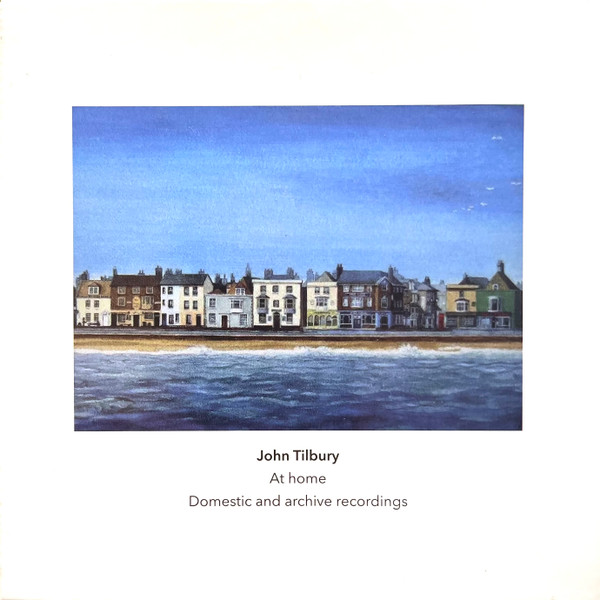
With bitter sweet sadness and joy, Another Timbre returns with what might just be its most important and evocative release of the year: ‘At Home’, an astounding, monumental box set, gathering X4 CDs worth of recordings by the legendary pianist, John Tilbury, that has been conceived as the final release of his career. Comprising incredible recordings made at home, ranging from 14th Century pieces by Guillaume de Machaut to new works by longtime friends like Howard Skempton, Michael Parsons, and Christopher Hobbs, as well as archival and new recordings of works by Cornelius Cardew, Christian Wolff, Morton Feldman, among others, and collaborations with Keith Rowe and numerous others, this astounding box set marks the end of an era on an incredible high, amounting to some of the most compelling music for piano that Tilbury has laid to tape during his long and truly remarkable career.
More than a century after Futurism, Dada, and Arnold Schoenberg’s 12-Tone Technique delivered their radical interventions with how we perceive the possibilities of sound and the making of music, the themes of “lost” and “found” remain a pressing concern. Being relatively obscure cultural positions, avant-garde and experimental music - the products of this early trinity, alongside the subsequent contributions of electronic innovators, and those working within jazz and freely improvised music - always present questions connected to what we have access to, or the degree to which we are aware of the full reality of activities. While reissues and archival releases over the last 20 or so years have taken great strides in attending to this condition, roughly the same period has witnessed significant losses of many of the context’s most innovative and important voices. Another Timbre’s latest release, ‘At Home’, builds a bridge between the two ends of this spectrum: that which is lost and that which is found. Gathering a wealth of material recorded at Tilbury’s home by the label’s own Simon Reynell over the better part of a decade, alongside previously unreleased archival recordings dating back as far as the 1970s, it has been announced as the pianist’s last release, effectively marking the end of his long and remarkable career. As heartbreaking as the notion of no longer anticipating further interventions by Tilbury with our hearts, ears and minds, we can’t imagine a more fitting end. Issued as a beautifully produced X4 CD boxset, accompanied by a 20-page booklet featuring extensive liner notes by Clive Bell, ‘At Home’ is poetic, virtuosic, and profoundly compelling. Six decades after he first made waves on the international scene, Tilbury goes out with a bang, delivering one of the best releases of his entire career as a fitting full stop.
There had always been a paradox to John Tilbury. A tireless promoter of the work of others, and the biographer of Cornelius Cardew, there is comparatively little within the public domain beyond the sprawling catalog of performances and recordings that he has produced over his long career. Born in 1936 and raised in London, he attended the Royal College of Music, where he studied piano under Arthur Alexander, before traveling to Warsaw at the height of the cold-war, where he studied with Zbigniew Drzewiecki and co-founded the Warsaw Music Workshop group with Zygmunt Krauze. Following his return to the UK, by the end of the 1960s his focus was entirely dedicated to the performance of contemporary music, particularly that of Morton Feldman, John Cage, and his close friend Cornelius Cardew.
Deeply principled and political, Tilbury’s musical legacy can be understood as being a living embodiment of the left: personal freedom expressed through collective participation, collaboration, and support. This is, perhaps, best gleaned through his relationship to The Scratch Orchestra; the group formally formed in 1969 by Cardew, along with the composers Michael Parsons and Howard Skempton, within which he was one of the earliest members. Enlisting professional, trained musicians and composers alongside amateurs, enthusiasts, and artists from different disciplines, The Scratch Orchestra was among the most radical groups of its moment, dedicated to non-hierarchical collective participation through a focus on improvisation and education, that counted many of the UK’s most striking musical figures as members: Christopher Hobbs, John White, Keith Rowe, Lou Gare, Michael Chant, Michael Nyman, Wendy Darling, Gavin Bryars, Brian Eno, Carole Finer, Stefan Szczelkun, Roger Sutherland, Hugh Shrapnel, Philip Dadson, Psi Ellison, and numerous others. While many of the principles embraced within the group continued to guide Tilbury over the course of his career, among the most striking aspects is his enduring dedication to the work of his fellow members - performing and recording it widely - especially that of Cardew, Parsons, Skempton, Finer, White, and Hobbs.
While Tilbury’s connection to legendary groups like The Scratch Orchestra and AMM - the groundbreaking group founded by Keith Rowe, Lou Gare, and Eddie Prévost in 1965 - which he helped reinvigorate into a new period of ferocious activity when he joined at the outset of the 1980s, has long dominated the broad public perception of the pianist and the lens through which his activities have been understood, his most important contributions to the contexts of avant-garde and experimental music are arguably of a quieter, more nuanced, and humbler sort: that of an interpreter, performer, and advocate of the work of others, as well as a visionary and singular improviser and collaborator with countless noteworthy figures - Derek Bailey, Keith Rowe, Eddie Prévost, Joelle Leandre, Marcus Schmickler, John Butcher, Thomas Lehn, Oren Ambarchi, Mark Sanders, Wadada Smith, John Edwards, and Bertrand Gauguet, among others, who span numerous generations of practice. In this, Tilbury has remained, since the 1960s, the UK’s closest equivalent to an artist like David Tudor, lending his virtuosic skill to the realization of the efforts of his peers, balanced against his own singular creative voice. It is precisely this spirit of activity that defines his final offering: ‘At Home’. As Simon Reynell illuminates in the album’s liner notes: “In 2018 John Tilbury became reluctant to take on more concerts. He lives in Deal on the Kent coast, 80 miles from London, and doesn’t have a car, so, although he was still in demand as a performer, at the age of 82, he decided to end his performing career. When I heard this, I asked whether - if I came to him - he would still be happy to be recorded at home. He said yes, and from then until spring 2026 I travelled to Deal every 6 or 9 months to record John playing piano and clavichord.. We recorded whatever John wanted to play at the time, and so assembled an unusual and varied collection of recordings ranging from pieces from Elizabethan songbooks to new compositions sent by old friends from Scratch Orchestra days.. In early 2026 - around the time of his 90th birthday - John decided that if we carried on much longer, he’d no longer be able to do justice to the music he was playing, and that we should stop.”
Upon the conclusion of the recording process, when curating what is conceived as his final release, Tilbury then decided to dig into his archive of previously unreleased recordings, placing some of the most striking of them, dating back to the 1970s, in conjunction with those made over the recent years. The result is a sprawling survey that offers a remarkable lens into his life’s work and many creative relationships: a roving journey that bends time and place. Across the album’s four CDs worth of material - 35 tracks in total, beginning with two dedicated to the 14th Century French composer Guillaume de Machaut - we are treated to sublime renderings of late works written for the pianist by Michael Parsons, Christopher Hobbs, Dave Smith, Mark R. Taylor, John Lely, Erika Fox, and Catherine Kontz, alongside stunning miniatures by Howard Skempton, stunning renderings of some of Cornelius Cardew's earliest piano pieces as well as ‘Volo Solo’ - conceived by the composer for Tilbury as an attempt to coin a new type of virtuosity - Linda Catlin Smith's ‘Poir’, Morton Feldman's ‘Madame Press Died Last Week at Ninety’ and ‘Piece for Four Pianos’ (along with Philip Thomas, Mark Knoop, and Catherine Laws), and Tilbury's own O'Hara Improvisations, interpreting performative drawings by Morgan O'Hara. Threaded among them are archive recordings reaching back to around 1970, including a stunning recording of Christian Wolff's ‘For Pianist’ as well as duos with Morgan O'Hara and Klaus Filip, an organ improvisation with Keith Rowe on electronics, ‘For Samuel Beckett’ made in collaboration with Sebastian Lexer during the London Musicians' Co-op Festival in 2005, and Tilbury’s own What is the Word, for voice and organ.
Over the course of its duration, ‘At Home’ unfolds as a journey across time and space, not only spanning the sounds that reach from early Renaissance France to some of the most radical and experimental works to have appeared during the half century - presenting a startling coherency and conversance throughout - but also an unprecedented crystallization of Tilbury’s long career and its many relationships and ideas. Particularly in the case of recent works written for him by longtime friends and collaborators like Howard Skempton and Michael Parsons - dating all the way back to Scratch Orchestra and earlier - it’s hard not to address the great loss that the pianist’s retirement will present as a vehicle and inspiration for their efforts. Yet, as it should be, every step of the way ‘At Home’ is a beautiful, challenging, and immersive affair, gathering together some of the most captivating music for piano that we can call to mind, allowing Tilbury to once again raise the bar and show us all how it’s done.
‘At Home’ marks the unquestionable end of an era as John Tilbury’s final release. Never to be outdone, his astounding virtuosity behind the keyboard calls out one last time on the monumental scale across these hours of recordings, gathered across the collection. He has given everything there is to give as an artist of his sort, and he does it again here, bringing a happy tear to those of us who count as his many fans.
Originally published by Soundohm.