“Rather than becoming an act of cultural appropriation or romantic Orientalism, the composer creates a fascinating and active dialogue between east and west, allowing attributes of both to be celebrated and complement each other.”
Having displayed an unparalleled dedication to his historical legacy and contemporary efforts alike, Soave returns with ‘Dusty Colors’, an astounding new full-length by Roberto Musci, one of the most enduring and important figures in the movement of Italian Minimalism. Utilizing the composer’s longstanding, singular approach to electroacoustic composition that first altered the collective consciousness back in 1984 with the legendary LP, ‘The Loa Of Music’ - intertwining field recording, samples, and Musci’s own instrumental interventions - ‘Dusty Colors’ draws its primary sounds from recordings and artifacts collected by the composer during two recent years of travel in India, sculpting a remarkable immersion, imbued with a profound sensitivity and generosity that marks a thrilling new high-water mark in his already astounding career.
Since its launch in 2017, the Milan based imprint, Soave, has remained one of our favorite labels working within the contemporary landscape of adventurous sound. While the label has dedicated significant efforts to illuminating ambitious works by a range of artists from a diverse number of geographies - Wolf Vostell, After Dinner, Ernst Thoma, Steve Birchall, etc. - the lion's share of their incredibly important work has been dedicated to illuminating radical works from Italy with reissues, archival releases, and contemporary efforts by Egisto Macchi, Tiziano Popoli, Arturo Stàlteri, Marco Dalpane, Riccardo Sinigaglia, Sandro Mussida, Piero Milesi, Daniel Bacalov, Giovanni Venosta, Giusto Pio, and Pier Luigi Andreoni & Francesco Paladino, among many others, bringing their efforts unprecedented levels of attention that they deserve. Among all the artists that Soave has worked with, few have been as emblematic of their initiatives as the visionary Italian composer Roberto Musci. In addition to reissuing his legendary and highly sought after 1984 debut, ‘The Loa Of Music’, they’ve reissued his equally important duo effort with Giovanni Venosta from the 80s and 90s, and offered a crucial platform for Musci’s always remarkable contemporary work, as in the case of ‘Goodbye Monsters’ that landed back in 2024. Now they continue this dedication to Musci with ‘Dusty Colors’, his latest, stunning full-length. Much like its predecessor, and a practice that traces its way all the way back to ‘The Loa Of Music’, ‘Dusty Colors’ draws on Musci’s lifetime of wandering the globe and explorations of its many musical traditions, in this case specifically those of India. In his own words, the album was “born from the encounter between Indian musical traditions, electroacoustic research, and sonic experimentation”, the fascinating juncture that he has been honing over a lifetime of work. Absolutely amazing, spanning twelve tracks across its two sides - each its own conceptual and sonic space with specific points of reference - drawing upon a sonic palette of extensive field recordings made in-situ, samples, and the composer’s own interventions on various instruments, Musci has radically expanded his creative explorations with ‘Dusty Colors’. Once again, the collaboration between Soave and Roberto Musci has borne remarkable fruit, cultivating some of the most striking work encountered from both.
Born in Milan in 1956, Roberto Musci began his musical endeavors as a student of guitar, alto sax, and various electronic instruments, before departing Italy and joining the hippie trail in 1974, staying on the road for roughly a decade, drifting between Africa, India, and the Near & Far East, studying music, making field recordings, and collecting instruments. Upon his return to Italy in 1984, he created his debut LP, the incredibly ambitious “The Loa Of Music”, a singular gesture that encountered the artist weaving recordings he had made during his travels with his own instrumental interventions, sculpting a unique practice at the outer boundaries of sampling and musique concrete, which would define much of his career over the decades since, most notably across an incredible series of albums made in collaboration with Giovanni Venosta across the 1980s and 90s. Gaining a steady following over the years, these albums would come to position him as one of the most important figures in the near undefinable movement of Italian Minimalism during the period that they emerged.
A fierce advocate of musical diversity, during the 80s and 90s Musci broadcast ethnic and electronic-experimental music on Rai and Radio Popolare, as well as composing for commercials, dance, poetry, theater, film, and playing with a vast range of artists - Claudio Gabbiani, Walter Prati, Giorgio Magnanensi, Massimo Cavallaro, Massimo Mariani, Moni Ovadia, Roberto Zorzi, Chris Cutler, Jon Rose, David Moss, Steve Piccolo, Elliott Sharp, Keith Tippett and the Third Ear Band - but has only released a slim catalog of solo work in recent years. Back in 2024, the appearance of ‘Goodbye Monsters’ seemed to indicate that the tide was shifting, illuminating that Musci was active as ever, and still traveling the globe extensively, a proof to which his latest, ‘Dusty Colors’, lays further and even greater claim.
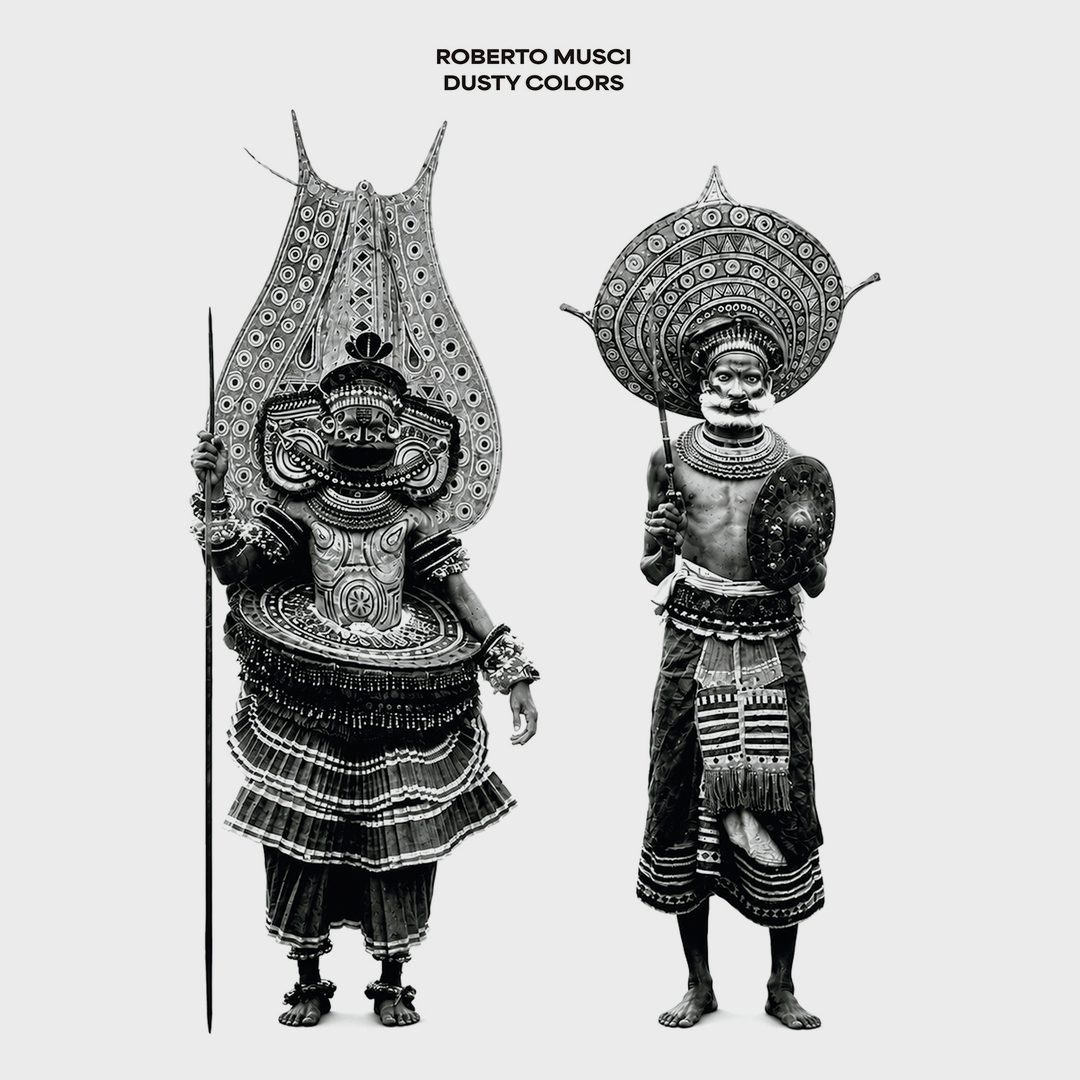
In Musci’s own words, ‘Dusty Colors’ is “a journey through traditional acoustic instruments, electronics, voices, and field recordings collected over the past two years along the dusty roads of India and inside Hindu, Sikh, Buddhist, and Jain temples. Real, geographical, and human fragments are transformed into soundscapes suspended between musique concrète, plunderphonics, sound art, and Indian music.” Across the album’s two sides, each piece presents a carefully constructed sonic environment of cultural expression, through which “Western music becomes an architecture of forms and tensions, while Indian music opens up a perceptual, meditative, and spiritual space. Sound becomes memory, journey, and knowledge.” While Musci has always pointed toward the sources and specific cultural contexts of his sonic material - be they samples of existing recordings or field recordings that he has made himself - the majority of previous releases have been constructed from sounds drawn from multiple geographies, across the globe, creating a democratic sense of equalization. ‘Dusty Colors’ is different. With the exception of the sounds that Musci creates and intervenes with himself, its sonic palette is entirely sourced from India, but the composer’s sensitivity, respect, and deep devotion to the country’s cultures and musical traditions, deftly navigates the pitfalls that many others have fallen prey to. Rather than becoming an act of cultural appropriation or romantic Orientalism, the composer creates a fascinating and active dialogue between east and west, allowing attributes of both to be celebrated and complement each other.
In many ways, the twelve tracks that comprise ‘Dusty Colors’ can be regarded as sonic entries in a travel journal, each referencing specific spaces that are populated by occurrences and cultural imprints - those occurring within, captured by field recordings, and those drawn from the broader society to which they belong - to be entered, explored, learned from, and entered into conversation with: the very thing that Musci does with his instrumental interventions. As he states: “my musical research approaches sound as both a journey and a way of knowing. To record, listen and collect instruments, voices, environments and sonic fragments is to enter into a relationship with cultures, spaces and ritual practices. Every sound carries a memory: not only musical but also geographical, symbolic and human.” As we encounter the fragments of ragas, rituals, the ambiences of temples and various environments, collaged, rearranged, and recontextualized, ‘Dusty Colors’ presents a slightly gentler touch than many of the composer’s previous efforts: the sonic sources integrating gracefully and allowed to retain a clear sense of their origins, rather than being wholly transformed by the collage techniques - creating uncanny, arrangements of bubbling sound fragments - for which Musci has been largely known. Even more strikingly, the generosity that pervades the album’s sounds is radically expanded by the dedicated digital space, accessed online by a QR code on each LP’s cover, that contains extensive texts by the composer highlighting pertinent aspects of Indian culture, music, and the creative process behind ‘Dusty Colors’, alongside images and videos, that unlock the project and broader spectrums of awareness in incredibly rich ways.
While ‘Dusty Colors’ belongs to Roberto Musci’s long career of sonic wanderings, incorporating themes of mysticism and the search for deeper meaning through sound, and is the unquestionable result of a lifetime’s refinement of a remarkable and entirely singular creative practice, it also represents a new, completely captivating evolution in his output that invites the listener into its intricacies on unprecedented terms. It’s truly engrossing and a joy for the ears and mind on every set of terms.
Originally published by Soundohm.