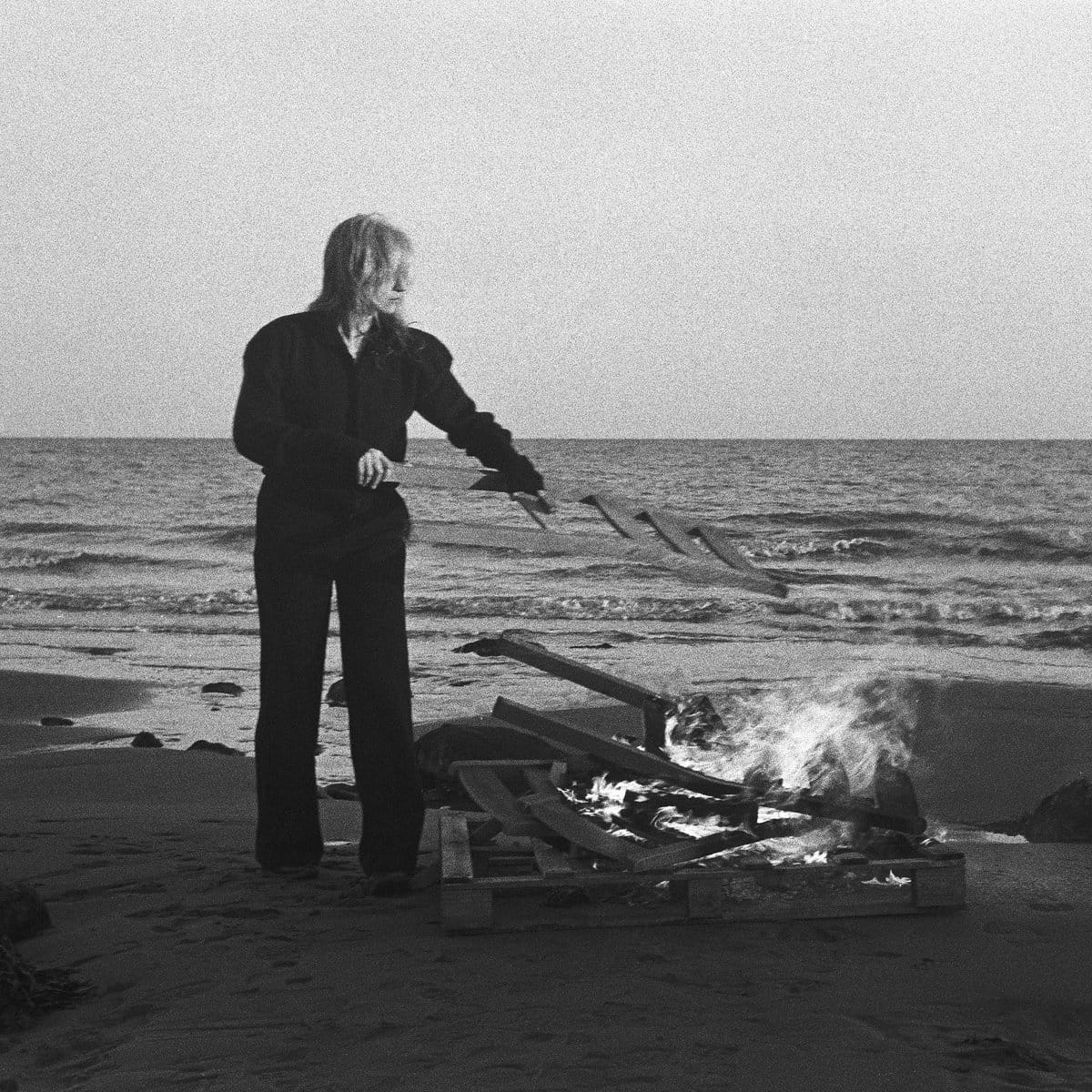
“Sublime and engrossing on creative terms, ‘Burning Song’ represents yet another remarkable stage in the composer’s immersive, highly singular sound world.”
Following an astoundingly prolific 2025, Ideologic Organ makes up the difference for a relatively quiet year with the weight of ‘Burning Song’, Kali Malone’s highly anticipated first solo full-length since 2024’s ‘All Life Long’. Recorded by the same trio that laid to tape the composer’s monumental ‘Does Spring Hide Its Joy’ - Malone on pipe organ, Lucy Railton on cello, and Stephen O'Malley on bowed guitar - across the album’s two sides we encounter Malone spinning her singular magic over seven remarkably concise and compact pieces, delivering introspective and emotive impact in a music that seems to transcend time and place.
Over the last decade, it’s been impossible to miss the ascending star of Kali Malone. Since first appearing on the Stockholm scene during the 2010s, the American composer has positioned herself as one of experimental music’s premier voices, channeling a practice that often reimagines and explores the contemporary possibilities of early and baroque tuning systems, culminating as a tense form of Minimalism that has captured the hearts of audiences across the globe. While certainly not limited to it - last year’s synthesis-based collaboration with Drew McDowall, ‘Magnetism’, being an easy example - a key feature of Malone’s work, particularly in live performance, has been working with church pipe organs, composing for their varied and specific tunings, within the spaces for which they were conceived. Her latest, ‘Burning Song’, does exactly this, emerging as the first contemporary work created on the “Bach Organ” at the Thomaskirche in Leipzig, where J.S. Bach was cantor for the final 27 years of his life and where his remains lie beneath the Church’s sanctuary. Enlisting the English cellist, Lucy Railton, and the American guitarist, Stephen O'Malley - marking the second recorded appearance of the all-star trio that recorded 2023’s ‘Does Spring Hide Its Joy’ - much like 2024’s ‘All Life Long’, we find Malone deviating from the explanted pathways of contemporary Minimalism, forgoing the tendency for durational composition in favor of the demands and challenges presented by shorter forms, stacking a stunning seven pieces across ‘Burning Song’s’ two sides. Sublime and engrossing on creative terms, ‘Burning Song’ represents yet another remarkable stage in the composer’s immersive, highly singular sound world.
Since an early flurry of activity housed on tiny cassette editions in 2016 - 'Black Gate', 'Tragic Chorus', etc. - and the appearance of her debut full-length, ‘Velocity Of Sleep’, the following year, the American composer, organist, and synthesist, Kali Malone, has been the closest thing to a wunderkind that experimental music might have, rapidly reaching heights of acclaim that few others ever have within the context. Raised in Colorado, Malone moved to Stockholm at 18 to study electro-acoustic composition, expanding her practice by learning to be an organ tuner, the instrument that has arguably best defined her presence on the experimental music scene. Her work - encountered live and via a steadily increasing suite of carefully crafted full lengths and EPs - deploys specific tuning systems in minimalist structure for pipe organ, choir, chamber music ensembles, and electroacoustic formats, imbuing it with rich harmonic textures, created through synthetic and acoustic instrumentation placed in repetitive motions and extended durations, imbued with a startling sense of emotive and dynamic depth.
Recently, collaboration has brought Malone into a new stage of development in her career, particularly evidenced by last year’s ‘Magnetism’, made and jointly billed with Drew McDowall; and her collaboration with Leila Bordreuil, ‘Music For Intersecting Planes’, that appeared earlier this year. While collaborative elements had begun to percolate within her efforts within live performances prior, this important development entered the wider consciousness via 2023’s ‘Does Spring Hide Its Joy’, her monumental, triple LP full-length, that enlisted the English cellist, Lucy Railton, and the American guitarist, Stephen O'Malley, into a trio formation. Neither O'Malley nor Railton need much introduction within the context of experimental music. O'Malley helped spearhead a newly reinvigorated underground metal scene in the United States during the 1990s as a member of Burning Witch and Thorr's Hammer, among other projects, before co-founding Sunn O))), the band with which he has become most associated. Shortly after co-founding the seminal metal imprint, Southern Lord, in 1998, O'Malley began to forge into more experimental waters, issuing solo efforts on imprints like Editions Mego, iDEAL, Table Of The Elements, Tapeworm, and Shelter Press, as well as collaborations with notables like Steve Noble, Oren Ambarchi, Randall Dunn, Anthony Pateras, François J. Bonnet, Thurston Moore, Mats Gustafsson, and others, witnessing a deep dedication to the context that would underpin the foundation of his founding of Ideologic Organ in 2011, as well as extensive work with a number of GRM associated projects and Mego. Railton, on the other hand, first emerged onto the London experimental music scene during the 2000s - founding the noted new music series, Kammer Klang, at Cafe Oto, as well as co-founding the London Contemporary Music Festival - and quickly became regarded as one of the most noteworthy cellists and young composers within the English context. Trained at the New England Conservatory in Boston and the Royal Academy of Music, since relocating to Berlin and other points, while collaboration remains central to her work, Railton’s solo work - particularly through 2025’s ‘Blue Veil’ - has increasingly taken center stage.
While certainly connected through its broader conceptual and technical frameworks, ‘Burning Song’ forgoes the long-form expanses of 2023’s ‘Does Spring Hide Its Joy’ - the preceding recorded encounter with the trio of Malone, Railton, and O'Malley - for seven shorter form pieces. With its first half commissioned for the 2023 Venice Music Biennale and presented at San Pietro di Castello, the album’s pieces marked the first instance since Malone’s childhood that she had used the piano to compose. Subsequently recorded over the course of two late nights in August 2025, at the historic Thomaskirche in Leipzig, Germany - the same church where J.S. Bach was cantor for the last 27 years of his life and was laid to rest - on its “Bach Organ”, with bespoke tuning and temperament systems based on historical norms of the baroque period. The performances were meticulously captured by Francesco Donadello who placed over 20 microphones throughout the space, achieving a finely tuned sense of location within the listening experience relating to the broader environment and each instrument - Malone’s organ, Railton’s cello, and O'Malley’s bowed guitar - within it. As each of ‘Burning Song’s’ pieces unfold, chords follow slow successions and transitions that are immersed in natural textures and ambiences produced by the space, collectively revealing introspective forms and moods, “built on discipline: structures that impose cyclical returns, the close labour of microtonal harmony”, unfolding more gradually and with more directness than many of her previous efforts.
Sublime, radiant, and consuming, drawing clear links between the concerns of contemporary experimentalism, those of historic Minimalism, and early and Baroque liturgical traditions, over the course of composing ‘Burning Song’ Malone recounts “feeling the weight of tradition lift, an ease of being determining the flow of the music”, perhaps because of the immediacy activated by the piano on which the compositions were begun, the totality of the album feels remarkably concise and compact, despite the scale of its sounds and what it takes on. ‘Burning Song’ is issued by Ideologic Organ in two stunningly produced vinyl editions (black and “glass clear”), housed in a tip-on gatefold sleeve with a printed inner, with liner notes by Jonathan Williger, and a 24” x 36” full-colour poster, as well as in a CD edition.
Originally published by Soundohm.