Hibiki Hana-Ma / Mycenae Alpha / Polytope De Cluny
*Restocked, reduced price* "Hibiki Hana-Ma" was created in 1969 for the Steel Pavilion of the Japan Iron and Steel Federation at the Expo 1970 in Osaka as musical part of a multimedia show. Even though the work does not bear the designation in its title, it can be already regarded as a Polytope: it was created for a specific architectural location, lasers and mirrors have been installed: a light choreography by the Japanese artist Keiji Usami accompanied the spectacle. This concept of synchroniz…

Diamanda Galás
Long out of print, Diamanda Galás' incendiary 1984-released second album is available once more, remastered by Brooklyn's Heba Kadry

Monochromes
*In process of stocking* “Tolimieri makes a universe of micro-nuance audible, with each piece consisting of hundreds, thousands or even tens of thousands of points of contact. Each point is just a little different from its predecessor. One by one, the points carry the music outwards, until the sound canvas is radiantly filled with the sensation of a particular touch.
The succession of Monochromes on these discs has a beautiful logic. I hear it as an attempt to “begin again”, to rediscover the pi…

drift nowhere past / the adventure of sleep
Rotterdam-based composer/pianist Reinier van Houdt created six pieces from March 22 to August 22, 2020 for a monthly 'quarantine' series of the online festival AMPLIFY 2020: quarantine, commissioned by Jon Abbey. Each of the six pieces on 'drift nowhere past' was recorded on the 22nd of each month (#18, #75, #128, #155, #194, #211). "I've made these pieces from what I played, listened to, recorded, played back, read, watched, heard, or imagined, each during one specific day in the quarantine of …

La Tempesta Colorata
Paradigm-shifting percussionist Valentina Magaletti stops time on 'La Tempesta Colorata', a long-form set that rolls thru tempos and time signatures with gymnastic flexibility, offering another spectacular entry to A Colourful Storm’s gravity-defying recent run of releases.
Magaletti is a regular and constant presence on these pages as a member of Moin, Vanishing Twin, Tomaga and CZN, as well as thru endless collabs with everyone from Floating Points to Nicolas Jaar, Jandek to Helm. For our mo…

Ocean
*Restored and remastered from the original tapes* "My task is to allow the listener to penetrate deeper into the music. The music is wholly improvisational. It has no concept in the rational sense of the word. It’s concept is purely intuitive. It presumes The Law of Analogies: “As above so below. Man is the same as the Universe. The Universe is the same as Man.” ("Emerald Tablet” by Hermes Trismegistus"). This intuition is a kind of rephrased logic which uses many more symbols which contain not …
Trio IX / Exercises
The American composer Christian Wolff (b. 1934) is the last living representative of the New York School (Rauschenberg, Rothko, etc.). Wolff was not even an adult when he studied with Grete Sultan and John Cage. Wolff’s music was much more politically motivated than that of Feldman and Cage, which is evident on this new Wergo album by Trio Accanto. The album features first recordings made in close collaboration with Wolff in the studios of Deutschlandfunk Cologne/Germany. Wolff's great “Trio IX …
Halleluja / Alle Vittime Senza Nome
*2022 stock* 'Halleluja, Peter Eötvös’s “stuttering oratorio”, with a text by the novelist Péter Esterházy, was first performed in 2016. It’s built around the historical figure of Notker Balbulus, Notker the Stammerer, a ninth-century Benedictine monk who was a chronicler and composer. But, Eötvös insists, “It is not so much a portrait of Notker as of the times in which we live … At first the choir represents a society that says ‘hallelujah’ to everything: they have to be satisfied with everythi…
Works For Double Bass
*2022 stock* 'Hans Werner Henze was, during his lifetime, probably the most-performed composer of western modern music, and his advanced yet sensuously traditional music remains an important presence on stages around the world today. Henze was deeply attached to Italy, where he spent a large part of his life. The roots of this album go back to a personal meeting between Henze and the Italian double bass virtuoso Daniele Roccato when Roccato was attempting to obtain Henze’s blessing for a theater…

Patterns In A Chromatic Field
'Morton Feldman has proved one of the 20th century’s most influential composers. Yet he remains one of its most enigmatic, and his late works retain an aura of mystery steeped with the grandeur, anxiety and quietly changing colour he adored in abstract expressionist painting and, latterly, Anatolian rug design. Patterns in a Chromatic Field (1981) is perhaps the most rhythmically active of these famously long, static pieces, which showed his increasing preoccupation with matters of form, scale a…

Suite 8 & 11 per pianoforte
Giacinto Scelsi (1905–1988) is one of the most unusual composers of the twentieth century, a unique figure whose importance was only fully recognized and celebrated after his death. During his lifetime, he was often dismissed, especially in Italy, as a pretentious dilettante because he did not notate his music himself. Beginning in the mid-1950s, he recorded his improvisations at the piano and had them transcribed by others. In this way, in the course of only a few years hundreds of piano pieces…

Music For The Double Life Of Amphibians (Landmark Recordings)
'The literal meaning of “amphibian” is “double life” and applies to animals living part of their lives in water and part of their lives on land. In the program note to his electroacoustic classic Music for the Double Life of Amphibians, Morton Subotnick states that “amphibian” is to be taken as a metaphor for the work’s structure and programmatic content, which follow a metamorphosis of being through the stages of amphibian to beast to angel. But it also applies to the musical material, the doub…
The Wild Beasts - Landmark Recordings
*2022 stock* Morton Subotnick achieved fame in the field of electronic music with Silver Apples of the Moon and The Wild Bull, his best-known tape works of the late 1960s. Since then, he has been active combining electronics with other media, notably employing gestural sketches on tape to alter sounds produced by voices and instrumentalists. The two works on this 2015 Wergo release are representative of Subotnick's methods, using a trumpet with a chamber ensemble in After the Butterfly, to reali…
Heliogabalus Imperator / Works For Orchestra
*2022 stock* The relationship between Hans Werner Henze and Oliver Knussen was one of great mutual respect. The German composer admired the British conductor and composer for electrifying performances of Henze’s own and other composers’ works. Knussen was an untiring and enthusiastic champion of his friend Henze’s music. The recordings collected here display Knussen’s deep understanding of Henze’s music. Knussen conducts the BBC Symphony Orchestra in sensitive and meticulous performances of comp…

Nam June's Spirit Was Speaking To Me
A spellbinding tribute from one multi-faceted artist to another. New York-based artist Aki Onda (b. 1967) conjured a transduction to the Korean multi-media pioneer Nam June Paik (1932-2006).

Cloud Shadows
*300 copies limited edition* Cloud Shadows is the third album by the American gamelan composer, Daniel Schmidt. The pieces in Cloud Shadows, which are quite varied and more current than the work represented on his first two albums In My Arms, Many Flowers & Abies Firma, mostly came about each in their own way. For example, the cloud shadows on the mountains of central Nevada, unimaginably old, invited Daniel into their realm, resulting in the opening composition ‘Cloud Shadows’. The composition …

In My Arms, Many Flowers
*New CD edition of sold out LP/CD* Recital is proud to publish the first album of American Gamelan composer Daniel Schmidt (b. 1942). Schmidt, who emerged in the Bay Area music scene in the 1970s, wove the threads of traditional Eastern Gamelan music together with American Minimalism (repetitive music). Schmidt was (and is still) a prime figure in the development of American Gamelan music – studying and collaborating with Lou Harrison, Jody Diamond, and Paul Dresher. He currently is a teacher a…
For Philip Guston
*2022 stock* Performed by Julia Breuer (flutes), Matthias Engler (vibraphone, marimba, glockenspiel, tubular bells), Elmar Schrammel (piano, celesta). Recorded 2007. One of Feldman's classic long-term late works, written in 1984. Wergo is proud to present Morton Feldman's four-hour-long trio For Philip Guston, performed by the ensemble Breuer-Engler-Schrammel. Feldman disagreed with those who regarded his works since the 1970s as being too long. 'In music, it's very difficult to distinguish betw…
Canti Del Capricorno
*2022 stock* Giacinto Scelsi wrote the twenty Canti del Capricorno between 1962 and 1972 for and with the Japanese singer Michiko Hirayama, who inspired them and who for decades remained their unique performer. The cycle is for solo voice, with instruments in some of the songs: a spiritual yet energy-filled music made of single sounds, microtonal inflections, breath, cries and invented syllables, closer to ritual than to song.
Hirayama, born in 1923, recorded it for Wergo when she came to Ulm in…
Nothing Is Real ...
CD with 20-page booklet. Recorded March 2001, Hessischer Rundfunk, Frankfurt. "Time and again I find myself having to pare away any musical gestures in a work in order to uncover the true idea in a piece." Alvin Lucier said this about his own practice of stripping composition back to its acoustic logic - removing the performer's ego, the expressive gesture, the narrative arc, until only the phenomenon remains. What is left, in each of the five works gathered here, is resonance: sympathetic vibra…

Phase Patterns / Pendulum Music / Piano Phase / Four Organs
"What I'm interested in is a compositional process and a sounding music that are one and the same thing" (Steve Reich, 1968). Minimal music, which numbers Steve Reich among its founders and as one of its most significant representatives, existed for hardly more than ten years. The Ensemble Avantgarde presents a wonderful survey of Reich's minimal music-compositions. The conceptional concentration in the musical work on the structurally simple means of its creation is seen especially in Reich's "…
s/t
Yiran Zhao makes use not only of musical elements but also of objects, bodies, movements and light-sources as compositional material. Many of her pieces inhabit the various boundary states between instrumental music, performance, sound-installation, and video-art. Leonie Reineke describes the composer in the CD-booklet as a “prudent researcher“, who encounters the sonic cosmos of her environment with great earnestness, and comes microscopically close to things.
In the composition “Piep“ she focu…
Earthing
"String quartet” seems a rather reductive way of describing any of the four utterly compelling works by Clara Iannotta that the Jack Quartet play here. For as well as demanding that the string players employ every conventional technique, the Italian composer extends their sound world farther, both with electronics and with “found objects” applied to the strings and bodies of the instruments.
The four pieces all date from the last seven years. The earliest, A Failed Entertainment, borrows the wor…
James Joyce, Marcel Duchamp, Erik Satie: An Alphabet
*2022 stock* This work began life as a radio play in 1982, a commission from and for Klaus Schöning and Cologne’s WDR. Working on the principles of collage, Cage brought together 15 unlikely characters – Narrator, James Joyce, Marcel Duchamp, Vocoder, Erik Satie, Jonathan Albert, Mao Tse Tung (as a child), Henry David Thoreau, Rrose Selavy, Thorstein Veblen, Buckminster Fuller, Brigham Young, and Robert Rauschenberg – who speak together, their dialogue comprised of literal quotations, freely ada…

Die Verwandlung des Zornes
*In process of stocking* The Zooming is implemented musically; it captures places on the globe that lie in a constantly narrowing field of view around the Kollegienkirche in Salzburg, the site of the piece's premiere. In the north and south, the latitudes represent the boundaries at 90° each, in the east and west, the longitudes at 180° each. The places where the four wind instruments play in the Kollegienkirche each lie on an imaginary line projected in the four different cardinal directions, n…
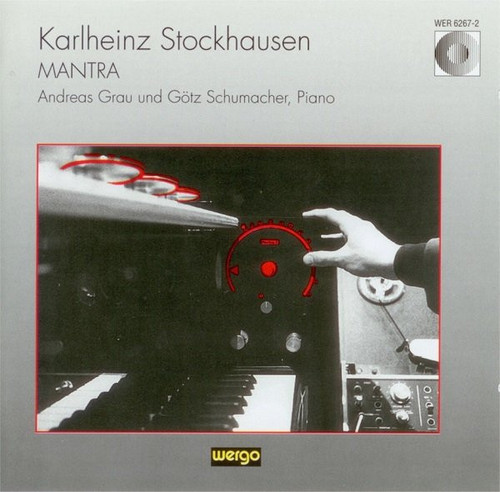
Mantra
'Composed in 1970, Mantra, for two pianos and ring modulation, was one of the decisive turning points in Karlheinz Stockhausen’s career. The 70-minute piece not only signalled a break with the text-based intuitive works, relying heavily on improvisation, that had come to dominate his output towards the end of the previous decade and a return to fully notated scores, but also introduced the idea of melodic formulae, the “mantra” of the title, which Stockhausen would eventually develop into the or…

Musica Da Camera
*2022 stock* The Polish composer Krzysztof Penderecki used to write chamber music even as a student in Krakow. He was writing the chamber music works for himself, then already an accomplished violinist, and his fellow students (The title "Sonata for Violin and Piano" from 1953 has only recently been published.). A specialty of these early works are Penderecki's inventions with which he altered the sound of the stringed instruments, indeed almost to the point of being completely unrecognizable. W…
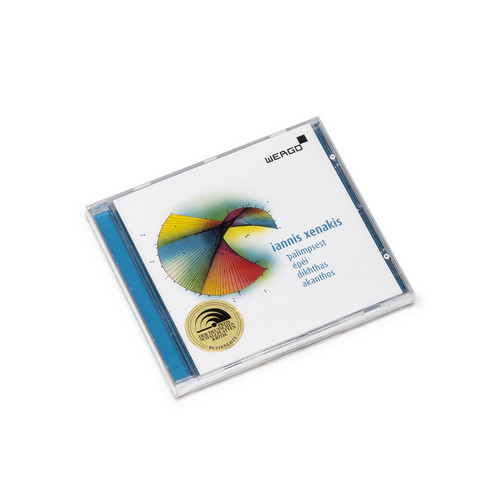
Palimpsest | Épéi | Dikhthas | Akanthos
*2022 stock* 'This collection of ensemble works, six altogether, ranges across the last two decades of Iannis Xenakis's life. It includes the last two pieces he composed, Zythos, for trombone and six marimbas, and O-Mega, for percussion and ensemble, both written in 1997, four years before his death. They are striking, small-scale examples of the bareness and drastic compression of his late style, but the finest music here is a bit earlier. In Échange, from 1989, a bass clarinet painstakingly un…

For Franz Kline · For Frank O'Hara · De Kooning · Piano Piece To Philip Guston
*2022 stock* Wergo presents Moton Feldman's compositions For Franz Kline · For Frank O'Hara · De Kooning · Piano Piece To Philip Guston. Performed by Ensemble Avantgarde.
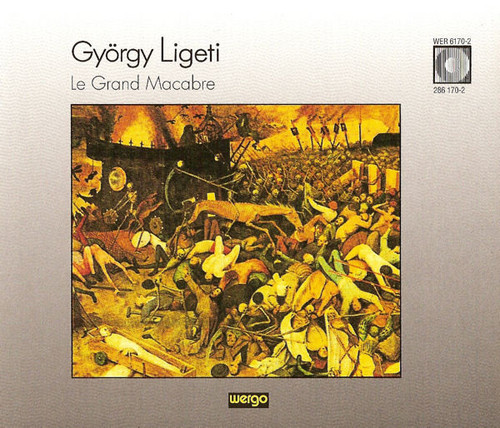
Le Grand Macabre
György Ligeti's only opera, Le Grand Macabre, is an entertaining, taut piece of musical theatre that sits somewhere between parody and ominous seriousness, between clowning and wisdom. Based on Michel de Ghelderode's play and set in the imaginary land of Breughelland, it follows Nekrotzar, alias the Grand Macabre, who has not only ambitions to suck blood but apocalyptic visions: he wants to bring about the end of the world personally, and fails.
Ligeti himself said its bizarre, exaggerated music…
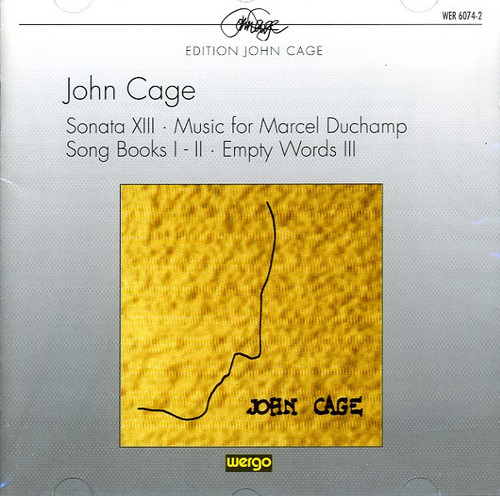
Sonata XIII / Music For Marcel Duchamp / Song Books I-II / Empty Words III
*2022 stock* John Cage's first manifesto, written in 1937, was called The Future of Music: Credo, and the future it described was an "all-sound music" open to every kind of noise. This volume of Wergo's Edition John Cage follows that idea across three decades, from the prepared piano of the 1940s to the vocal and spoken works of the 1970s.
Sonata XIII, from the Sonatas and Interludes, and Music for Marcel Duchamp are pieces for prepared piano, played by Peter Roggenkamp: screws, bolts and rubber…
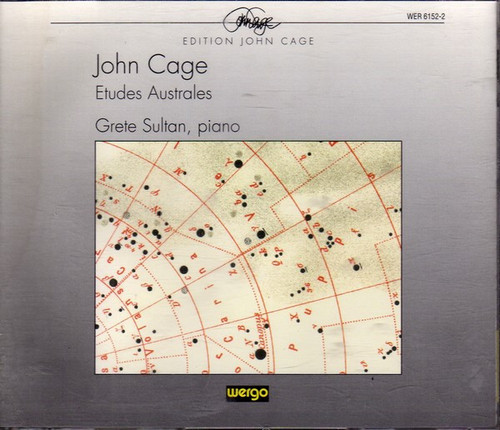
Etudes Australes
'Etudes Australes was composed specifically for Grete Sultan, so this album is among the definitive recordings. As an indeterminate piece for solo piano (okay, well, a "duet for two hands"), this sounds very similar to Music of Changes, Winter Music, etc. Here, though, Cage generates indeterminacy by turning once again to using star charts as tools of composition, as he did previously in the wonderful Atlas Eclipticalis.
In a way, I find the piano to be more suited to star charts than almost any…
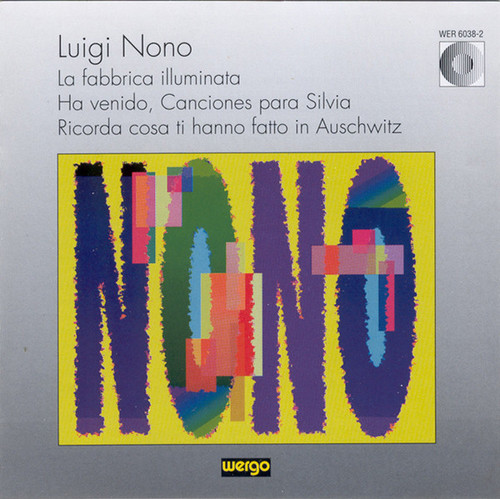
La Fabbrica Illuminata / Ha Venido, Canciones Para Silvia / Ricorda Cosa Ti Hanno Fatto In Auschwitz
*2022 stock* Magnetic tape for serial use is not the prerogative of Stockhausen or the French members of the GRM. On the other side of the Alps, at the RAI Studio di Fonologia in Milan, Luigi Nono worked for a long time on the development of a new form of theatrical composition. In the 1960s, his research led to the creation of a series of works that are difficult to classify: A floresta è jovem e cheja de vida (1966), Y entonces comprendió (1969-70), but especially La fabbrica illuminata from 1…

Continuum / Zehn Stücke Für Bläserquintett / Artikulation / Glissandi / Etüden Für Orgel / Volumina
*2022 stock* This CD of works by the Hungarian composer György Ligeti represents an extremely interesting combination of several of his serene works for harpsichord, organ, and wind quintet with two electronic compositions from the late 1950s.
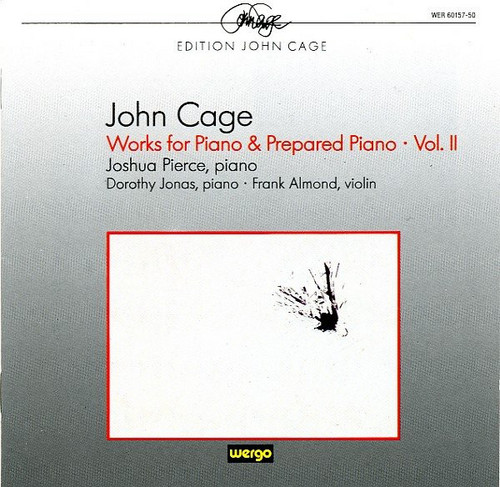
Works For Piano & Prepared Piano · Vol. II (1944-1958)
*2022 stock* This recording deals with works composed between 1944 and 1958, including several of Cage's lovely and masterful prepared piano pieces, which will come as a major surprise to those familiar only with his chance compositions. Joshua Pierce is the principal pianist (assisted by Dorothy Jonas on the Three Dances, written for two pianos) and attacks the pieces with a nice balance of delicacy and aggression, although compared to the earlier Angel recording of the abovementioned Three Dan…
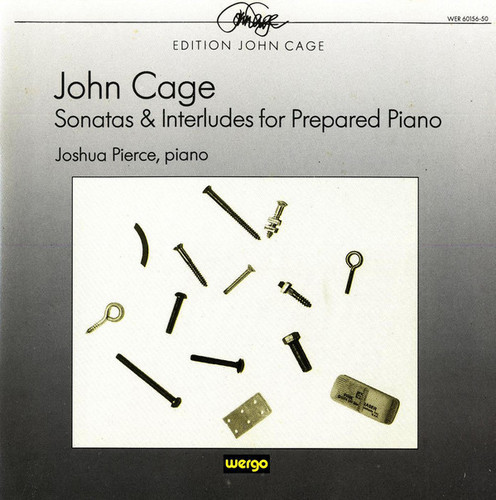
Sonatas & Interludes For Prepared Piano
*2022 stock* Sonatas and Interludes for Prepared Piano, a cycle of 20 short pieces for prepared piano (a piano modified by inserting nuts and bolts and other objects between the piano strings in order to produce percussive and otherworldly sound effects) by American composer John Cage. Created in 1946–48 after the composer had been introduced to Indian visual and performing arts, the cycle was intended to represent the so-called permanent emotions—the heroic, the erotic, the wondrous, the comic,…
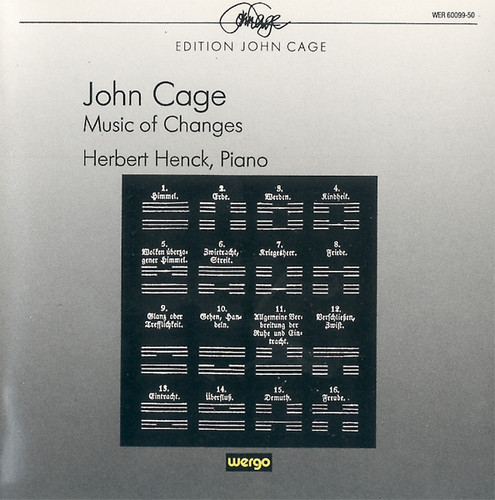
Music Of Changes
*2022 stock* It's over 70 years since John Cage wrote his pivotal Music of Changes, and it's beginning to show its age. It feels very much of its time, with its uncompromising adherence to the 64 hexagrams of I-Ching, the Chinese book of changes, determining the direction of the piece and its use of sudden, percussive attacks on the strings or the body of the instrument. But for all that there is no denying the extreme stamina and concentration required of the performer, and here Herbert Henck e…
Four Organs / Phase Patterns / Pendulum Music
Three early compositions (1968-1970) by Steve Reich, one of the most prolific exponents of minimal music, in stunning interpretations by the critically acclaimed Ensemble Avantgarde. Available on vinyl (180gr, gatefold sleeve incl. download code) for the first time ever!
Kontakte
Kontakte is a Stockhausen classic from 1959, for electronics, percussion and piano (played here by David Tudor). One of his "moment form" compositions, which "...lead up to no climax, nor do they have prepared, and thus expected, climaxes, nor the usual introductory, intensifying, transitional, and cadential stages which are related to the curve of development in a whole work; they are rather immediately intense and -- permanently present -- endeavor to maintain the level of continued 'peaks' up…

Strahlen
*2022 stock* The origins and technical content of Strahlen (‘Rays’), a work left incomplete at the time of Stockhausen’s death, are complicated. It’s best to watch the documentary about the work before hearing it through, so that your mind’s eye is tuned in to what is going on, and what lies behind the concept and techniques used in its realisation.
Part of the genesis of Strahlen was a desire to create a ‘virtual vibraphone’ with the ability to play extended notes, dynamic crescendos and freaki…