We use cookies on our website to provide you with the best experience. Most of these are essential and already present.
We do require your explicit consent to save your cart and browsing history between visits. Read about cookies we use here.
Your cart and preferences will not be saved if you leave the site.

Merzbow

Masami Akita was born in 1956 in Tokyo, Japan. Akita is a graduate of Tamagawa University, Art Department, and majored in Painting & Art Theory. Akita formed the premier Japanese Noise group Merzbow in 1979. Merzbow have released over 300 recordings, on tape, LP and CD, to date, working with many different media such as video, film and CD-ROM, both in the directorial and soundtrack role.

 

Masami Akita was born in 1956 in Tokyo, Japan. Akita is a graduate of Tamagawa University, Art Department, and majored in Painting & Art Theory. Akita formed the premier Japanese Noise group Merzbow in 1979. Merzbow have released over 300 recordings, on tape, LP and CD, to date, working with many different media such as video, film and CD-ROM, both in the directorial and soundtrack role.
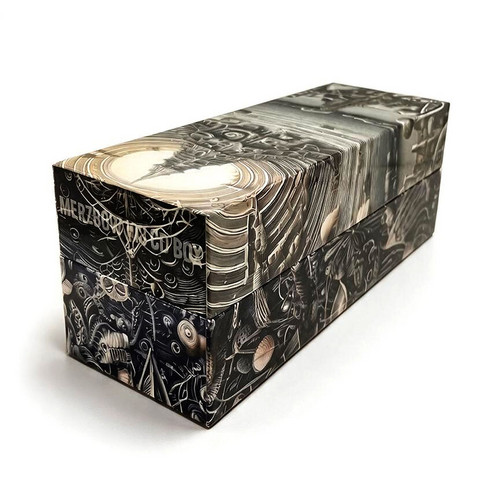
 

Double Beat Sequencer Vol.2
Double Beat Sequencer Vol.2 continues Merzbow’s deep dive into a particularly vicious corner of his archive: mid‑2010s sessions built around a relentless “double beat” framework, then buried under signature torrents of noise. Where Vol.1 sketched the template - rigid sequencer patterns hammered into shape and then abused - this instalment feels even more single‑minded. A handful of cycling pulses become the spine for entire pieces, driven by a strict, mechanical insistence that Masami Akita trea…
Double Beat Sequencer Vol.1
Double Beat Sequencer Vol.1 finds Merzbow threading a hard, skeletal pulse through the heart of his noise, treating rhythm less as a scaffold for genre than as another engine of excess. Across these tracks, fixed and cycling beats - the “double” sequences of the title - form blunt, looping structures that Masami Akita subjects to his typical barrage of distortion, feedback, metallic scree and feral electronics. The result is not noise suddenly tamed, but rhythm subjected to the same merciless tr…
TripleAkuma
TripleAkuma is the third in a series of essential live documents from Merzbow. The stage and the studio are not the same place, and Merzbow has an acute understanding of this juxtaposition. Whilst the sheer density of the music might be maintained across both spheres, the live experience of Merzbow is truly something that exists as profoundly physical and moreover, overtly performative. Merzbow’s live methodologies draw not just from a saturation of frequency at all levels, but a recognition of …
Remblandt Assemblage
One of the most essential early documents of Japanese noise, originally recorded and mixed at home in 1980 and released in 1981 on cassette by Lowest Music & Arts, now given the physical treatment it always deserved: a 2LP set housed in a natural birch wooden box with laser print, hand-numbered edition of just 99 copies. Ninety-nine! With a double-sided 42 x 60 cm poster, heavy card insert reproducing the original master tape cover, and black cardboard strip with album credits. An art object, pl…
Tapestry Of Noise
** 2026 Stock **  If Laptop Noise looks forward into the blinding glare of the digital, Tapestry of Noise looks outward and backward, unspooling an expansive grid of analogue and hybrid recordings that show how Merzbow’s classic language was woven together in the first place. Slowdown’s 6CD expansion assembles long, previously scattered or hard‑to‑access works into a single, overwhelming fabric that moves from twitching tape‑loop delirium to fully seared harsh‑noise architectures. Early discs re…
Laptop Noise
** 2026 Stock ** Laptop Noise zeroes in on the period where Merzbow’s long‑running practice of junk‑metal abuse, feedback and tape saturation is rechannelled through the seemingly modest frame of a computer. Across six discs, this edition amplifies the original’s premise into a deep survey of his fully digital soundworld: long‑form works where full‑spectrum distortion, high‑frequency shrapnel and seething low‑end swarm are carved into towering blocks, then eroded into swarms of microscopic detai…
Kachouzu
On Kachouzu, Merzbow compresses his late‑period harshness into four short movements, a 2×6″ lathe‑cut blast where metallic textures, searing feedback and dense midrange roar behave less like tracks than like successive cross‑sections of the same noise storm.
Pendulum
**200 copies, sold out at the label** New single from the undisputed god of Japanese noise. Masami Akita - the man behind Merzbow - returns with two tracks recorded in February 2024 at Munemihouse, his legendary home studio in Tokyo. Two sides of pure sonic assault that swing just as the title suggests - "Pendulum, Part 1" and "Pendulum, Part 2" - masses of frequencies in constant motion, pendulums of noise crossing the sonic spectrum with the violence and precision that only Akita can orchestra…
Gman+
Gman+ gathers some of the most elusive material from Merzbow’s 2011–2012 period and welds it into a single, punishing disc, four tracks that function as both archival rescue and self‑contained statement. The collection pulls together work originally issued in limited form, recasting it as a crucial chapter in the same cycle that produced Kumo No Zettaichi, Sugamo Flower, Bit Bluesand Kotorhizome. Across “Gman”, “HJYUGTF2”, “Hakutouwashi” and “Lop 13”, Masami Akita works out a language of layered…
Kotorhizome
Kotorhizome catches Merzbow in a phase where noise stops behaving like a vertical wall and starts acting more like an underground network. Recorded between 2011 and 2012 and released later as part of the Slowdown archive cycle, the album is built from a deceptively modest setup: small koto, synth, and drone box woven into three extended pieces. The title fuses “koto” with “rhizome,” hinting at what the music does structurally - traditional string resonance is fed into electronics and allowed to …
Bit Blues
Bit Blues sits in the middle of Merzbow’s Horizon cycle like a scorched signpost, three tracks cut from performances recorded at Munemihouse in 2011 and 2012 and later remastered in 2021. All the music is by Masami Akita, working with a small, intensely exploited setup that favours dense, bit‑crushed textures and overdriven loops over the more sprawling configurations of earlier decades. The title points in two directions at once: “bit” as in digital grain and reduced resolution; “blues” as in a…
Sugamo Flower
Sugamo Flower compresses a particular 2011 moment in Merzbow’s practice into two long tracks that feel like one continuous, mutating organism. Both pieces are sourced from performances recorded that year, later repurposed as material for “Sugamo Flower Festival” on the split LP Freak Hallucinations with Actuary (2012), which gives the album a double life: document of an event and quarry for subsequent work. Central to the sound is the return of the Korg AX30 multi‑effect pedal, a unit Masami Aki…
雲の絶対値 Kumo No Zettaichi
On Kumo No Zettaichi, Merzbow trades drum violence for a hall of hovering machines, two 2011 pieces where small drone boxes, oscillators, and minikoto threads knot into a dense but strangely weightless sky of electric weather. It is harsh ambient as charged cloud bank rather than blunt impact.​
Arijigoku (Test Mix)
On Arijigoku, Merzbow drags live drums and high-saturation electronics into the same pit, a 2008 vortex where blast-beat turbulence and molten noise spiral together like a ritual gone feral. It is harsh music with a striking sense of propulsion, less wall than constantly collapsing tunnel.
Yono's Journey
Yono's Journey invites listeners to travel through Akita's sonic landscapes, perhaps following an animal guide. Merzbow turns a 2007 home-recorded session into a three-part storm, where hyper-saturated feedback and low-end throb fold into each other like a moving landslide. It is Japanoise as pure velocity: no narrative, just impact reshaping the inner ear.
Black Rome
The ominous title evokes fallen empires, decadent excess, historical weight. Rome - eternal city, center of classical and Catholic civilization - becomes "Black," suggesting inversion, corruption, death. Perhaps this is Rome during plague, Rome in ashes, Rome as symbol of all empires' inevitable decline. Black Rome channels these associations into dense, imposing noise constructions demonstrating apocalyptic intensity. Empire rises and falls; Merzbow provides the soundtrack to collapse.
Electronic Union
Electronic Union suggests synthesis, merger, coalition - multiple electronic elements combining into unified sonic statements. These mid-2000s recordings demonstrate Akita's mature integration of diverse digital techniques, creating hybrid approaches transcending any single method. "Union" implies collective action, solidarity, workers organizing - perhaps the various electronic components forming their own labor movement against conventional music's exploitation.
Merzbird Variation
Merzbird (Important Records, 2004) stands among the most celebrated laptop-era releases. This "Variation" offers alternate perspectives on that material - different plumage for the same sonic creature. Bird imagery connects to Akita's growing animal rights consciousness while invoking bird-inspired composition traditions from Olivier Messiaen to contemporary field recording. The bird represents freedom, flight, song - yet also vulnerability, threatened ecosystems, species extinction. Merzbow's b…
Plasma Door
The evocative title conjures thresholds between states of matter - solid becoming liquid becoming gas becoming plasma. Plasma Door captures Merzbow at a moment of material transformation, sound itself seeming to change state under extreme pressure. Plasma - the fourth state of matter, found in stars and lightning - represents extreme energy, matter pushed beyond normal limits. The "door" suggests passage, transition - portals to altered perceptual states. Listeners passing through this door ente…
Sphere Sessions
Sphere Sessions suggests three-dimensional sound constructions - recordings enveloping listeners in dense, immersive noise environments. Akita's spatial awareness reached new sophistication in these mid-2000s productions - creating environments rather than merely sequences of events. The sphere represents perfection, completeness, infinite symmetry - yet these sessions likely explode such ideals, fragmenting smooth surfaces into jagged shards. The tension between geometric perfection and sonic c…
1 2 3 4 5 6 11 15