Philip Glass
Philip Glass began from premises similar to Steve Reich's but shunned Reich's austere science and always remained closer to popular music than to classical music. He moved away from the arduous repetitive patterns of Music In Twelve Parts (1974), rediscovered melody and approached the format of the opera from a different perspective with Einstein On The Beach (1976). Movie soundtracks, operas and collaborations with pop/rock musicians became his preferred media.

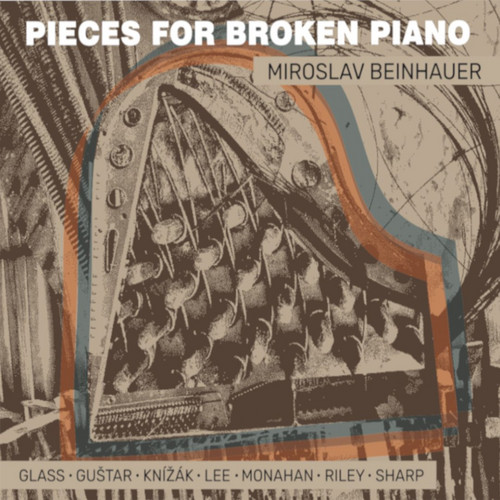
Pieces For Broken Piano
Pieces for Broken Piano turns a weather‑wrecked 1916 Gebrüder Stingl grand into an accidental “prepared” instrument, as Miroslav Beinhauer navigates new works by Terry Riley, Philip Glass, Milan Knížák, Gordon Monahan, Elliott Sharp, Milan Gustar and Yoon‑Ji Lee written specifically for its fractured voice.

Glassworks
Philip Glass’s seminal 1982 album Glassworks remains one of the most influential and accessible works in contemporary classical and minimalist music, bridging the worlds of concert hall and popular listening with timeless elegance.
Originally conceived as a “Walkman‑suitable” work, Glassworks was designed for intimate, personal listening on cassette, with a special headphone‑oriented mix that brought listeners deep inside Glass’s intricate, pulsing sound world. The album’s six short, vividly con…

Kronos Quartet Performs Philip Glass
On Kronos Quartet Performs Philip Glass, Kronos Quartet turns four string quartets into a self‑portrait of the composer, charting his path from theatre and film scores to music written directly for the group, all in a language of pulsed clarity and slowly deepening harmony.

Einstein on the Beach
The concert version of Einstein on the Beach by Ictus, Suzanne Vega, and Collegium Vocale Gent distills Philip Glass’s pioneering minimalism into a mesmerizing sound ritual. Stripped of Robert Wilson’s grand staging, Vega’s measured narration weaves through the ensemble’s crystalline precision, revealing the raw musical architecture of this modernist epic.

Philip Glass: The Complete Piano Etudes
Vanessa Wagner breathes new life into Philip Glass: The Complete Piano Etudes, revealing the powerful lyricism and subtle turbulence of Glass’s minimalist language. Her interpretation brings emotional intensity and poetic nuance across all 20 etudes, reflecting over a decade spent exploring the repertoire and making for an immersive listening experience.

Music with Changing Parts
Founding work of minimalism, Music with Changing Parts is a piece with free instrumentation. The musicians choose which part to play among the 8 staves of the score. At each indicated cue, the musicians can change part, which produces an abrupt change of instrumentation. While the music is based on a melodic material limited to a few notes that are repeated in patterns that expand or contract, the changes in orchestration refresh the listening experience by producing sonic contrasts. These tec…

Minimalist
1990 release ** "This superb collection of works by 20th century minimalist composers spotlights works written for string orchestra. It opens with John Adams' Shaker Loops, a piece with strings set on rapid tremolo throughout -- creating a beautiful, shimmering quality counterbalanced by an aggressive scrubbing sound. Steve Reich's Eight Lines -- a reworking of his incredible 1979 work Octet, scored this time for string orchestra and piano -- is a real gem. The orchestra moves like a well-oiled …

Philip Glass concert / Richard Serra film
Rare invitation card to a 1972 event at Leo Castelli Gallery in New York presenting music by Philip Glass and film by Richard Serra.

Anahit / Mikka / Mikka “S”/ Strung Out
Absolutely essential 1976 ambient/modern classical compilation of solo violin music by three legendary composers.

Solo Music
A Shadar milestone of electric minimalism, a great copy of the original Philip Glass 1975 LP for your aural pleasure.

Music in Similar Motion / Music in Fifths
Original 1973 first press of the second LP issued by Glass on his own Chatham Square label. A dizzying and glowing hypnotic mass of classical minimal avant-garde.

Music With Changing Parts
Original 1971 first pressinng of Philip Glass' 2LP masterpiece on the composer's own semi-private Chatham Square label.

4 Pianoforti
Great catalogue of this 1999 event of legendary minimal piano performances in Rome.

Goebbels/Glass/Radigue
*2024 stock* Erwan Keravec's 4th opus devoted to contemporary music, Goebbels/Glass/Radigue features a trio of contemporary music maestros. Evocative, minimal or sensitive, 3 very different ways of imagining music. Heiner Goebbels places the bagpipes in the mountains, then abruptly in an industrial landscape, all the while quoting Bach, while Philip Glass' music uses the repetition of 5 notes served by continuous breathing. Finally, Eliane Radigue brings the instrument closer to intimacy.

John Giorno, William Burroughs, Laurie Anderson, Philip Glass, Patti Smith, Allen Ginsberg, Frank Zappa
You're A Hook** Original copies of this rarity. Factory sealed. Few copies available ** A Dial-A-Poem Poets life-centering collection of different ensembles of speakers with and without instrumental music. Works by Amiri Baraka, William S. Burroughs, Jim Carroll, Jayne Cortez, The Four Horsemen (B.P. Nichol, Steve McCaffery, Paul Dutton, Rafael Barreto Rivera), John Giorno, Brion Gysin, Rose Lesniak, Ned Sublette.
"Mutant Disco was the big thing downtown, and Giorno wanted a piece of it. The irritating ran…
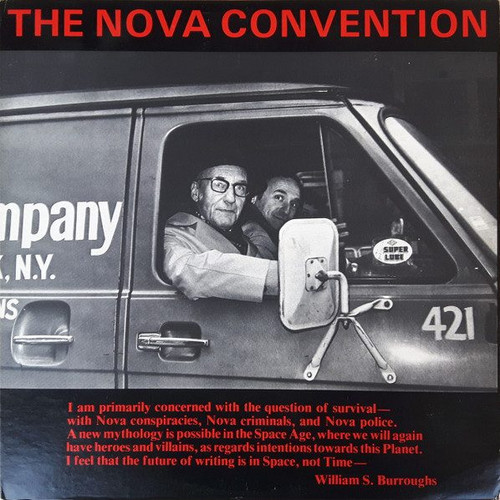
The Nova Convention
** Original copies of this rarity. Factory sealed. Few copies available ** In 1978, Semiotext(e) founder Sylvere Lotringer approached John Giorno about organizing a tribute to William S Burroughs, bringing together European and American academics for a series of seminars, celebrating the writer as a "philosopher of the future", someone who best understood postindustrial society. Giorno was more interested in a counterculture event that would feature musicians, poets, novelists and artists along…
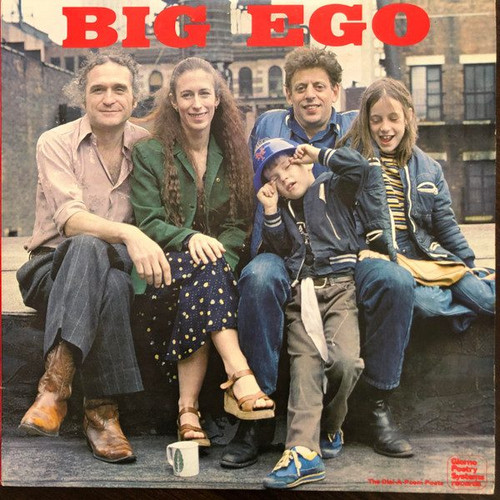
Big Ego
** Original copies of this rarity. Factory sealed. Few copies available ** The seventh in the Dial-a-Poem Poets LP series. Iconic cover featuring Giorno posing with Philip Glass, Meredith Monk, and two children in a park. It also features Robert Ashley's “Interiors with Flash” a study for what would become 'Automatic Writing' "Yet another fine album title from Giorno Poetry Systems, which could apply to any organisation or person applying any form of censorship on the already dead forms of med…

Solo Piano
With Solo Piano, Glass presents himself “unplugged” - no electronic keyboards or synthesizers, and no overdubs, either - just solo piano. “Metamorphosis” was written in 1988 and takes its name from a play based on Kafka's short story. Its second track, “Metamorphosis Two”, formed the basis of one of the main musical themes in the film “The Hours”. It is also the song that the American rock band Pearl Jam uses as their introduction music to concerts. “Mad Rush” was written for the occasion of the…

Music In Fifths / Two Pages
Cantaloupe continues its recording series of the masterworks of the music of our time with this brilliant disc of two early classics by composer Philip Glass, performed by the Bang on a Can All-Stars. Glass is arguably minimalism's most well-known and influential composer. Before film soundtracks, operas, and universal acclaim, there were these intense, rugged, and demanding early works for keyboard. In Music in Fifths and Two Pages, Philip Glass's ideas are at their most basic, using only addit…

Behind the facts. Interfunktionen 1968-1975
** 2021 Stock. In process of stocking** Hard-cover. Cloth boards issued without dust jacket offset-printed sewn bound. Critical anthology of the art journal Interfunktionen, an art journal which published 12 issues between 1968 and 1975 in Cologne, was founded in 1968 as a form of protest by artists who had no affinity with the critical lines that were redrawn at Documenta that year. The review was of considerable importance as a vehicle for propagating pro-European ideas and as a union between …