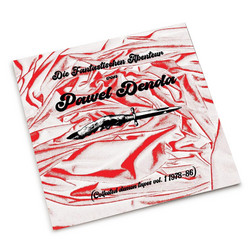
** Limited edition of 100 copies. Including 2 exclusive stickers and a signed statement ** Die Fantastischen Abenteuer von Pawel Denda arrives already wreathed in rumor, staging its own origin story like a low-lit exploitation film. Pawel Denda is introduced as a pre‑WW2 Polish-born priest who dies in Rome at the end of the last century, having supposedly lived a double life of criminality, vice and collaboration: “paedophile, dangerous criminal, whore monger, homosexual, nazi collaborationist… plus, anything worse you can imagine about a fucking Polish priest.” This deliberate excess is the project’s first key: it doesn’t ask to be read as straight biography so much as grotesque caricature, a concentrated symbol of corruption projected onto the figure of the cleric. The record’s fantasia works because it leans all the way into that lurid premise, then translates it into sound.
The narrative continues with Pawel wandering through central Europe before reaching Rome, where he befriends painter Bruno Barborini. Before his death, Pawel leaves Bruno a box, asking him to hide it somewhere in his house until “the elects” would one day find it. Years later, that prophecy allegedly plays out: Marcos Barbos Rodriguez, Bruno’s son, and Frather Rudolf von Old Europa, cleaning a basement crammed with forgotten objects, discover the box and its contents - a series of manuscripts and music cassettes all written and recorded by Pawel. In the story, the dead priest “comes from the past” and instructs Marcos and Rudolf to bring his corrupt life and sounds to the masses. It’s a perfectly circular myth: the material is tainted, the messenger is tainted, the act of re‑presentation is tainted, and the record revels in that triple contamination.
Sonically, the album is billed, with characteristic misspelling and bravado, as “best SataniK Industrial-Pop arriving directly from the past & going into the future.” That phrase sketches out its aesthetic position. On one axis, it taps into the feral theatrics of industrial music - distortion, ritualized noise, processed voices, crude rhythms, and an obsession with institutional violence and religious imagery. On another, it toys with pop forms: hooks that surface then are shredded, danceable grooves buried in abrasive textures, choruses that feel more like curses than sing-alongs. The “Satanik” tag signals not theological depth but a gleeful inversion of sacred symbols, mirroring the invented biography’s gleeful debasement of the priestly figure.
The framing text’s litany of insults is clearly over the top, yet that overstatement performs an important function in the listening experience. It warns the audience that this is not a cautious or polite critique of power, but a full-on splatter of rage, sarcasm and decadence against religious authority and historical guilt. The supposed tapes and manuscripts in Bruno’s basement become a convenient device for staging a time slip: Pawel’s fictional recordings are presented as artifacts of a corrupt past that nonetheless speak fluently to the present, when institutional abuses and their cover‑ups still dominate headlines. The “from the past & going into the future” tagline suggests that the record treats history not as something closed, but as an open wound whose pus can still fuel new music.
At the same time, the project’s camp excess and tongue‑in‑cheek mythology prevent it from collapsing into simple moral outrage. There is a sense of gleeful bad taste at work, a willingness to push every trope too far and to let the grotesque remain grotesque rather than redeeming it. The involvement of Marcos Barbos Rodriguez and Frather Rudolf von Old Europa is cast in mock‑hagiographic terms, as if they were chosen to act as apostles of Pawel’s “corrupt life & sounds.” That mock‑hagiography mirrors the structure of religious storytelling - relics discovered, instructions from beyond the grave, a mission to disseminate - but flips it by turning the “saint” into an avatar of everything the institution claims to suppress.
Die Fantastischen Abenteuer von Pawel Denda ultimately operates on several levels at once. It is, at its most immediate, a blast of noisy, theatrical industrial‑pop that delights in its own transgression. It is also a meta‑narrative about how underground cultures create and recycle myth, using invented biographies and found‑object stories to lend weight and texture to sound. And it is, beneath the bluster, a dark joke about faith, guilt and the impossibility of clean histories, suggesting that sometimes the only honest way to talk about institutional rot is to exaggerate it until it becomes monstrous, then set that monster to a brutal beat.