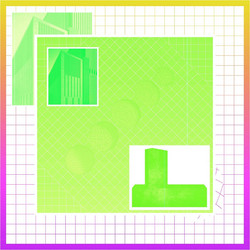
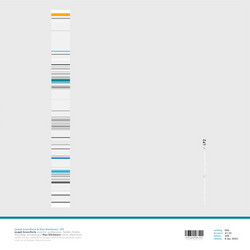
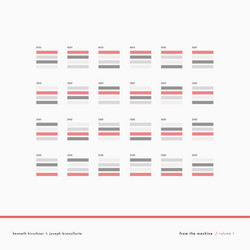
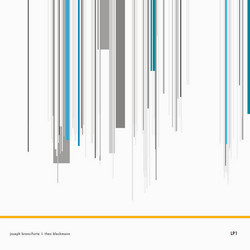
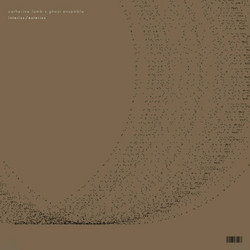
Iterae is issued as a multi-disc edition designed for both shelf and wall—referencing the scale of the vinyl LP while quietly subverting its familiar expectations. The format distributes the album's material across four 80mm compact discs. Each disc can be played independently or sequenced freely, extending the music's own recursive methodology into its physical presentation. A full-sized compact disc is included on the rear for continuous playback. The design incorporates an integrated rear wall-hanging tab for display as a fixed visual work. Here, the playback medium itself is treated as a sculptural form, reframing the album as a physical system—a site of logic rather than nostalgia.
Iterae links two performers from opposite sides of the Atlantic known for their transformations of Fender Rhodes electric piano. Jozef Dumoulin is a Belgian keyboardist recognized for his role in redefining the Fender Rhodes as a 21st-century instrument, forging a highly personal musical language through extensive electronic manipulation. Joseph Branciforte is a composer, producer, and fellow Rhodes experimentalist known for bridging acoustic and electronic worlds in collaborations with Theo Bleckmann, Taylor Deupree, and Ryuichi Sakamoto. Both performers are fluent improvisers, with musical vocabularies drawing broadly from jazz, electronic, and contemporary music.
Here, however, the focus is squarely on distillation: small fragments captured, transformed, and recombined into cascading, lattice-like structures. The result is a sound that merges aspects of the early glitch movement with bold explorations of harmony and form—weaving together threads from modern classical, electroacoustic, and ambient to create something decisively of the present.
Recorded over two days in New York, Iterae captures the artists' first ever musical encounter—a fact belied by the depth of their interaction. The performances center around two separate Rhodes pianos, each artist applying his own array of processing and effects. In addition to sound generation, Branciforte harnesses a custom live editing system—designed to process both musicians' outputs in real time. This software allows him to capture and reconfigure musical material on the fly, creating architectural patterns and layers from small details within the unfolding improvisation.
The music unfolds with an unbroken focus and sense of direction, dense tapestries of glitches giving way to moments of deeply intuitive, harmonic convergence. The juxtaposition of open-ended improvisation and the precise, methodical compositional vision for which Branciforte is known creates a dynamic interplay, where flow and memory, improviser and editor remain in constant dialogue. At 70 minutes, the release is one of the longest in either artist’s catalogue. This expansive format allows for a panoramic listening experience, where textural and motivic ideas accrue, dissolve, and reappear across extended timescales. “Usually, I favor concision in recorded works,” notes Branciforte. “The logic of the way these pieces unfolded demanded a larger canvas.”
The result is music shaped by sonic openness, patient listening, and long-range compositional thinking in equal measure—with technology serving as the medium through which these forces converge. Iterae may be the clearest articulation yet of the balance between immediacy and structural depth that has come to define both artists’ approaches.