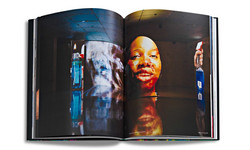
Lothar Baumgarten
Seven Sounds, Seven Circles (7CD Box)
* Sold out at the source, last copies around * April 2007. On a wooded peninsula jutting into the Hudson River near Beacon, New York, Lothar Baumgarten sets up his recording equipment and waits for night to fall. For the next eighty minutes, he captures the sounds of a landscape haunted by overlapping histories: the shrieking and croaking of native fauna, the distant clatter of an Amtrak train, the hum of resurgent nature reclaiming the ruins of industry. This is Denning's Point - once home to the Munsee tribe, who called this place Matteawan, meaning "trout stream"; later the site of the Denning's Point Brick Works, whose output helped build the Empire State Building and Rockefeller Center; now a state park where hikers encounter the skeletal remains of America's industrial past overgrown with wildflowers and weeds.
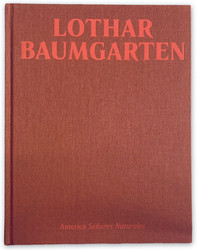
The German conceptual artist had been investigating the collision of culture and nature since the late 1960s, when he began photographing ethnographic museums to expose how Western institutions frame and contain the "other." He studied under Joseph Beuys at the Kunstakademie Düsseldorf. Between 1978 and 1980, he lived for eighteen months among the Yãnomãmi people in the upper Orinoco region of Venezuela and Brazil - an experience that would transform his practice and generate decades of work exploring colonialism, displacement, and the fragile persistence of indigenous cultures. When he represented Germany at the 1984 Venice Biennale, his floor piece America Señores Naturales - the names of Amazonian peoples engraved in marble - won the Golden Lion.
But Seven Sounds / Seven Circles, created for his 2009 exhibition at Kunsthaus Bregenz, marked a different kind of investigation. Rather than mapping the traces of vanished cultures onto institutional spaces, Baumgarten turned his attention to the acoustic ecology of a single place where multiple histories coexist in sound. The seven hours of recordings that comprise this work are not documents of pristine wilderness. They are portraits of a landscape in transition - nature neither conquered nor victorious, but negotiating its relationship with human presence in real time.
What we hear is not the Edenic soundscape of relaxation CDs. It is something stranger and more unsettling: the nocturnal chorus of frogs and insects punctuated by the mechanical rhythm of trains; the rustle of wind through trees growing among brick foundations; the calls of birds whose ancestors witnessed both the Munsee and the factory workers. Baumgarten sought to capture not just the sounds of the night, but the ghosts of the area's past and the possibility of an ominous future.
The methodology recalls Bernie Krause's biophonic research and Chris Watson's attention to the acoustic signatures of place. But where those practitioners often seek out remote locations untouched by human activity, Baumgarten finds his subject in a liminal zone - a peninsula where the industrial and the natural, the historical and the present, the human and the non-human exist in uneasy cohabitation. The recordings become a meditation on what remains when empires of brick and commerce crumble, and on what new ecologies emerge in the spaces they leave behind.
As Michael Brenson wrote of Baumgarten's work in The New York Times: "What interests him is the space between him and them, between culture and nature, and between our civilization and theirs." In Seven Sounds / Seven Circles, that space is rendered audible - seven hours of sound that oscillate between document and elegy, between scientific observation and spiritual practice.
Baumgarten died in Berlin in December 2018. His work remains in the collections of the Museum of Modern Art, the Metropolitan Museum of Art, the Tate, the Centre Pompidou, and dozens of other institutions worldwide. Seven Sounds / Seven Circles stands as one of his most immersive and accessible works - an invitation to listen, as he did, to the voices of a landscape speaking across time.