“it’s no surprise that his delivery is in a semi-conversational, classic beat poetry/So I Married an Axe Murderer style, pitched somewhere between narration and rap”
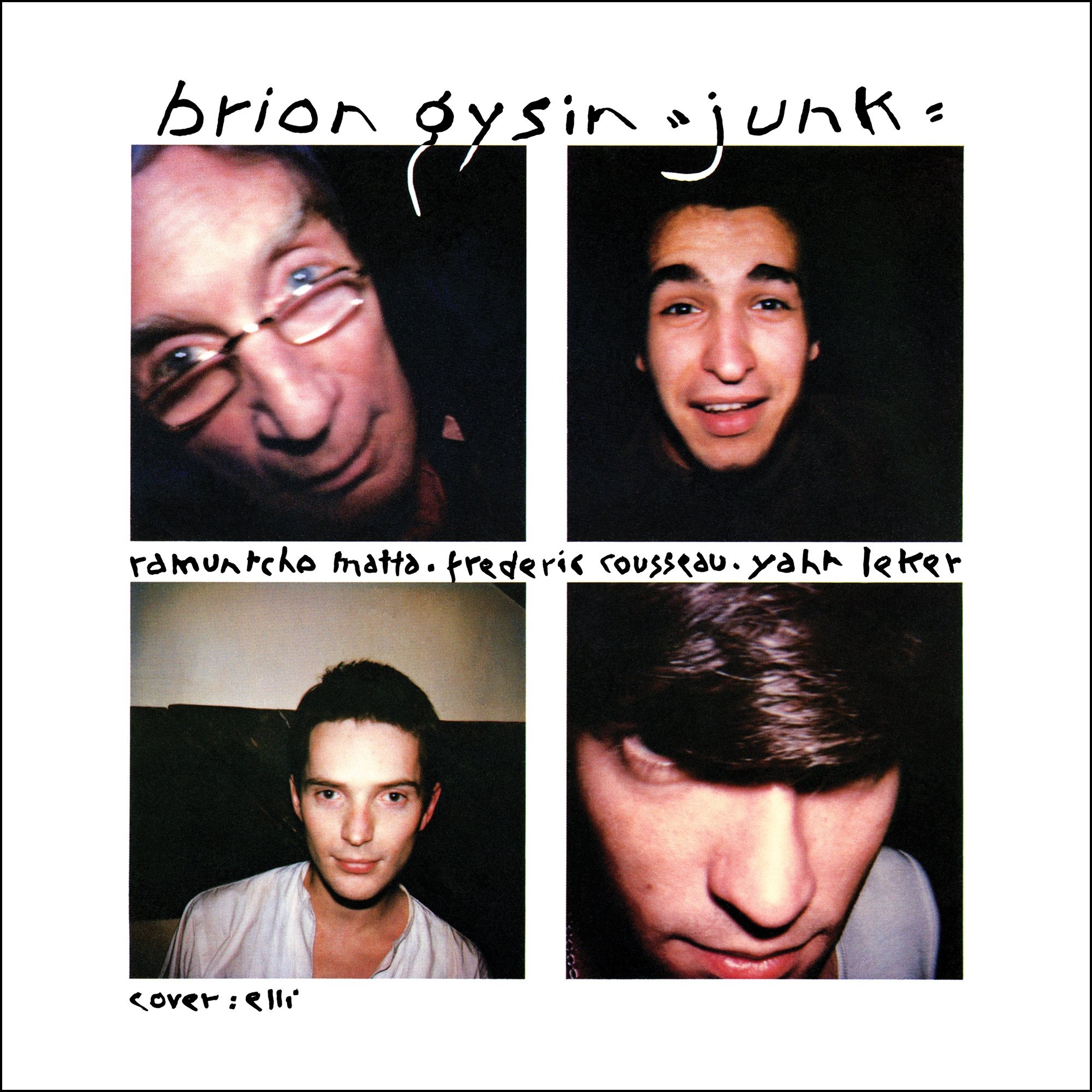
rion Gysin’s name is most frequently mentioned in relation to the innovative “cut-up” poetry that he pioneered and which was subsequently developed by his friend William S. Burroughs. Like Burroughs, Gysin was no stranger to recording studios, but whereas his more famous friend tended to perform readings of his work or to pop up here and there in the recordings of artists on the alternative spectrum from Laurie Anderson to Tom Waits, Gysin put his name to an album that could actually be considered more-or-less commercial music of its time. For its original 1985 release, this album was titled Ramuntcho Matta Presents Brion Gysin / Polo Lombardo but since then it’s been more informally named after one of its most memorable tracks, “Junk,” and that’s the title of this newly augmented edition of the album.
At the time of the recording, French producer Ramuntcho Matta had been working in New York for a couple of years, and despite its noticeably international personnel, Junk is a very early ‘80s, New York kind of album. The opening track “Kick (Discomix)” is jazz-inflected funk-pop. It features jazz legend Don Cherry and Senegalese drummer Abdoulaye Prosper Niang as well as Matta on guitar, and an otherwise obscure but very good bassist called Fil Mong. It sounds a bit like the kind of records artists as dissimilar as Talking Heads and Nina Hagen were making around that time.
Its more individual character comes from Gysin himself. His voice – especially compared to Burroughs’ – is surprisingly warm and avuncular and in some ways a bit anachronistic. By that time, Gysin was in his seventies – he would die aged 80, a year after the album’s release – so in a way it’s no surprise that his delivery is in a semi-conversational, classic beat poetry/So I Married an Axe Murderer style, pitched somewhere between narration and rap. The words to “Kick” prefigure those of the rest of the album in their simplicity. Essentially the lyrics amount to the phrase “kick that habit, man” delivered with a variety of tones and emphases. All very simple and possibly quite irritating ‒ but the simmering funk behind Gysin’s vocal is extremely listenable and Cherry’s pocket trumpet in particular is fantastic. “Sham Pain” is even funkier and bouncier, with Matta and Yann Leker of French New Wavers Modern Guy bringing Nile Rodgers-style guitar to the party while Gysin yammers away with almost Fred Schneider ebullience.
Fairly early on, it becomes inescapably obvious that although Gysin is the raison d’être for the album, he is also by some distance its weakest link, saying repetitive and not always interesting things in a slightly silly way. But that said, he’s entertaining too and his persona is far lighter and more fun than one might assume from his written works. “Junk” itself sounds like a dead ringer for Naked-era Talking Heads, if David Byrne was tone deaf. It’s a great, funky, highlife-inflected funk/disco track, and when Gysin limits himself to vocal interjections, it’s a winning formula.
When he actually sings though, it’s not so much. Again, what lets the song down ‒ surprisingly for a writer of his stature ‒ is Gysin’s words. Though few will disagree with the sentiment, one might expect more from a poet and close associate of Burroughs than “Junk is no good baby! No good, no good, no good” ‒ but that’s what you get. As a piece of music, however, “Junk” is catchy and fun.
And so it goes. “Stop Smoking” is hard-hitting and funky and has Elli Medeiros on backing vocals, but it has a silly, extremely trivial Gysin vocal that sounds like one of Jim “Mr. Magoo” Backus’ novelty records. “Baboon” is bright and colorful with Gysin making silly animal noises, “V.V.V.” is bold and celebratory. And it’s really only the delicate, poignant “All Those Years” that has much sense of human depth to it. Different mixes of “Kick” and “Stop Smoking” are welcome if not essential, and an instrumental version of “Kick” is good too but a bit aimless. In the end, the instrumental confirms against the odds that although at times he’s objectively quite irritating, Gysin’s presence has much to do with the overall effect and success of the music.
For all its avant-garde credentials, Junk works best as an album of fairly typical New York/New Wave funk/disco and though Brion Gysin has a somewhat lofty arthouse reputation it’s no more, and no less, radical or listenable than something like the B-52s. Gysin remains an iconic, influential figure to this day, but not really in the field of popular music. Though it’s recommended to the curious, or just to fans of the era and milieu, Junk demonstrates why that is.
Originally published by Spectrum Culture.Read the original article on Spectrum Culture