“A joy for the ears, heart, and mind that remains urgent and affecting after the better part of 50 years, doubling as a much needed historical intervention.”
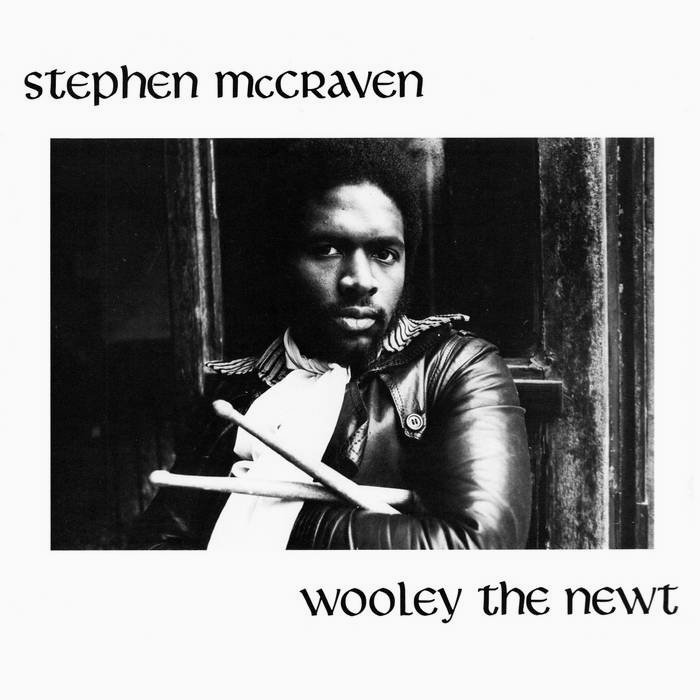
Building on their incredible, recent momentum over the last year, Moved By Sound returns with what might be their most exciting release of 2025, a revelatory historical intervention taking form as a much needed reissue of the drummer Stephen McCraven’s astounding debut as a leader, ‘Wooley the Newt’, originally issued on Marion Brown’s Sweet Earth record label in 1979. A towering artistic statement that has remained quietly nestled within the canon of private press loft-jazz for the better part of a half century - gathering a devoted following, with original copies commanding eye watering prices - this remarkable gesture distills the moods and creative temperaments of its era, weaving a tightly wound, deeply lyrical tapestry that incorporates the best of free and spiritual jazz, while standing far out on its own.
Over the last few years, the imprint, Moved By Sound, has emerged from the mists of the English countryside, building a catalog of noteworthy, unexpected, and beautifully produced reissues that has entirely blown our minds. First came one of the great holy-grails of 1970s private press free jazz, Jeanne Lee’s ‘Conspiracy’. Then there was Sirone’s ‘Artistry’ and Malik's Emerging Force Art Trio’s ‘Time & Condition’ - two equally towering efforts of private press free jazz - before the imprint delved toward more diverse waters with reissues of Plastic People Of The Universe’s ‘Egon Bondy's Happy Hearts Club Band’ and Reet Hendrikson’s ‘Reet’, each radically expanding our perceptions of the label’s modus operandi. Then, last year, they dropped the first ever reissue of Children Of The Sun’s incredible, lone LP, ‘Ofamfa’, from 1971, only to raise their game again a few months ago with the first ever vinyl pressing of the guitarist Michael Gregory Jackson’s ‘Frequency Equilibrium Koan’, followed by a much needed reissue of Shirley Collins’ groundbreaking, 1959 debut ‘Sweet England’. Roughly belonging to the network of ‘loft-jazz’ that flowered in East Coast cities during the 1970s and 80s - encountering artists seeking liberation from the often predatory and creatively constricting mechanisms of the music industry through the founding of their own record labels and venues - it’s an absolute gem, blending the lyricism of spiritual jazz and the ambitious expressions of free jazz. Doubling as a fascinating lens into the evolving continuums of African American music, this artifact by the father of the widely celebrated drummer and bandleader Makaya McCraven is a truly monumental gesture that will leave little question, once heard, why original copies command the eye watering prices that they do.
Born in Washington, D.C. in 1954, the drummer and percussionist, Stephen McCraven, sat firmly within the astounding movement of jazz that threaded its way across the 1970s and 80s, building upon and refining the radical innovations that defined the decades before, subsequently delivering some of the most visionary and singular creative gestures ever produced within the idiom. Shifting within a cross-country axis during his early years, McCraven started playing drums in school bands at age 8 in Palo Alto, California, before moving to Connecticut at the age of 10, where he attended the Jimmy Stavris Drum School, refining a virtuosic ability that eventually led him to Berklee College of Music - during roughly the same period that David S. Ware and Alan Braufman were in attendance - where he studied with Alan Dawson, and then the University of Massachusetts where he studied with Max Roach and Archie Shepp. By 1977, at the age of 23, he was touring Europe with Marion Brown, and laying down the drums on what would become Brown’s 1978 LP ‘La Placita’. For a period, he stayed behind and settled in Paris, where he studied with Philly Jo Jones, Kenny Clarke, Oliver Johnson, and George Brown, before returning home and embarking upon the recording of his first release as bandleader, ‘Wooley the Newt’, for Marion Brown’s Sweet Earth in 1979, enlisting Sulaiman Hakim and Richard Raux on saxophone and percussion, Jack Gregg on bass, and Michel Graillier on piano and percussion. While by no means his only effort as a leader, the album remains one of his defining statements: a diamond nestled within a career working largely as a sideman within the bands of giants like Archie Shepp, Sam Rivers, David Murray, Yusef Lateef, Mal Waldron, Harold Ashby, Freddie Hubbard, Hank Crawford, Charles Tolliver, Michael Gregory Jackson, Benny Golson, Arthur Blythe, Billy Harper, and a near countless number of others.
Comprising five tracks over its two sides, ‘Wooley the Newt’ is a lost grail of private / artist run presses of the 1970s, standing alongside Sirone’s ‘Artistry’, Malik's Emerging Force Art Trio’s ‘Time & Condition’, Abdul Wadud’s ‘By Myself’, numerous releases on Charles Tyler’s AK-BA and Steve Reid’s Mustevic Sound, and a string of others. Perhaps more distinctly, falling roughly within the decade where it does, ‘Wooley the Newt’ reflects the slightly shifting tides within the avant-garde jazz scene of the moment. Rather than being a full blow-out of hard blown fire, the album distills its writhing energy into highly wound efforts of poetic lyricism, compositional intricacy and grace. Moving between passages that embody the deep, harmonically and rhythmically rich territories celebrated within spiritual jazz - activating almost trance inducing states as the band intertwines their conversant interventions with razor sharp parries - and more furious moments of free improvisation, each member soaring on their respective instruments, channeling the deepest corners of their expressive souls, as well as heart-wrenching balladic moments, ‘Wooley the Newt’ manages to crystallize all that is great about jazz into its shifting tides.
Astounding and illuminating on countless terms, not the least of which being that none of the players on ‘Wooley the Newt’ are household names, and thus casting light onto five sinfully overlooked artists, producing a body of sound that stands high within the truly towering canon of 1970s independent jazz, it’s impossible to overstate how important Moved By Sound’s reissue of Stephen McCraven’s astounding debut as a leader is. A joy for the ears, heart, and mind that remains urgent and affecting after the better part of 50 years, doubling as a much needed historical intervention.
Originally published by Soundohm.