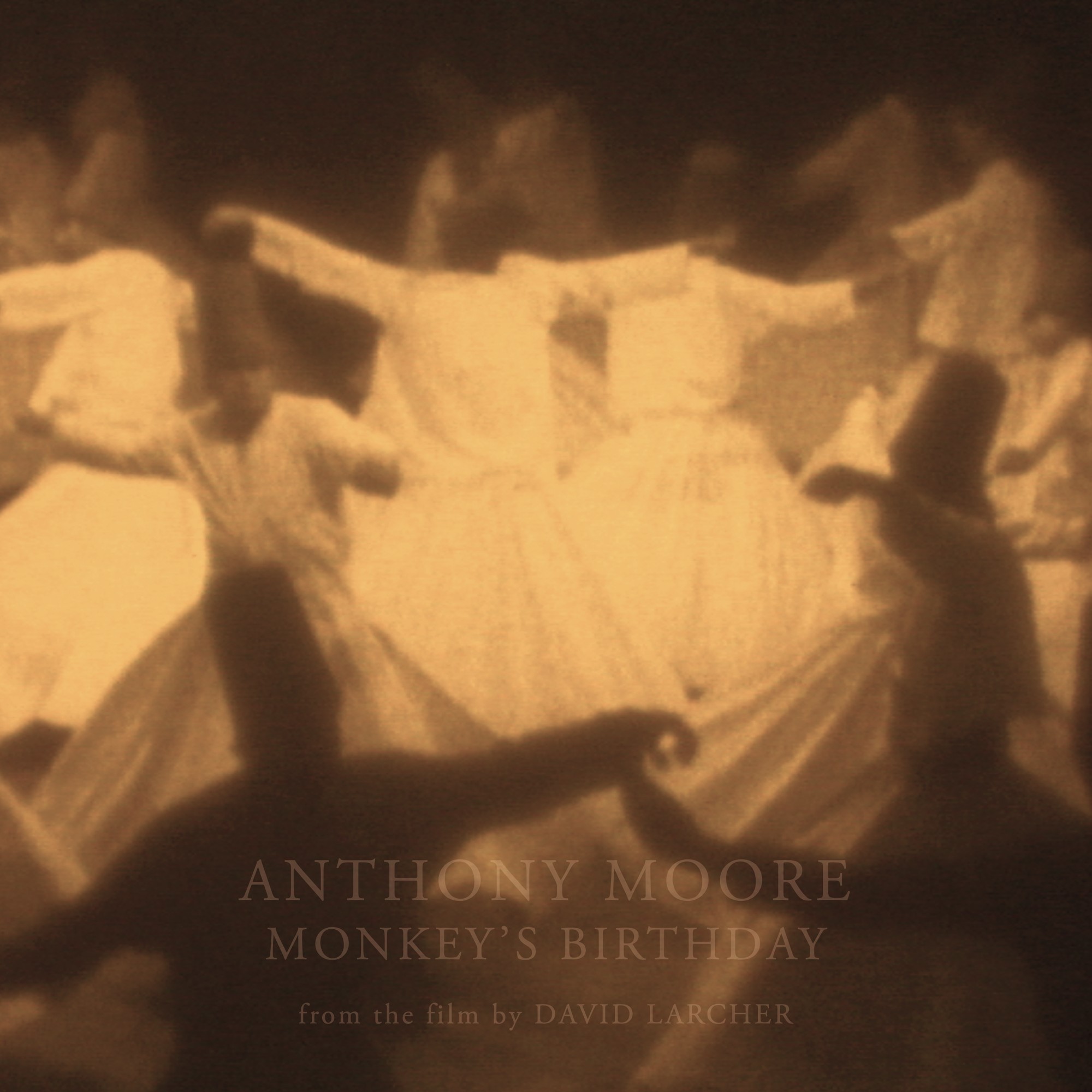
“Multifaceted and meandering, ‘Monkey’s Birthday’ unfurls as a tapestry of unified sonority, maximizing the potential of its raw sonic materiality within meticulously crafted structures”
Building on the momentum achieved by Paradigm Discs’ incredible release of Anthony Moore’s 1969 soundtrack for David Larcher’s ‘Mare’s Tail’, issued back in 2024, the label and composer rejoin forces with the first ever stand-alone release of the pair’s follow-up collaboration, presenting a beautifully produced, first-ever limited vinyl edition of Moore’s soundtrack from Larcher’s ‘Monkey's Birthday’, created between 1973 and 1975. A stunningly singular work of musique concrète, largely sculpted from countless hours of field recording while the duo traced their way from Germany to Turkey over numerous years - imbuing the idiom with an engrossing sense of psychedelic abstraction and musicality - it’s an absolutely astounding artifact that, while very much of a time and place, remains hugely compelling and radical roughly a half century down the road.
For roughly three decades the London based imprint, Paradigm Discs, has displayed a deep dedication to the platforming of rigorous, but under-celebrated trajectories of experimental and avant-garde music, assembling a carefully constructed catalog of archival releases and reissues by Hugh Davies, Pauline Oliveros, Daphne Oram, Max Eastley, Trevor Wishart, Gentle Fire, and a great many more. Back in 2024, the label unearthed a previously unreleased soundtrack, made in 1969 by the legendary British experimental musician and composer, Anthony Moore, for David Larcher’s seminal 1969 film, ‘Mare’s Tail’, highlighting a crucial juncture within the histories of experimental sound and cinema. Having remained uncharacteristically quiet ever since, Paradigm Discs now returns our attention to the pair’s remarkable efforts together with the release of ‘Monkey's Birthday’, Moore’s equally astonishing soundtrack for Larcher’s film of the same name, created between 1973 and 1975.
Since his emergence during the second half of the 1960s, British experimental musician and composer, Anthony Moore, has carved a singular and uncompromising path through the wilder territories of organized sound. A student of Indian Classical music, who founded the ensemble, Slapp Happy; worked with Henry Cow, Kevin Ayers, and Pink Floyd; for many Moore’s greatest contributions have been through his solo efforts, particularly two albums produced for Polydor - “Pieces From a Cloudland Ballroom” and “Secrets Of The Blue Bag” created while he was living in Hamburg, Germany, during the early 1970s. While largely overlooked at the time, their inclusion in the second installment of Alan Licht’s Minimal Top Ten series, in 1997, introduced them to a legendary status within the minimalist tradition that sent collectors scrambling through bins for scarce copies.
For the entirety of his long career, Moore has remained both ambitious and difficult to nail down, consistently creating explicitly experimental works like “Reed Whistle And Sticks” (1972), “CSound & Saz” (2022), while simultaneously flirting with the popular realm, most notably through a series of records released between 1976 and 1984, in addition to his work in Slapp Happy and other projects, as well as a recent run of song based LPs for Drag City. Back in 2024, Paradigm Discs’ release of the composer’s soundtrack for David Larcher’s 1969 film, ‘Mare’s Tail’ - among the composer’s earliest known efforts - offers a crucial illumination of the truly experimental temperaments that rest at Moore’s creative root. Now, the release of ‘Monkey's Birthday’ takes this initiative one step further down the road (literally and figuratively).
Moore and Larcher belonged to the same generation of radical English artists who emerged during the second half of the 1960s, each drawing, within their respective fields - music and film - upon avant-garde ideas and practices, while utilising new and developing technologies as central forces within their work. Their first effort together, ‘Mare’s Tail’, represents a perfectly intertwined collaboration between the pair: Larcher delving into the meanings and possibilities of film itself, while Moore tested the limits of what could be done with tape recorder with his sonic counterpart, engaged in open and co-operative exploration. Over the following years, Moore would continue to push his own creative boundaries creating soundtracks for experimental film, working with directors like Klaus Wyborny, Dore O, and Werner Nekes that he met while living in Germany, before, in 1973, he and Larcher rejoined to embark upon ‘Monkey’s Birthday’, the follow up to ‘Mare’s Tail’ and arguably the most ambitious project that either ever engaged.
Created between 1973 and 1975, ‘Monkey’s Birthday’ is effectively a road movie, capturing Larcher, Moore, and their crew wandering across Germany, Hungary, Romania, and rural Turkey over the course of the years it took to make, amounting to a sprawling, six hour experimental epic. As Henrik Hendrikson stated in 1977, writing in ‘Perspectives on British Avant-garde Film’: “The film is at once a diary of that voyage, a romanticization of the quest implicit in the conceit of the wandering protagonist, and a universalization of that quest beyond the individual protagonist”, becoming a meditation on light and color through Larcher’s use of re-photography (optical-printing). As they traveled, Moore made extensive recordings that would provide the raw material for most of the soundtrack, reworking Islamic chant; field recordings; tape loops; jam sessions; various voices from the crew and general public; recordings of esoteric texts read by Heathcote Williams; and cut up voice recordings by Moore’s fellow Slapp Happy members, Dagmar Krause and Peter Blegvad, who were also present on the journey, from a battery powered studio in the back of a truck belonging to their convoy. This first ever stand-alone release of the soundtrack is conceived, across its roughly 45 minute duration, as a distillation of the essence of the film.
Placed alongside the roughly contemporaneous efforts of Luc Ferrari ('Hétérozygote’, 'Presque rien No.1’, etc.) and Barney Wilen (‘Moshi’) as well as Roberto Musci’s (latter appearing with ‘The Loa of Music’) Moore’s ‘Monkey’s Birthday’ rests at a radical juncture within the idiom of musique concrète, during which field recordings operated as a radical (and often controversial) material, drawing the realms of abstract art back toward the real world. Embracing an explicitly psychedelic mindset that subtly bridges it with the popular realm of its day, the two sides of the album unfold with a truly singular and striking sense of musicality, establishing a deep sense of tension with the soundtrack’s strong disposition toward abstraction and the grounding use of the human voice, as well as an intoxicating listenability fairly uncommon within musique concrète. Multifaceted and meandering, ‘Monkey’s Birthday’ unfurls as a tapestry of unified sonority, maximizing the potential of its raw sonic materiality within meticulously crafted structures, as its sounds intertwine, jitter, and dance, inviting the listener onto the open road for a journey that spans time and place: very much of its moment, while remarkably resonant today.
Further expanding our understanding of Anthony Moore’s position as a truly singular experimental composer within his generation, while distinct from the music for which he is most well known from the first half of the 1970s - 'Pieces From The Cloudland Ballroom' and 'Secrets Of The Blue Bag’, and his work in Slapp Happy - ‘Monkey’s Birthday’ remains within his entirely distinct conception of minimal music. As such, within historical terms, as well as that of pure artistic accomplishment, this remarkable soundtrack, lingering in the shadows for 50 years, emerges as one of the most important archival releases, not to mention film soundtracks, to have appeared in the last decade: a truly engrossing marvel in every possible way.
Originally published by Soundohm.