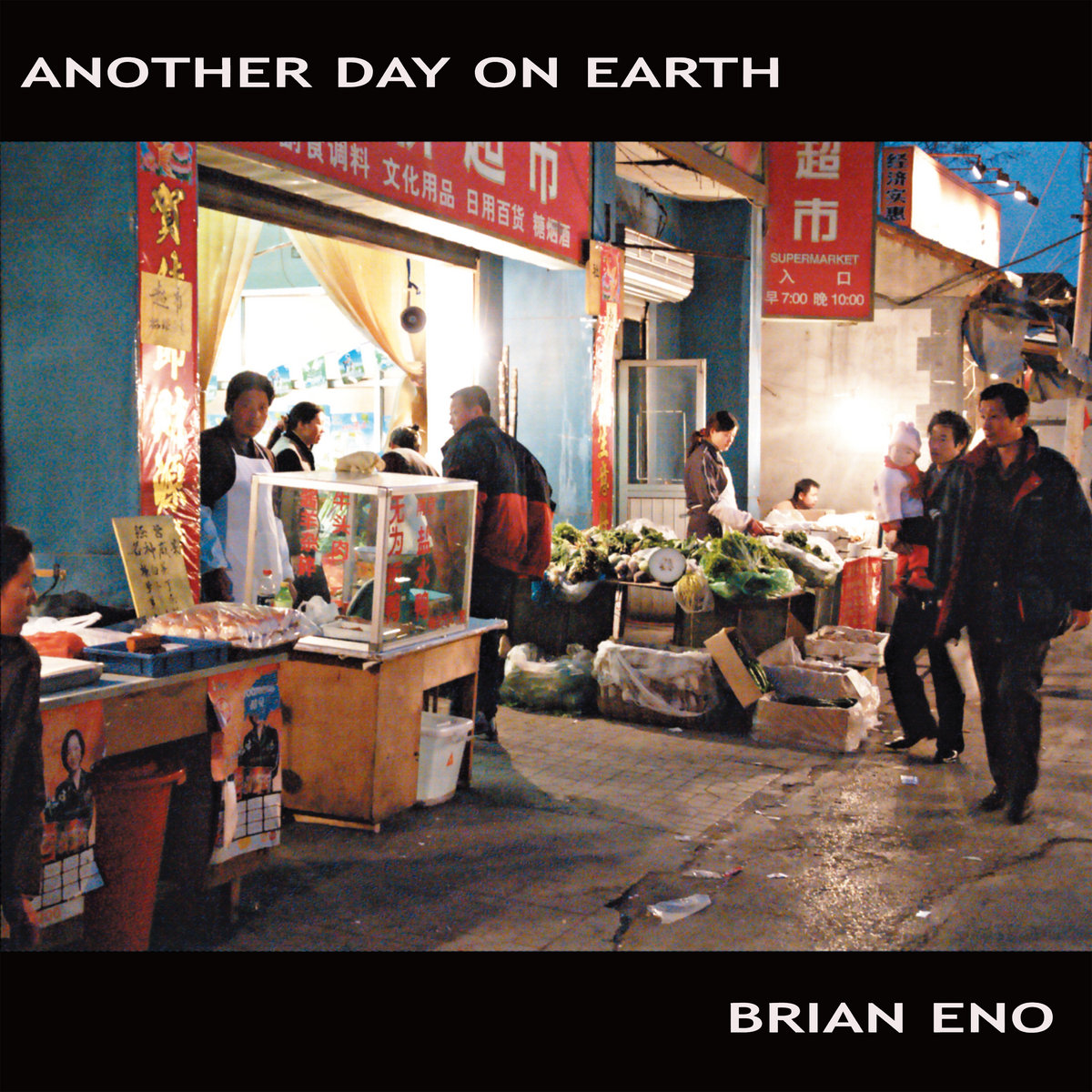
“Comprising eleven, fittingly pop-song length tracks, ‘Another Day on Earth’ is a potent reminder of Eno’s sensibility for song-craft, not least rooted in his own incredible singing voice.”
In nothing short of a hugely significant event, State51 raised their already high bar, excavating two astounding full-lengths by the shapeshifting polymath, artist, musician, and composer, Brian Eno, from the first decade of the new millennium: 2001’s ‘Drawn From Life’, made in collaboration with the German electroacoustic composer Peter Schwalm, alongside an all-star cast of collaborators that includes Can’s Holger Czukay and Laurie Anderson, and 2005’s monumental, pop masterstroke ‘Another Day on Earth’. Both out of print for nearly two decades, these stunningly produced first-ever reissues on both LP and CD formats - marking the debut vinyl pressing of ‘Another Day on Earth’ - made in close collaboration with the artist, reveal the remarkable range, diversity, and versatility of Eno’s musical endeavors, always adapting to zeitgeists and new technologies of a given moment, while retaining the signature creative vision and virtuosic sense of craft that has made him arguably the most influential artist of the last 50 or so years.
Since launching during the early 1990s, the London based imprint, State51, has retained a startling sense of ambition, while refusing to be nailed down. The sprawling catalog of music released under their heading entirely sidesteps the constraints of genre or presumptions dictated by taste, making their latest collaboration with one of contemporary music’s greatest, visionary shape-shifters, Brian Eno, a more than logical fit. Diving off the beaten path of the English composer, musician, and visual artist’s expansive discography, the label has excavated two of Eno’s neglected gems from the 2000s - 2001’s ‘Drawn From Life’, made in collaboration with the German electroacoustic composer Peter Schwalm, and 2005’s ‘Another Day on Earth’ - reissuing them for the very first time, and thus offering them the much needed reappraisal that they deserve. Whether viewed together or separately, these two full-lengths illuminate Eno’s restlessly searching creative spirit through the diversity and scope of his pursuits within a relatively short period of time: ‘Drawn From Life’ being an evolution of his celebrated work in the realms of harmonic and rhythmical ambiences, while ‘Another Day on Earth’ carries forward the experimental pop explorations begun in 1974 with ‘Here Come The Warm Jets’ and intermittently carried forward across the years. Both are understated, consuming, and products of Eno’s careful attunement to a given moment - its cultural zeitgeists and generative tools - while entirely timeless.
There is arguably no artist, working in the last fifty or so years, more influential than Brian Eno. His position in the history of music is legendary as both an innovator and producer: one of those rare artists whose impact has been felt by nearly everyone with whom he shared this planet during his years of activity. Born in 1948, like so many of England’s great musical contributors, Eno is a product of his country’s post-war art school system, supported by Socialism, within which he studied painting and experimental music during the 1960s. Following the completion of his studies, he moved to London where he became involved in the Scratch Orchestra and the Portsmouth Sinfonia, participating in the former’s debut recording of Cornelius Cardew’s ‘The Great Learning’, issued by Deutsche Grammophon in 1971 (and reissued earlier this year). While his early forays into sound were far from insignificant, his fates took a turn in 1971 when he co-founded Roxy Music and subsequently was met by pop cultural fame for his contributions to the project’s early output, playing an EMS VCS 3 synthesizer, as well as contributing tape effects, backing vocals, and production, catching the public eye with his searing glam image and captivating stage persona. As big as Roxy Music may have been, Eno’s star was ascending and couldn’t be contained. Following his departure from the group in 1973, he embarked upon a now legendary collaboration with Robert Fripp which would emerge as ‘No Pussyfooting’ later that same year. Quick on his feet, he entered the studio again as a solo artist, beginning the process of recording his debut LP, ‘Here Come the Warm Jets’ issued in 1974, which along with its three follow-ups, ‘Taking Tiger Mountain (By Strategy)’ (1974), ‘Another Green World’ (1975), and ‘Before and After Science’ (1977) is regarded as a landmark in the field of experimental rock. More than nodes in Eno’s long and varied career, it was these albums that would lay the groundwork for his legendary efforts as a producer on hugely important recordings by John Cale, Nico, David Bowie, Talking Heads, Television, Devo, Jon Hassell, U2, Robert Wyatt, and numerous others over the decades to come.
While often difficult to observe due to the relentless forward-march of his long and varied career, Eno has proven himself to be an artist who works in loops, often doubling back on himself and mining his own efforts as sources for innovation and change. The first of these occurred just over a year into his solo career. At the heights of his fame, enjoying critical success for his first two LPs, he veered toward the experimental roots cultivated within the Scratch Orchestra and the Portsmouth Sinfonia, recording ‘Discreet Music’, a collection of minimalist works featuring synthesizer and tape delay, as well as an ensemble piece conducted by Gavin Bryars, marking the first iteration of what would become known as “ambient music”, issued alongside important experimental efforts by Christopher Hobbs, John Adams, Gavin Bryars, David Toop, Max Eastley, John Cage, Michael Nyman, John White, Harold Budd, and others, on his own Obscure Records label. ‘Discreet Music’ established a new beginning in Eno’s efforts. Over the coming years, the emerging idiom of ambient music would dominate the wide-reaching perception of his artistic endeavors via now seminal albums like ‘Music For Films’, ‘Ambient 1 (Music For Airports)’, ‘Ambient 4 (On Land)’, as well as noteworthy collaborations with Cluster, Harold Budd, Jon Hassell, Laraaji, and others. Fascinatingly, by the early 1980s, however, Eno would find himself drawn back toward the realms of popular music, marked by the seminal LP ‘My Life In The Bush Of Ghosts’, made in collaboration with David Byrne, effectively beginning a period that has endured over the decades, during which the two sides of his practice - minimal, experimental, ambient works, and song based music more closely aligned with pop and rock - would emerge roughly simultaneously. The contrast displayed by State51’s reissues of Brian Eno and Peter Schwalm’s 2001 hybrid ambient outing, ‘Drawn From Life’, and his song based 2005 full-length, ‘Another Day on Earth’, perfectly illuminates the two astounding sides of Eno’s musical work.
Originally released on Virgin Records in 2001, ‘Drawn From Life’ stands among the most overlooked full-lengths in Brian Eno’s catalog, in part because his involvement was left ambiguous upon its release, and because of major label acquisitions that left it lingering out of print. A full collaboration with the German electroacoustic composer, Peter Schwalm, who he had met through Eno’s longtime friend Rolf Engel, ‘Drawn From Life’ builds its unique sonic landscape upon previous efforts by the pair, working on the soundtrack for the director Nicolas Winding Refn’s ‘Fear X’ and the Japan-only release ‘Music for Onmyo-ji’, a two disc ‘image album’ for Reiko Okano's manga adaptation of Baku Yumemakura's novel series of the same name. It also notably incorporates an all-star cast of collaborators, including Holger Czukay, Laurie Anderson, Nell Catchpole and Leo Abrahams.
Comprising eleven tracks, ‘Drawn From Life’ is among the most creatively complex efforts in Eno’s catalog, incorporating aspects of his practice as an experimental and ambient composer alongside his work as a song-writer. Unmistakably aligned with the pastoral beat oriented work (ambient trip-hop, electronica, and IDM) appearing within the UK musical landscape of the 90s and early 2000s - Aphex Twin, Massive Attack, Boards of Canada, etc. - the album is a lens into the zeitgeists of its moment, encountering the shapeshifting polymath, working in closely aligned dialog with Schwalm’s carefully honed vocabulary as an electroacoustic composer, incorporating then newly emerging technologies, sound palettes, and techniques, and languid, pulsing compositions that vacillate between passages of forthright experimentalism and left-field pop. As Julian Cowley pointed out upon the album’s release back in 2001, Eno and Schwalm’s endeavors have “something of the quality of [Miles] Davis’s cathedral-in-sound ambience [...] pinpoints of sonic light set within incense-heavy atmospheres.”
Simultaneously working as a time capsule that sheds important light onto Eno’s activities at the dawn of the new millennium - thus illuminating a great deal of the groundwork for the incredible work that has appeared since - as well as an enduringly engaging body of work - expansive, detailed, and intricate - like so many of his efforts the distinct voices of the collaborators - Schwalm, Czukay, Anderson, Catchpole, and Abrahams. We’re absolutely thrilled to see this one reissued for the very first time after remaining out of print for decades.
Brian Eno’s first truly song-based album since 1992s ‘Nerve Net’, and carrying forward the endlessly seductive thread of his practice that began in 1974 with the release of ‘Here Come the Warm Jets’ and carried forward through the years with notable outings like ‘Wrong Way Up’, made in collaboration with John Cale, 2005’s ‘Another Day on Earth’ has long remained one of his most acclaimed solo records, as well as holding an especially warm place in the heart of his dedicated fans. Further displaying Eno’s malleable approach to circumstances, despite displaying a very different sensibility to ‘Drawn from Life’, it features a number of the same collaborators - Nell Catchpole, J. Peter Schwalm and Leo Abrahams - and shares his lyrical credits with Michel Faber and Danny Hillis. Interestingly, the album’s direct song-based predecessor featured largely electronic elements and driving beats that drew on dance music, ‘Another Day on Earth’ winds back the sonic palette slightly, returning to something closer to the sublime territories encountered on 1990’s ‘Wrong Way Up’.
Comprising eleven, fittingly pop-song length tracks, ‘Another Day on Earth’ is a potent reminder of Eno’s sensibility for song-craft, not least rooted in his own incredible singing voice. While, at times, incorporating the flowing forms rooted in his more ambient and experimentally aligned work - making it an engrossing hybrid of practices - it’s hard not to get caught in a wish Eno had committed more of himself to this type of work over his career, when navigating the album’s two sides. Similar to most of his efforts, ‘Another Day on Earth’ is very much a product of the temperaments and emerging technologies of its moment - its creator always having his finger on the pulse and displaying a willingness to adapt - as well as of the contributions of his collaborators and their respective sensibilities. Yet, despite its display of certain approaches that aesthetically locate it within the first half of the 2000s - particularly the relatively early, occasional use of autotune technology, and electric beats, processing, and arpeggiating synths lines - the album feels remarkably timeless.
Beginning with the mesmerizing tune, ‘This’ - a pitch perfect companion to songs like ‘Lay My Love’ and ‘Spinning Away’ from ‘Wrong Way Up’ - Eno moves into the minimal, pulsing and heart-wrenching ballad ‘And Then So Clear’, his emotive, autotune vocals drifting through drifting, melodic soundscapes, co-populated by the gentle notes of guitar. From here, he opens compositional space within the album’s arc, moving through two tracks of largely instrumental, ambient / experimental approach that are as engrossing and masterful in their discrete moments as much as in context, before arriving back at the vocally driven, ambient / pop territories plumbed by ‘Caught Between’ and ‘Passing Over’, the chanting, relative vocalizations of the latter feeling like they might be lost work by Camberwell Now.
As ‘Another Day on Earth’ continues to arc, ebb, flow, and transform across its second half, hitting intoxicating highs with ‘Just Another Day’, before reaching its conclusion with the brilliant, spoken conceptualism, voiced by Aylie Cooke, of ‘Bonebomb’, we are presented with not only some of Brian Eno’s most compelling work of the new millennium, but also of his entire career. An absolute creative marvel on its own terms, perhaps more than any other album that he ever made, ‘Another Day on Earth’ draws clear through-lines across his entire career, feeling very connected to the celebrated early efforts that emerged on ‘Here Come the Warm Jets’, ‘Taking Tiger Mountain (By Strategy)’, ‘Another Green World’ (1975), and ‘Before and After Science’, while deftly incorporating a great deal of what he developed in his ambient and more experimental works, not to mention the huge gains established by his work with John Cale on ‘Wrong Way Up’, it’s quite simply stunning, making it that much more tragic that it has remained out of print since 2008, and correspondingly exciting that State51 has taken on the task to bring it back to our ears. Issued for the first time ever on vinyl, as well as a newly remastered CD edition, both including the previously Japan-only bonus track ‘The Demon of the Mines’, and featuring the original cover art - a photo taken by Eno himself in Beijing, China - this is unquestionably one of the most exciting reissues we’re likely to encounter this year: a sonic landmark of quietly towering scale, the like of which only Brian Eno could make.
Originally published by Soundohm.