
David Rothenberg
David Rothenberg (born 1962) is an American clarinetist, composer and writer who teaches philosophy and music at the New Jersey Institute of Technology. He is known for playing music with birds, whales and other animals, and for books that treat animal sounds as music, among them Why Birds Sing and Thousand Mile Song, a study of whale song that came with recordings of his clarinet duets with whales. Rothenberg studied at Harvard and took a PhD at Boston University.
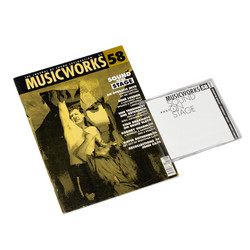
Musicworks 58 - Sound On Stage Part 1 (CD+magazine)
One of the best magazines of experimental music / sound art, founded by John Oswald and published since 1978. Includes feaurures, essays, interviews, reviews, etc., and comes with a CD with (often exclusive) music/sound in relation to the contents of the magazine. In this issue: René Lussier, Joëlle Léandre, Stan Brakhage, John Cage, etc. Sainkho Namtchylak, Ben Neill, etnomusicology, etc.

Sudden Music
Music, said Zen patriarch Hui Neng, "is a means of rapid transformation." It takes us home to a natural world that functions outside of logic, where harmony and dissonance, tension and release work in surprising ways. Weaving memoir, travelogue, and philosophical reflection, Sudden Music presents a musical way of knowing that can closely engage us with the world and open us to its spontaneity.Improvisation is everywhere, says David Rothenberg, and his book is a testament to its creative, surpris…

From This World, Another
From This World, Another marks the first release for Terra Nova Editions, a new series of books not available from our usual distribution channels. This book is published along with a new album of music, recorded remotely during the pandemic, by David Rothenberg and Stephen Nachmanovitch, two veteran improvisors who also have written books on improvisation and the creative process. What started out as liner notes just got longer and longer…
Stephen and David share an affinity for improvising mus…
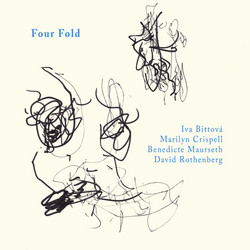
Four Fold
Four Fold unites four singular musicians—Iva Bittová, Marilyn Crispell, Benedicte Maurseth, and David Rothenberg—in a chamber where jazz, improvisation, and modern composition intertwine. Voices and instruments curve and spar, yielding an album of subtle poetics and palpable communion whose articulated silences are as charged as its most explosive moments.
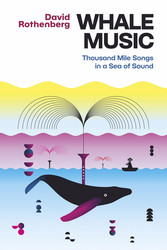
Whale Music Thousand Mile Songs in a Sea of Sound
The marvelous sonic world of whales, from the perspective of music and science. Whale Song is an astonishing world of sound whose existence no one suspected before the 1960s. Its discovery has forced us to confront the possibility of alien intelligence—not in outer space but right here on earth. Thoughtful, richly detailed, and deeply entertaining, Whale Music uses the enigma of whale sounds to open up whales' underwater world of sonic mystery. In observing and talking with leading researchers f…

(c)ovid's metamorphoses
Big Tip! With a wide range of work by sound artists and musicians, writers, filmmakers, photographers, and visual artists, (c)ovid's Metamorphoses uses the Covid-19 pandemic and its far-reaching consequences as an instrument for change, artistic and otherwise. A play on experiment across various fields of artistic practice, all featured work revolves around ideas of transmission and inspiration, conjuring up a massive body of vital and daring artistic expressions unashamedly avant-garde. (c)ovid…

Nightingale Cities
Outstanding release. Five years in the making, David Rothenberg’s Nightingales in Berlin project includes a book, a film, many live concerts, and this double CD, including a 20 page color booklet of stills from the film and music not available in any form online. Here’s what Rothenberg says about the project: “I used to make interspecies music largely on my own, seeing myself as some kind of individual explorer seeking out musical ideas with creatures we can’t even talk to. But in recent years I…
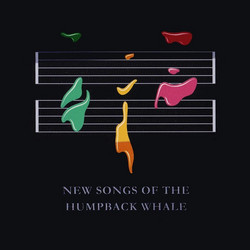
New Songs Of The Humpback Whale
Packaged in a deluxe, heavy duty 6 panel digipak and insert containing an essay from David Rothenberg and Michael Deal designed whale song visualizations. What record album was so important that ten million copies of it needed to be pressed at once? You guessed it. Songs of the Humpback Whale. In 1979 National Geographic Magazine inserted a flexible "sound page" inside the back cover of all of its editions in twenty-five languages, and that is supposedly how many they printed. No human pop star …
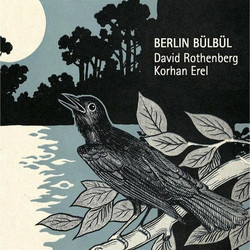
Berlin Bulbul
There are three distinct ways nightingales sing and countersing to each other, beginning late at night and ending by dawn in the first weeks of spring. Most males are ‘inserters,’ meaning that they wait about one second after a neighbor’s song finishes before starting their own. Songs alternate between one bird and another. Then there are ‘overlappers,’ who start their song about one second after their neighbor begins, as if to cover up or jam the neighbor’s signal. It may be some kind of threat…
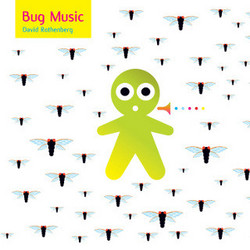
Bug Music
There has been rhythm on this planet for millions of years longer than humans have opened their mouths to sing. Long before birds, long before whales, insects have been thrumming, scraping, and drumming complex beats out into the world.
David Rothenberg decided to investigate the resounding beats of cicadas, crickets, katydids, leafhoppers and water bugs in his unusual third foray into music made with and out of the animal world. After working with birds and whales, he now tackles the minute …
You can't get there from here
Robin Rimbaud aka Scanner is a conceptual artist, writer, plasticien sonore and composer working in London, whose works traverses the experimental terrain between sound, space, image and form. Since 1991 he has been intensely active in sonic art, producing concerts, installations and recordings, the albums Mass Observation (1994), Delivery (1997), and The Garden is Full of Metal (1998) hailed by critics as innovative and inspirational works of contemporary electronic music. He scored the hit mus…