
Giacinto Scelsi
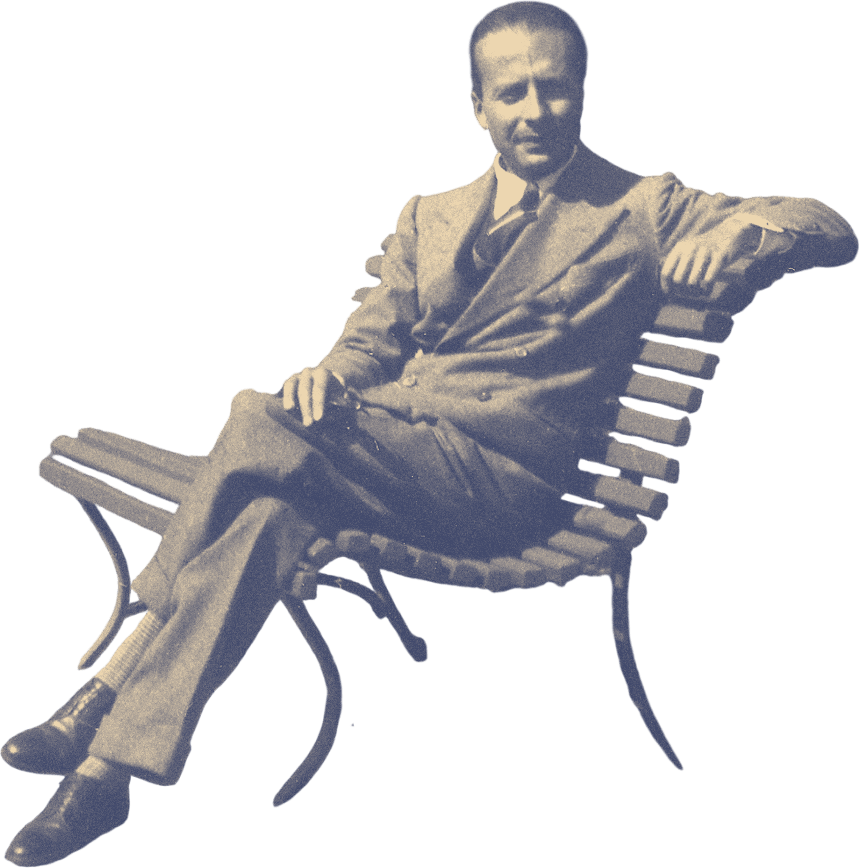
Giacinto Scelsi was an Italian composer who also wrote surrealist poetry in French. He is best known for writing music based around only one pitch, altered in all manners through microtonal oscillations, harmonic allusions, and changes in timbre and dynamics, as paradigmatically exemplified in his revolutionary Quattro Pezzi su una nota sola ["Four Pieces on a single note"] (1959).
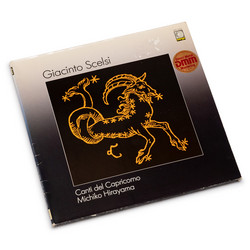
Canti Del Capricorno (LP)
First album with the full cicle of songs by the outstanding and influential Italian composer sung by their dedicatee, privately recorded in 1969 (featuring Alvin Curran) and 1981 and released by Wergo in 1987.
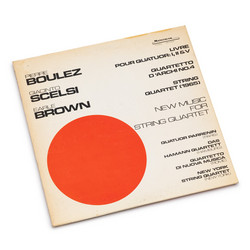
New Music For String Quartet (LP)
Compositions for string quartet spanning from 1949 to 1965 released on Mainstream's avant-garde series directed by Earle Brown.
Quattro Pezzi / Pranam II / Okanagon / Kya (LP)
condition (record/cover): NM/EX Gatefold sleeve. Giacinto Scelsi (1905-1988), one of the most enigmatic figures of 20th-century music, presents four essential works exploring his revolutionary approach to sound. Scelsi's radical music focuses on the microtonal universe within single pitches – sound as living, breathing matter rather than melodic material.
Quattro Pezzi (su una nota sola) showcases his groundbreaking chamber orchestra aesthetic built on single notes. Pranam II creates ritual int…
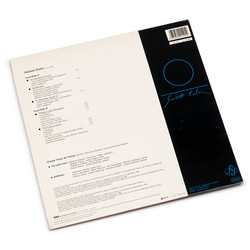
Musique Sacrée (LP)
condition (record/cover): NM/NM Gatefold sleeve. A profound exploration of sacred music by one of Italy's most enigmatic composers! Giacinto Scelsi (1905-1988), whose work remained largely unknown until late in his career, created a unique compositional language centered on microtonal explorations and the inner life of single sounds. This rare Fy release presents his sacred works, revealing Scelsi's deeply spiritual approach to composition. Moving beyond traditional harmonic structures, these pi…
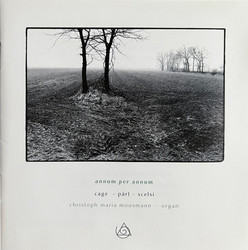
Annum Per Annum
1995 release ** Contemporary music for organ by Arvo Pärt, John Cage and Giacinto Scelsi.
Scelsi, Byzantium, The Alchemists
1994 release ** "From the Byzantine Alleluia that begins this ritual to the Scelsi Alleluia that brings it to a close, a circular program weaves a path through the world of Christian theology, Jewish tradition and alchemy, brought together by the universalist music of Giacinto Scelsi. Michael Maier was an alchemist composer whose three voice fugues speak of bizarre cures and spiritual unions. Veronika Krausas set a text by Quintan Ana Wikswo evoking the first female alchemist, Maria the Jewess. …
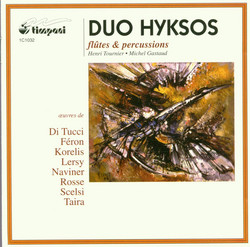
Flutes & Percussions
2011 release ** Works for flute and percussion by Petros Korelis, Jacques Di Tucci, Roger Lersy, François Rosse, Alain Féron, Giacinto Scelsi, Yoshihisa Taira, Jean-Yves Naviner.
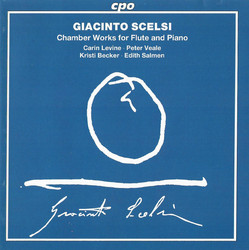
Chamber Works For Flute And Piano
1998 release ** "For the first time, we can hear Giacinto Scelsi playing piano! It's short (3:51) and the recording quality substandard, but Scelsi's improvisation with Carin Levine, Krishna e Radha, gives a window into the mind of one of the greats--that until now we could only hear through the veils of transcription and composition. The other premiere is Quays, for alto flute (1954). Levine has made her mark in the avant of avant-garde flute. The remaining pieces here have all been recorded a…
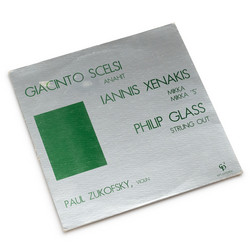
Anahit / Mikka / Mikka “S”/ Strung Out
Absolutely essential 1976 ambient/modern classical compilation of solo violin music by three legendary composers.

Outre-Nuit
Outre-nuit as Outre-noir by Pierre Soulages, the greatest nuances on subtle variations. The programme can be listened to in one go between Clara's two compositions, it's Xnoybis, an extraordinary performance by the great Giacinto Scelsi - a piece that makes you feel like you're listening for the first time - Giacinto Scelsi's Xnoybis (1964) is a journey amongst the reliefs contained within one single pitch. Written in three parts, the piece is an instinctive approach to the sound spectrum (the t…
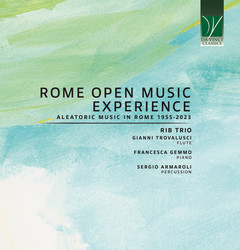
Rome Open Music Experience
*2024 stock* "Rome: not only the capital city of Italy, but also an acronym standing for Roman Aleatoric Music Experience. The three musicians of the Rib Trio, featured in this Da Vinci Classics album are all among the leading experts in the field, and they decided to explore a quintessentially Roman phenomenon, i.e. the fertile ground found by aleatoric music in the Roman area, from the post-World-War II years until present-day. Aleatoric music is music whose notational parameters (such as pitc…
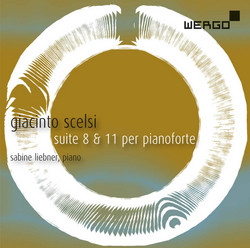
Suite 8 & 11 per pianoforte
Giacinto Scelsi (1905–1988) is one of the most unusual composers of the twentieth century, a unique figure whose importance was only fully recognized and celebrated after his death. During his lifetime, he was often dismissed, especially in Italy, as a pretentious dilettante because he did not notate his music himself. Beginning in the mid-1950s, he recorded his improvisations at the piano and had them transcribed by others. In this way, in the course of only a few years hundreds of piano pieces…
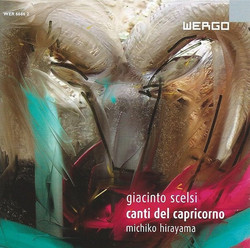
Canti Del Capricorno
*2022 stock* Giacinto Scelsi wrote the twenty Canti del Capricorno between 1962 and 1972 for and with the Japanese singer Michiko Hirayama, who inspired them and who for decades remained their unique performer. The cycle is for solo voice, with instruments in some of the songs: a spiritual yet energy-filled music made of single sounds, microtonal inflections, breath, cries and invented syllables, closer to ritual than to song.
Hirayama, born in 1923, recorded it for Wergo when she came to Ulm in…
Sfera
Giacinto Scelsi (1905-1988) was an Italian composer and rather unusual pioneer of electronic music. His works are neither based on traditional techniques nor do they resemble concepts of the 'new music' avant-garde. Since the 1950s he recorded improvisations on the ondiola (an early electronic instrument) to magnetic tape, often in multiple layers. These recordings were then transcribed into scores by his assistants – probably constituting the first attempt at making electronic music heard throu…
Works for Violin and for Viola
** In process of stocking ** Giacinto Scelsi (La Spezia, 1905 – Rome, 1988) is one of the most original Italian composers of the twentieth century. Musician and poet of aristocratic descent, Scelsi spent his childhood in his family’s castle, in Valva, where he received “un’educazione medievale” in which he recalls “scherma, scacchi, latino”, 1 and developed an early attraction towards improvisation on the piano. “De l’age de trois ans et demi, j’ai commencé à improvisers au piano. [...] je ne s…
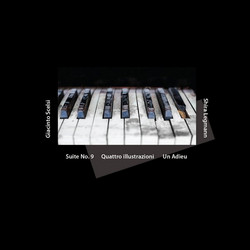
Suite No.9 / Quattro Illustrazioni / Un Adieu
Shira Legmann is an Israeli concert pianist, with a wide repertoire from Baroque to contemporary and experimental music. This album contains three piano works by Italian composer Giacinto Scelsi: Suite No.9 "Ttai" (1953), Quattro Illustrazioni (1953), and Un Adieu (1978/1988). This is Legmann's second CD on Elsewhere Music, following the 2019 album "Barricades" in which she was the pianist for Michael Pisaro's composition for piano/electronics.Legmann's clean, supple yet solid piano sounds, whic…
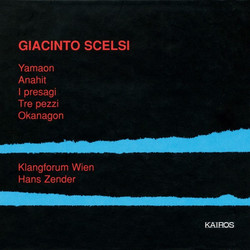
Yamaon
Yamaon (1954-1958) for bass, alto saxophone, tenor saxophone, contra bassoon, percussion and doublebass is one of the wildest and most direct works of Scelsis. Just as the composition I presagi completed in the same year, the title warns of the destruction of a Mayan city. As Varèse in Ecuatorial and Nocturnal, Scelsi in Yamaon works with a differentiated repertoire of vowels, consonants, and syllables. These have no linguistic semantic meaning, but convey heterogeneous values of expression. “Wh…
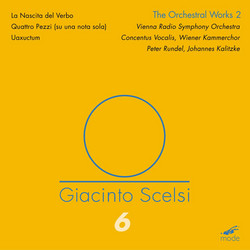
The Orchestral Works 2
Three orchestral works by Giacinto Scelsi recorded in Vienna in 2005: Quattro Pezzi (su una nota sola), Uaxuctum, and the first recording of La Nascita del Verbo, with the Vienna Radio Symphony Orchestra and choirs.
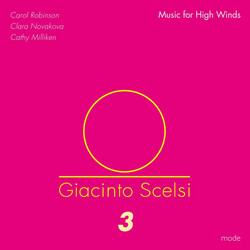
Music For High Winds
Giacinto Scelsi's music for high winds, solo and duo pieces for clarinet, flute, piccolo and oboe written between 1953 and 1970, played by Carol Robinson, Clara Novakova and Cathy Milliken. Volume 3 of Mode's Scelsi Edition.
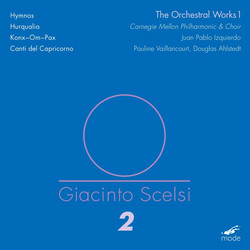
The Orchestral Works 1: Hymnos, Hurqualia, Konx-Om-Pax
Volume 2 of Mode's Scelsi Edition: the orchestral works Hymnos, Hurqualia and Konx-Om-Pax, played by the Carnegie Mellon Philharmonic and Concert Choir under Juan Pablo Izquierdo, interspersed with Canti del Capricorno sung by Pauline Vaillancourt and Douglas Ahlstedt.
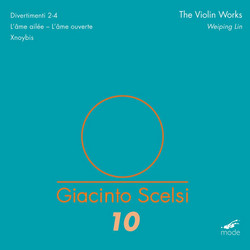
The Works for Violin
The first complete recording of Giacinto Scelsi's works for solo violin, including the first recording of Divertimento No. 2, played by Weiping Lin, assistant concertmaster of the Vienna Radio Symphony Orchestra.

Earle Brown Contemporary Sound Series Vol. 4
"Wergo's reissues of the legendary Earle Brown Contemporary Sound Series have been a big hit with fans of contemporary music around the world. Each set is a treasure-trove of works by a wide range of composers, performed by some of the finest musicians of the time. The three CDs of volume four feature string quartets by Boulez, Scelsi and Earle Brown, works for chamber orchestra by Xenakis, Aldo Clementi, Bo Nilsson, Wlodzimierz Kotonski and Yuji Takahashi and works by Milko Kelemen, Niccolo Cas…
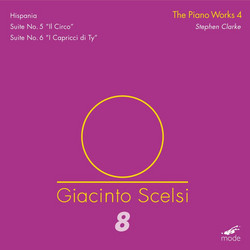
The Piano Works 4
Fourth volume of Giacinto Scelsi's piano works: Hispania, Suite No. 5 Il Circo and Suite No. 6 I Capricci di Ty, three first recordings of large early works from the 1930s, played by Stephen Clarke.
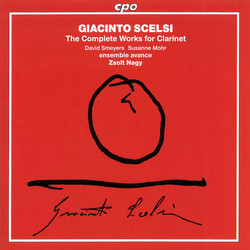
Complete Works For Clarinet
Giacinto Scelsi was both reclusive and inexact in the way that he dated and named his compositions. This rendition of Tre Pezzi (a broad title Scelsi used numerous times for different pieces) focuses on narrow ranges in the B-flat clarinet, demonstrating the thin margin of tonal range between the phrases that come sometimes fast, sometimes slow. Kho Lho, on the other hand, pairs a clarinet and flute duet so closely that the instruments' tones merge into a thick strand of sound. Maknongan is a r…
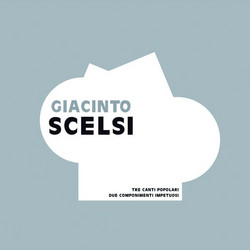
Tre Canti Popolari + Due Componimenti Impetuosi
2CD collection which re-releases two previous Sub Rosa CDs Tre Canti Popolari (SR 051CD, 1992) and Due Componimenti Impetuosi (SR 063CD, 1995), now remastered and with a new design. This is the vocal and piano music of visionary Italian composer Giacinto Scelsi (1905-1988). Performed by: Marianne Pousseur, Lucy Grauman, Vincent Bouchot, Paul Gerimon, Georg Alexander Van Dam, Jean-Paul Dessy, Jean-Luc Fafchamps, and Johan Bossers. Scelsi will always be known as an atypical composer. Throug…
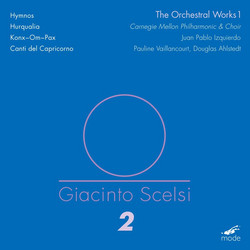
The orchestral works 1
Scelsi Edition volume 2: three rarely recorded orchestral works, Hymnos, Hurqualia and Konx-Om-Pax, played by the Carnegie Mellon Philharmonic under Juan Pablo Izquierdo, with selections from Canti del Capricorno sung by Pauline Vaillancourt and Douglas Ahlstedt.
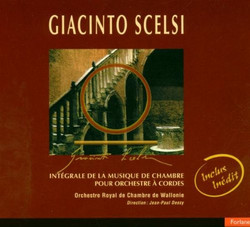
Integrale de la musique de chambre
Long deleted, this is a must have cd collecting all the Scelsi pieces for string orchestra. "An internal struggle, stemming from the introductory tremolo, all through its serene yet chaotic means of lumonisity"
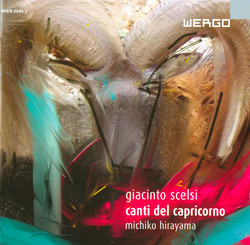
Canti Del Capricorno
Original copy, the title of Scelsi's song cycle possibly refers to the fact that the sign of the Capricorn corresponds with an area of the Earth stretching from India to South America and includes, most significantly, the Amazon. The Amazon, as Scelsi noted, is a place where a pre-historic human culture survives. Scelsi's Songs (19) of the Capricorn, reduce the concept of "song" to poetically loaded vocal utterances imaginatively recalling the conditions of music and language in humankind's dist…
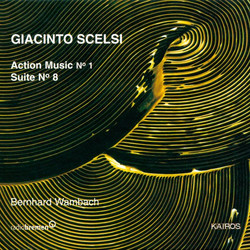
Action Music
Giacinto Scelsi’s relationship with the piano is interesting and contradictory. For no other instrument has the Italian composer and poet composed so many pieces; to no other instrument does he seem so closely attached, both personally and biographically; and no other instrument disappeared so abruptly and finally from his scores as the piano, the European showcase instrument. With the piano, we can follow the break lines and develop-ments in the musical thinking and works of Giacinto Scelsi, wh…
Natura renovatur
Giacinto Scelsi (1905-88) has featured prominently in my music writing life for a decade and a half, ever since I wrote Discovering Scelsi on my first computer for Piano Journal (Oct. 1986), one of the first UK articles about this fascinating and elusive composer.There are particular reasons why the Scelsi CD in the latest, indispensable batch from Kairos prompted a trawl of my files. Scelsi applauded my analysis of his piano music and we had a cordial correspondence, after which I met him tw…
Complete Works for Flûte and Clarinet
The Complete Works for Flute and Clarinet: In both original works and transcriptions, the Ebony Duo explores Scelsi’s use of special sound colors and his coloring of sound. Transcriptions especially prepared by the clarinetist (and pianist) Michael Raster provide the basis for some of the works on the present album. Yet Scelsi’s original intentions incurred no damage as a result of this recrafting. To the contrary! “The formidable technical demands that playing on two strings with in part opposi…
Quattro illustrazioni / Suite N° 8 \"Bot-Ba\" / Cinque incantesi
Crazy about the sound: the composer as a medium fHis bizarre way of composing earned Giacinto Scelsi not only fame and respect; he was also mockingly accused of dilettantism. Scelsi regarded himself not as a composer in the traditional sense, i.e. one to combine form, rhythm, pitch and sound in an intelligent way and note the result down on paper, but as a tool. His music was created during periods of meditative contemplation recorded by him on tape, to be noted down only afterwards. Eastern rel…
Ho Khoom Pranam
an original copy of an awesome Scelsi LP, featuring Hô (1960) - Four melodies for solo voices. Pranam I (1972) - (In memory of the tragic loss of Jani and Sia Christou) for voice, 12 instruments and tape. Khoom (1962) - (Seven episodes of a story of love and death in a distant land) for voice and 6 instruments. Hô and Khoom were recorded in 1960-1962: Pranam I, in 1972.
The works of double bass
The first complete recording of Giacinto Scelsi's music for double bass, played by Robert Black with guests on cello, harp, tam-tam and second bass, including Ko-Tha in Fernando Grillo's transcription.
Pranam II for ensemble
It is scored for two flutes, violin, viola, cello, bass clarinet and electric organ. This is a really beautiful piece of tranquil music, full of touching sweetness.
Collection vol.1
The first in a series of recordings devoted to the music of Giacinto Scelsi, devised by Stradivarius in conjunction with the Isabella Scelsi Foundation. The series comprises new, original recordings made in 2005, marking the hundredth anniversary of the composer's birth.
The Piano Works 1
First volume of Mode's Scelsi Edition and of the traversal of his piano works: Giacinto Scelsi's Sonatas No. 2 and No. 4 and the nine-movement suite Ttai, played by Louise Bessette.
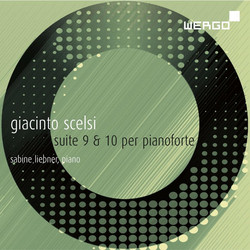
Suite 9 & 10 per Pianoforte
Giacinto Scelsi's Suite n. 9 "Ttai" (1953) and Suite n. 10 "Ka" (1954) for piano, played by Sabine Liebner, recorded in 2014 at the Deutschlandfunk Kammermusiksaal in Cologne.

Giacinto Scelsi
**Comes in glossy gatefold sleeve with 20-page booklet ** Features 6 works by the influential Italian avant-gardist of the 20th century, dating from 1961-1990. Pranam I (for voice, 12 instruments and tape, 1972); Anagamin. Celui qui choisit de revenir ou pas (for 12 strings, 1965); Quattro pezzi su una nota sola (for chamber orchestra, 1959); Quartetto n. 4, (1964); Okanagon (Tam Tam and double bass, 1968); Quartetto n. 2 (1961). "For Giacinto Scelsi, music was above all a manifestation of the e…
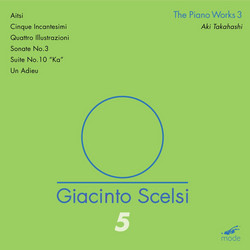
The piano works 3
Aki Takahashi plays Giacinto Scelsi's piano works in 2005 recordings, mostly pieces she prepared with the composer, including the Quattro Illustrazioni depicting the incarnations of Vishnu.