The Art Of Living Dies...
Lack of musical material, minimalism but not for it's purposes, patterns shifting in themselves...The Art of Living Dies...The piece is performed by Michael Moser, a cult figure in Austrian new music, whose work includes significant collaborations with bands like Polwechsel and Zeitkratzer and artist such as Bernhard Lang, Peter Ablinger, Fennesz, David Sylvian (Manafon). Very slow, extremely static, the piece drives into one direction, without specific target but also without tendency to be con…
Quartet / Octet
Taku Sugimoto, guitar and composition, with Klaus Filip (sine tones), Ko Ishikawa (sho), Moe Kamura (voice), Kazushige Kinoshita (violin), Radu Malfatti (trombone), Masahiko Okura (clarinet), Taku Unami (sine tones), Nikos Veliotis (cello). 2013.
Plays Brown, Cage & Feldman
An accomplished group in the world of chamber music, the Concord String Quartet, active from 1971-1987, gained almost immediate attention from the press as well as a dedicated following, after winning the prestigious Walter W. Naumburg Chamber Music Award in 1972. Although the quartet was a classical string quartet, these rare 1973 recordings show the groups affinity for the "New York School" of avant-garde composers, like Earle Brown, John Cage and Morton Feldman, as well. Side B is entirely co…
Ensemble Works 3
Xenakis Edition volume 13: works for soloist and ensemble by Iannis Xenakis, played by members of the International Contemporary Ensemble under Steven Schick, with the first recording of Zythos for trombone and six marimbas.
Onsets
Five chamber works by Tim Hodgkinson, co-founder of Henry Cow, for ensemble and electronic sound, bass clarinet and strings, and string quartet with harp, trombone and synthesizer, played by Hyperion Ensemble and others.
Complete String Quartets
The three string quartets of Helmut Lachenmann, Gran Torso, Reigen seliger Geister and Grido, played by the JACK Quartet in a recording endorsed by the composer.

Visitazioni
Two works from different periods come together in this "case-book": Ora (1997/2001) and Visitazioni (2011/ 2013). Times ... ways ... experiences intersect. Ora is a single stream of sounds and silences of 120 minutes. It can be "healed" (replaced) according to the feel of the listener. Its division into sections - like the same graphic score - have this unique feature. Headphone listening at a low volume is absolutely privileged. Visitazioni, referring to similar principles but changing the ways…

Pneuma
Pneuma presents five distinctive pieces by British composer Martin Iddon, performed by specialist new music ensembles. The set includes “pneuma.sarx” for Trio Atem (flute, voice, cello), “pneuma.kharis” (flute, cello, voice), “Danaë” (solo piano, Catherine Laws), and two works for larger instrumentations. Iddon’s music occupies unique territory, weaving together sparse, breathy textures and sudden shifts in color and gesture, drawing frequent reference to medieval and early Renaissance models - …
Piano Music
Two compositions exploring the decay of the piano from Wandelweiser composer Eva-Maria Houben. Fading sound is the link between life and art; between perception in daily life and perception while performing, while composing.“Fading sound is the link between life and art; between perception in daily life and perception while performing, while composing. And the awareness of fading sound may become the awareness of presence.” Halfway through Eva-Maria Houben’s abgemalt, the pianist unfurls a …
Works for String Quartet and Percussion
"The evolution of the string quartet repertory has accelerated during the last half of the twentieth-century and beyond as composers from both the mainstream and the avant-garde have mined its seemingly inexhaustible creative resources. This CD features the virtually unprecedented combination of string quartet and percussion. It contains three works by prominent American experimentalist composers from several generations exploring the ensemble's unique sonic resources in diverse stylistic settin…
Matthew Shlomowitz and Peter Ablinger
Works by Matthew Shlomowitz and Peter Ablinger for piano and found sounds. Mark Knoop performs Matthew Shlomowitz's "Popular Contexts", for piano and sampler keyboard and selections from Peter Ablinger's ongoing cycle "Voices and Piano". Both works deal with collected sonic objects - Shlomowitz's widely varied samples, ranging from insect noises to airline safety announcements, and the recorded speech of Ablinger's subjects - forcing them into musical juxtaposition with the piano.
"Popular Conte…
Organ Works Vol. 1
I put my music into the space. I don’t want to send any messages, I think of nothing and I don’t want to purport any meanings. The listeners hear what they hear and behave to the music as they feel.
Austrian composer, Klaus Lang, describes himself as observer of tones. As stated himself, his roots belong to Gregorian tradition and his music definitely represents abstract way of perceiving it.
Though abstraction (of form and content), he is interested in clarity and truth.
His work includes piec…
Logical harmonies
Logical Harmonies assembles seven pieces by UK composer Richard Glover, realized by a mobile ensemble including Philip Thomas (piano), Mark Bradley (clarinet), Mira Benjamin (violin), Andrea Stewart (cello), Bob Gilmore (keyboard), Seth Woods (cello), and others. Glover’s process-based music explores the transformation of simple harmonic patterns - major and minor thirds, triads, pure intervals - over extended time. Rather than evoke drama, each work layers tones and intervals into evolving cons…
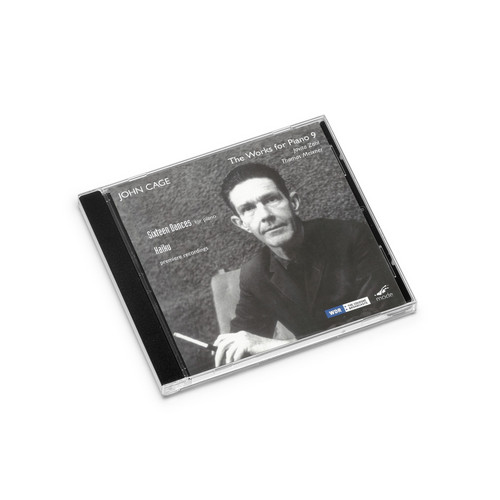
The Piano Works 9
First recordings of two major piano works by John Cage from 1950-51 found at the New York Public Library: Haiku and the solo piano version of Sixteen Dances, played by Jovita Zähl, with Thomas Meixner on percussion in two alternate dances.
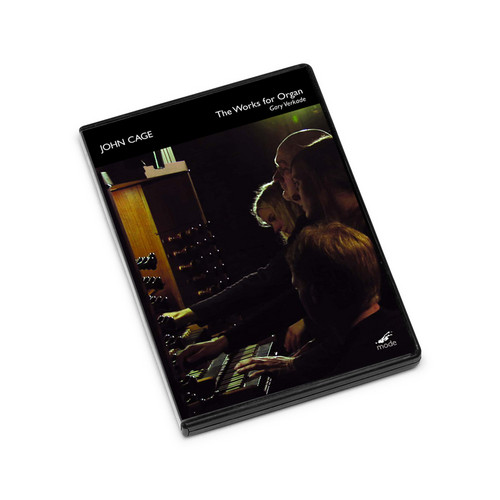
The Works for Organ
First complete recording of John Cage's works for organ, played by Gary Verkade on the organ of Gammelstad Church, Sweden: Some of 'The Harmony of Maine', Souvenir, ASLSP and Organ2/ASLSP, with 4'33'' on the DVD only.
Violin & Orchestra
Carolin Widmann’s widely acclaimed ECM recordings have traversed a broad arc of music – from Schubert to Xenakis. Here she turns her attention to one of the pivotal compositions of Morton Feldman. Violin and Orchestra, composed in 1979, marked a new direction, with an almost painterly attention to detail in slowly unfolding music. It is not a concerto in the strict sense of the term, not soloist with orchestral support. The violinist must move inside the glowing colour-field of sound. In t…
Sonatas & Interludes
How rare, and valuable, it is to be able to experience one composer’s masterwork through the sensibility of another significant, stylistically distinct composer – via a performance that reveals unexpected aspects of both. that is to say, an approach to performance not as an act of self-conscious, flamboyant or dramatic interpretation, according to the concerns of technique, expression, and projection that are at the heart of an instrumentalist’s presentation of a musical score to an audie…
Music Of Changes
The title is a double pun. The score is the first that John Cage devised allowing the hexagrams of the I Ching to fully determin e how the music would procee d, event by event, gesture by gesture—the musical details (pitch, duration, dynamic s, density, tempi) being painstakingly, albeit fortuitously, derived through point-by-point con sultation from charts of possi bilities designed by the composer. (Christian Wolff, Cage’s young friend and musical associate, had presented Cage with a co…
Sinergy
The question of form is key in the music of Earle Brown, one of the foremost American composers of the past fifty years. It was a certain amount of serendipity and a shared interest in the liberation of musical form which brought Brown to gether, circa 1951, with John Cage, Morto n Feldman, Christian Wolff, and David Tudor, in what was for a time called the New York School. … There was a close identification between these composers and painters at this time, and Feldman and Brown, especially, to…