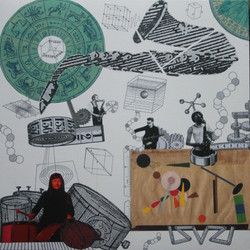
Death Of A Century is the second CD by Milusic, the long-running project of poet, musician, mail artist and painter Roberto Migliussi. Following 2018’s Dance Mystique, it returns to ADN with a more explicitly conceptual assault: a kaleidoscope of twentieth-century voices, damaged cultural memory and post-industrial electronics. Migliussi has been active since the 1980s, when he founded the influential fanzine and magazine Idola Tribus and began developing cassette-based experiments from radio samples, ethnic sounds, drum machines and early electronic textures. Those methods remain central here, but they arrive newly charged - less like nostalgia than a late-night broadcast from history’s overloaded subconscious.
Migliussi’s practice has always drawn together the literary, the esoteric and the stubbornly physical grain of obsolete media. His long-standing work around Austin Osman Spare and related occult writers gives Death Of A Century its deeper shadow: this is a record attuned to voices as vessels, fragments as spells and technology as a haunted channel. Joined once again by David Granziera of Teatro Satanico, Milusic constructs a sonic journey where cultural figures from the last century appear not as honored guests but as unstable presences - fleeting recognitions in the static. Salvador Dalí, Antonin Artaud, Jack Kerouac, Allen Ginsberg, Aleister Crowley and other familiar or half-familiar voices drift through the album’s circuitry, their words and personas detached from linear biography and recast as elements in an unruly audio collage.
The sequence opens with Apopantos, where mystical choirs, disembodied speech and electronic percussion establish the record’s ritual temperature. Colonies moves through Eastern-inflected atmospheres, Western melodic residue and the unexpected, almost comic intrusion of frogs - a reminder that Milusic’s surrealism is never too solemn to let the natural world crash the séance. Esperanza places declamatory narration against electronic rhythms, while Ortensia Bistrot begins with a groove-minded keyboard figure before electronic percussion and faint, dwarf-like voices begin to unsettle the room. Everywhere, sounds are treated as characters: they enter, interrupt, linger at the edges and sometimes return wearing another mask.
As the album progresses, the collage becomes denser and more narratively unstable. Orange Soda floats on airy electronics and syncopated radio fragments, with words landing like overheard slogans from a station that no longer exists. Atlante brings a jazzy undertow to spoken performance, while President USA builds a narrative line over a thick synthetic field that feels equal parts political broadcast and malfunctioning dream. Hippies provides some of the record’s heaviest rhythms and most unnerving electronic shades, pressing the album’s beat-driven side into darker territory. On Anacleto, a female vocal presence enters the foreground; Hermete restores an orientalizing mood, with vocal traces rising and thinning into the air.
Late in the sequence, Morituri touches the mechanical resonance of the classic German electronic school, its machine pulse and undefined voices evoking the cool, impersonal geometry associated with Kraftwerk, then bending it into Milusic’s more theatrical, haunted vocabulary. The closer, Karawane, is the album’s most explosive movement: overlapping voices and blowing electronics collide in a final rush that feels like a parade, a breakdown and a radio tower going down at once. It leaves the listener inside the record’s central paradox - a work obsessed with cultural death that refuses stillness at every turn.