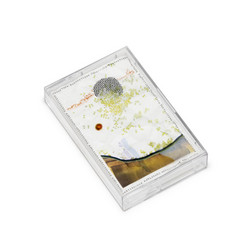
Chris Connelly
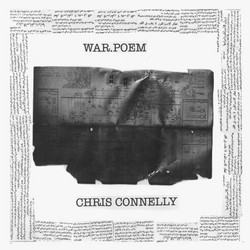
War Poem (LP, Military Grey)
Label: Dirter Promotions
Format: LP
Genre: Experimental
Out of stock
** Edition of 300 ** War Poem is Chris Connelly at his most distilled and uncompromising, an album that treats experimental sound not as abstraction but as a form of protest. Recorded at The Rock Noir studio over 2025/2026, the project began with a news item: a report on the Israeli military’s use of flechette shells in Gaza. That single, horrifying detail opened onto a deeper investigation into the history of 20th‑ and 21st‑century warfare - into how technology, language and policy conspire to turn devastation into procedure. Rather than respond with lyrics or conventional song structures, Connelly chose to answer in the language of machines, tape, error and endurance.
Every sound on War Poem originates from a small arsenal of obsolete devices: a Tape‑O‑Matic 710 reel‑to‑reel from 1958, a 1960s Mayfair JVC reel‑to‑reel, a 1965 G.E. solid‑state portable reel‑to‑reel, a portable 1970s Panasonic cassette player, a ring modulator and a handful of additional effects and synths. These are not retro fetish objects but instruments in their own right, each with a specific noise floor, bias, instability and grain. Connelly leaned into those characteristics, pushing tape into saturation, exploiting wow, flutter and mechanical irregularities until the machines began to “speak” in their own distressed voices. The resulting textures feel scorched and bruised, haunted by their own material history.
The heart of the record is War Poem Zero, a loop that takes up the entire first side. It was born by accident: Connelly threaded a reel onto the machine the wrong way up and hit play. What emerged was a sound he describes as possessing a “great melancholy and beauty,” a fragile, damaged figure that seemed to hold in miniature everything he was trying to confront. Rather than correct the mistake, he surrendered to it, letting the loop run, morph and accumulate small changes over time. Side one becomes an act of listening as much as composition: the patient witnessing of a broken signal that refuses to disappear, echoing the way certain images of war lodge in the mind and repeat long after the news cycle has moved on.
Elsewhere on the album, the vocabulary expands but the ethos remains the same. Layers of treated tape, ring‑modulated tones and distressed synth wash fold into one another, sometimes coalescing into pounding, “old school industrial” heft, sometimes thinning to near‑silence where only the crackle and whine of the machines remain. Rhythms arise from mechanical repetition rather than drum programming; crescendos are built from the stacking of noise bands and feedback rather than traditional harmonic tension. The music’s brutality is less about volume than about exposure: you are placed very close to the machinery, hearing every scrape, drop‑out and overload as if seated inside the mechanism of a weapon.