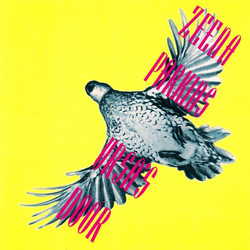
Electric Garden captures Sissy Spacek and Smegma at a moment when the borders between both projects had already started to melt, fixing onto tape a 2013 session at Portland’s Pink House that feels less like a meeting and more like the documentation of an already‑shared bloodstream. The recording sits at the tail‑end of Sissy Spacek’s West Coast tour, just before the project would tighten into the duo configuration of Charlie Mumma and John Wiese, and at a point where Smegma had long since embraced its most stripped, mutable form. Rather than presenting two self‑contained line‑ups facing one another across the room, the album reveals an ensemble made of overlapping memberships, mutual infiltrations and circulating roles.
The personnel list makes this entanglement explicit. Smegma are reduced here to their essential core of Ju Suk Reet Meate and Oblivia, a configuration that foregrounds agility over mass. Sissy Spacek, meanwhile, is represented by Mumma and John Wiese, itself a transitional formation en route to the later duo identity. Wiese had been part of Smegma’s orbit for years, contributing electronics and tape manipulation; Oblivia had already slipped regularly into Sissy Spacek performances and recordings; Mumma had become a stabilising force within Sissy Spacek, steering the project through phases of grindcore implosion, electro‑acoustic rubble, free improvisation and splintered electronics. By the time they walk into The Pink House together, notions of “guesting” or “cross‑over” barely apply - the projects are already porous in practice, and the session simply lets that reality speak.
Accordingly, Electric Garden refuses the narrative of a summit between two distinct entities. From the first moments, distinctions fold in on themselves: guitar is treated as unstable texture more than riff machine, electronics swell and recede like air pressure rather than punctual effects, percussion toggles between impact and particulate noise, and turntables smear fragments that feel at once archival and uncannily present. Instead of spotlighting who plays what, the recording allows sounds to emerge through collective accumulation. You hear clatter, feedback, warped loops and environmental bleed, but their origins are less important than the way they collide and recombine, like currents knotting in a single body of water.
In this sense, the album stands in sharp contrast to Ballast, the 2018 Sissy Spacek/Smegma collaboration built from heavily multi‑tracked, post‑facto constructions. Where Ballast works architecturally - layering and re‑layering discrete contributions into dense, studio‑sculpted environments - Electric Garden is rooted in the behaviour of a room. The Pink House isn’t just a location; it is an instrument. The recording keeps the physicality of shared space intact: spill between microphones, the way sound curls around furniture, the slight disorientation as sources drift in the stereo field. Tape loops blur into live electronics. Scraped metal and drum resonance get caught by the room and handed back as ghost harmonics. Brief eruptions of guitar or radio surface, shimmer against turntable detritus, then are swallowed by a new mass of noise.