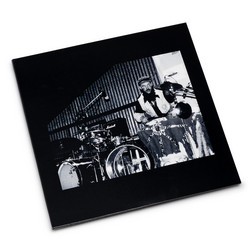
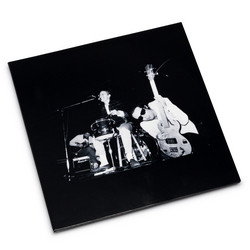
Annihilation of Samsara documents the first trio recording by Attila Csihar, Balázs Pándi and John Wiese, but it feels less like a new band forming than like a latent structure finally surfacing after years of subterranean crossings. Each of these artists has spent decades pushing at the boundaries of experimental sound - from black metal and ritual performance to free improvisation, harsh noise and abstract electronics - usually in parallel, occasionally in close orbit, rarely at direct intersection. Here, those trajectories finally collide, not to create a tidy fusion, but to expose the unstable zone where their practices overlap, interfere and erode one another.
The root system of this meeting reaches back to 2005, when Csihar and Wiese first shared space on Sunn O)))’s European tour. Csihar had already become one of extreme metal’s defining voices through his work with Mayhem and, within Sunn O))), was gradually turning “vocals” into something more diffuse: fog, vibration, architecture. In that context, his voice ceased to be narrative and instead became weather, a ritual pressure field inside the drone. Wiese’s electronics, meanwhile, helped push Sunn O))) into destabilised psychoacoustic territory where amplified tone blurred with environment, PA hum, room resonance and sheer physical overload. Both were, in different ways, preoccupied with transformation - with sound losing its fixed identity and becoming a bodily, unstable presence.
The album’s title, Annihilation of Samsara, offers a conceptual lens through which to hear this behaviour. In several Eastern traditions, samsara designates the cyclical condition of birth, death and rebirth, a loop sustained by attachment and repetition. To annihilate samsara is not merely to destroy, but to exit that cycle - to reach a state where recurrence no longer governs experience. The trio does not translate this theme into easy symbolism; instead, the idea is enacted structurally. Sounds emerge, decay, and reappear in altered forms, but the music resists settling into loops that reassure or patterns that resolve. It keeps approaching suspension - states in which time feels stretched, thickened, unmoored from linear expectations, as though the recording were constantly trying to slip beyond recurrence into a different order of experience.