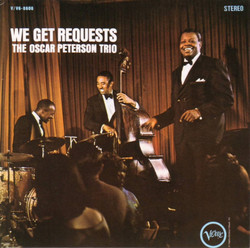
In 1963 and 1965 Oscar Peterson performed at the Kulttuuritalo in Helsinki. He was the leader of what was then considered one of the most closely-knit bands in the history of jazz, made up of Oscar himself and two other fabulous jazzmen, Ray Brown on bass and Ed Thigpen on drums. For the 1965 concert, trumpeter Clark Terry was invited to join the legendary trio.
The Helsinki concerts were both part of whirlwind European tours that included performances all over the continent, from France and Germany to the Scandinavian countries. The band’s tremendous success was by no means due to luck. Peterson greatly admired the musicians he had recruited for their immense technical prowess and creativity—yet he exhorted them further to outdo themselves and strive to create a real osmosis in the way they interacted on stage. What sprang up from this three-way symbiosis was pure enchantment. As Peterson repeatedly said, “It’s the group spirit that’s important. I’m just the piano player.” He often described his philosophy, saying, “Jazz is a very democratic musical form. It comes out of a communal experience.” And delighted audiences participated enthusiastically in this spirit.
Peterson was known as the “Maharaja of the keyboard,” a nickname he was given by Duke Ellington. Contained in every one of his musical phrases was the entire legacy of jazz—the fervor of gospel and the power of swing. Yet showing through the harmonic architecture, the refined polyphony, and his pronounced partiality for form was an immense musical culture. Peterson’s command of all musical genres, together with the group chemistry, empowered him to be, above all, a musician of the moment.
Through a close partnership established with YLE, the Finnish radio station, we at The Lost Recordings were able to gain access to the analog tapes of these two concerts. The tapes were in perfect condition, but we still had an enormous amount of work to do on the audio levels, as the mixing had been done haphazardly. The resulting recording does full justice to these two hitherto unreleased gems. Sadly, the trio split up several months after this performance. These two concerts reached the musical summits of jazz and immortalized the apogee of what was, and remains, one of the most legendary trios in the world.