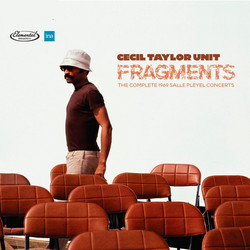
Fragments: The Complete 1969 Salle Pleyel Concerts restores a night that sat in legend for decades to its full, disorienting glory. On 3 November 1969, Cecil Taylor brought his working Unit to the 8th Paris Jazz Festival and, instead of offering a polite festival sampler, delivered two full sets of unbroken invention at Salle Pleyel. Here, for the first time, those performances are heard complete: no editorial fades, no selective excerpts, just the sustained pressure and turn‑on‑a‑dime responsiveness of a band at absolute peak. The lineup alone signals the gravity of the event - Taylor on piano, Sam Rivers on tenor and soprano saxophones and flute, Jimmy Lyons on alto saxophone, Andrew Cyrille on drums - but it’s the way they inhabit the room, collectively reshaping time and density in real time, that makes this release feel truly monumental.
Transferred from the original analog tapes preserved in the INA archives and mastered for 180g vinyl by Matthew Lutthans at The Mastering Lab, the music lands with a physicality that matches contemporary accounts of Taylor’s live impact. You hear the percussive thunder and iridescent clusters of his piano not as blur but as a highly articulated barrage; individual attacks, pedal work and internal string resonance register inside the overall onslaught. Rivers moves between roaring tenor, needling soprano and suddenly weightless flute, each change of horn opening a different corridor for the music to move through. Lyons, ever Taylor’s most faithful melodic mirror, threads bright, tart alto lines through the storm, his phrasing tying Taylor’s harmonic explosions back to the blues and bebop roots they never entirely abandon. Cyrille’s drumming, all rolling momentum and splintered pulse, functions simultaneously as propulsion, commentary and shock absorber, translating Taylor’s keyboard detonations into a constantly reconfiguring rhythmic field.
Fragments is as much a deep archival object as it is an overwhelming listen. The heavy vinyl and expansive format give the music literal space to breathe; side breaks are treated as structural pauses rather than arbitrary cuts, reinforcing the sense of two vast, through‑composed arcs rather than a stack of tracks. A richly illustrated booklet situates the concerts visually and historically, gathering rare photographs by Jean‑Pierre Leloir, Jan Persson, Christian Rose and others that capture the Unit mid‑eruption, as well as the atmosphere of late‑60s Paris on a night when the free jazz vanguard took over one of its most august halls. New liner notes by writer Phil Freeman trace the music’s internal logic and its place in Taylor’s trajectory, while first‑hand testimonies from Andrew Cyrille, Jack DeJohnette, Matthew Shipp, Karen Borca and Monique Rivers open up a chorus of perspectives: musicians who were on stage, in the audience, or downstream of the shockwaves this band sent through the idiom.
Behind the scenes, the project bears all the hallmarks of a major, long‑gestating restoration. Produced for release by Zev Feldman, with Jordi Soley and Carlos Agustín Calembert as executive producers and Lindsay Fitzgerald and Jack DeJohnette as associate producers, the edition reflects years of coordination between label, archivists and surviving participants. The source tapes, safeguarded by INA, form the backbone; Lutthans’ mastering work brings them into the present without sacrificing their grain, preserving tape hiss and room noise just enough to keep the listener inside the 1969 acoustic. The result is a soundstage where you can map the group spatially - Taylor’s piano hammering from one side, horns crossing in front, cymbals blooming in the air above - while still feeling the music as a single, surging organism rather than a studio‑style mix.
For devotees of Cecil Taylor’s work, Fragments: The Complete 1969 Salle Pleyel Concerts fills in a crucial live chapter, sitting alongside classics like Nefertiti, The Beautiful One Has Come and The Great Concert of Cecil Taylor as a document of how his concept functioned on stage: relentless yet agile, densely layered yet acutely responsive to every micro‑gesture from his partners. For those new to this phase of his music, it offers an unfiltered encounter with free jazz at a point when it was still redefining the limits of ensemble interaction and concert‑hall possibilities. Above all, it captures four musicians in a moment when risk, stamina and imagination were pushed to the edge for two entire sets - a night whose fragments have finally been reassembled into the full, startling picture.